Thou Hast Made Me Endless
Part IV
Rabindranath Tagore (1861-1941 AD) the Nobel Laureate of 1913 was introduced to the West primarily through the collection of English translation of some of his poems/songs captioned as ‘Gitanjali’ (=Offering of Songs).
More translations of his works followed by the poet himself and others after he had won the Nobel, including poems/songs, dramas, short stories etc. However, such efforts were sporadic and sluggish, mostly on individual initiative, which still remain so.As a result, a vast volume of the poet’s works remains un-translated while, it appears, it is an impossible proposition to translate even a substantial part of the poet’s total works to permit those, not privileged by the knowledge of Bengali language, a reasonably broad view of his myriad creations where unfathomable perceptional depth of top grade aesthetics runs through, literally true to his song “Thou hast made me endless / Such is Thy pleasure”.
Notwithstanding this, an upsurge of Tagore translation took place in the last decade of the twentieth century by virtue of a good number of eminent poets/translators e.g.William Radice, Joe Winter, Ketaki Kushari Dyson, to name a few, all of whom left their valuable contribution to this oeuvre and my book THE ECLIPSED SUN is a modest addition to this. I have put stress on a few aspects of the poet’s works, particularly those in his twilight years, which seemed to me quite inadequately covered so far. The followings are presented mostly based on this book.
RAJAT DAS GUPTA: Calcutta: e-mail: rajarch@cal3.vsnl.net.in
Poem No: 10 of Patraput written at Santiniketan in 1935, 6 years before the Poet’s death.
[Translator’s note: Through his various dissertations Tagore lucidly explained different parts of Upanishada, the scripture for mankind left by the Indian sages 4000 years back. Like me who do not have access to the original Upanishada for lack of command over Sanskrit, the language in which it was composed, may find Tagore’s essays/poems as the best guide to Upanishada. Thus is one of the numerous annotations on Upanishada by Tagore -]
“Those who are craven take this world as comprising impediments only which impair their vision and hope. So they know only the impediments as the truth, but not the real truth. But he who is great, sees the truth instantly beyond all impediments. That is why there is a gulf of difference between their thoughts. When everybody is in chorus that they see only darkness, he can assert- “Beyond all darkness I have seen Him who is great and luminous." (Upanishada)
This annotation resounds in this poem also which helps us share the poet’s glimpse of the ultimate truth beyond the daily torments of this mortal world.
For long is carrying my body
Small moments’ rage, enmity and anxiety –
Overshadowing soul’s liberty
With his own ambiguity.
With Truth’s mask Truth he will conceal,
His doll with Death’s clay build he will;
Yet, Death will trace in it if,
It will be his grief.
His play is for self deception,
But that it is play is never his conviction.
Offerings to Death he will relentlessly pile,
Spin in rotations of tear and smile;
With the steam and bubbles of woos
And ignominies he boos.
Daily his ego shoots fiery missiles
Only the ashes from void piles.
In search of my inner self
Into the light I delve
That every morning will reveal,
In it, Creation’s serenity to feel.
I take apart my soul from this body
Out of all futile anxiety
Caught in the soiled trap of many an hour
There for ablution in heavenly shower;
Where rests the silent mail
Whose invitation never did I hail.
Then I recall – O Sun,
The saints’ prayer ages back done –
“O Luminous, shrouds your golden bowl
Truth, our final goal;
Unfold it O Gracious!”
Of which I be conscious –
To extend my awakening
Along His rays from horizon every morning.
I pray- O Sun, lift this lid, my body
Comprising atoms and molecules shoddy
Of your radiating mass
That hide the Ultimate enormous –
Be that mystery revealed in my vision clear;
Your holiest exuberance may I peer.
My innermost truth that was latent
In your vastness without an extent
Along with the un-devised earth
Is yours only, at your mirth.
At your splendor’s brim
Humans sighted their nobility supreme –
That from age to age you did compile
By the Persian Gulf, Himalayas or Nile.
Said they – “Sons of the Immortal we are –
Did vision that Superman
From beyond the darkness, blazing golden.”
----------------------------------------------------------------------
Also listen to: Hridoy Amar Prokash Holo (Tagore song) - Paromitar Ek Din
Wednesday, July 04, 2007
Tagore: Such is Thy pleasure
Topics
Culture: Tagore

Tuesday, July 03, 2007
Innovate or perish
Keep innovating or you’ll perish
From The Statesman
Technological and economic forces are generating innovations like iPhones. They are creating new opportunities, new wealth and new billionaires.
Global corporations must be opportunistic.
They must always be on the lookout for new ideas and the possibilities of their practical applications; and moreover they should be ready to do so before anyone else does. That is the only way a corporation can go from one exponential change to another and always be on the cutting edge of technology and management.
For global businesses, the best strategy is to look for a technology, an idea or a business method that creates new market space and a cyber-niche that never existed before, and establish market dominance until another one appears and makes it obsolete. But a company doesn’t have to be inventing newer technologies; instead it should be on the lookout for them and adopt them. This is one of the reasons that the US companies are offshoring their businesses abroad because offshoring is inshoring and extension of brainpower.
By offshoring work to India, the United States is gaining brainpower. If we network the world’s best brains, the rate of innovation should increase dramatically. But that also means that the rate of obsolescence too would increase, leading to a state of turbulence, which could be a source of self-renewal or self-destruction.
File sharing in creative expression, for example, in music recording, has been generating turbulence that has necessitated new business models, since lawsuits against piracy don’t work very well. The Internet is challenging old business models. Businesses, however, flourish in a stable environment.
Whatever good or evil Microsoft Corp. might have done because of its monopoly practices, Windows operating system has provided a universal standard and created desktop stability. But some time a unique application could be replaced with a clone without adverse effects or disruption. For example, Netscape’s Navigator, which had reached a critical mass, was overtaken by Microsoft’s Internet Explorer.
In the digital age, one cannot count on the blessings of killer applications for too long because they have a short life span. Just as transistors transformed the global economy from industrial to an information age, mobile computing and the Internet are transforming the information age to virtual age. Gordon Moore predicted that every 18 months, computing power will double at constant cost and his law has held its sway. The same has been true of the bandwidth, which is becoming faster and cheaper.
Miniaturisation, mobilisation, and speed have gone hand in hand with the power of networks, whose value increases dramatically with each additional node and hotspot. From subways to highways to public buildings, inexpensive digitisation has begun to penetrate all things, enabling them to network and collaborate and become sentient in a manner of speaking. Whatever is digitised can be networked and shared.
Every human activity can be digitally designed and built with an Internet connection. In short, whatever can be networked makes it both a consumer and a supplier of information, which makes the global supply-chain system of information an inexhaustible source of further value added information.
Networked databases can profile potential customers, for example, for greater marketing efficiency through target marketing. Offshoring reduces transaction costs but of course global corporations should have a larger vision than merely reducing transaction costs more effectively. A horizontal or hetrararchical core and ring management structure - a dynamic and stable core of top executives and a fluid and flexible ring of disposable employees, such as outsourced contractors or offshored workers - is the emerging shape of a modern business. And from this point of view, a global corporation is dynamic network of mutually beneficial and productive relationship with workers, business partners and customers. Not bricks and stones, only digits shall rule. That’s the future.
Let’s keep in mind that the networked world, a world of collaboration first began when telegraph reached a critical mass in 1843, making possible the rise of Associated Press, the first network of collaborative information gathering and distribution. However, not all ideas and inventions have the same impact on society.
Chinese invented the moveable clay and metal type printing press in 1041 with little social consequences for the Chinese society. But when a German craftsman Johannes Gutenberg re-invented the movable type printing press in 1436-1440 and published the Bible in 1452, he couldn’t have predicted the unintended consequences. In the hands of Martin Luther, printing became a revolutionary application, which he used with a devastating effect against the Church and unleashed Protestant Reformation that led to prolonged civil strife in many European nations.
We do not know how the convergence of innovations and emergence of newer practical applications will impact our daily lives and the networked economy in which we work today. For example, how iPhone and its competitors will change the real world as they incorporate the virtual social worlds of Second Life, MySpace and YouTube and the mirror worlds of Google Earth is difficult to say. But an innovative corporation will be on the lookout for a killer application emerging from the great convergence that is taking place now and adapt to its own advantage before anyone else does it.
(ND Batra is professor of communications and diplomacy at Norwich University and is the author of Digital Freedom)
Topics
Management
Tuesday, June 26, 2007
Keeping young minds open
Letter from university campus
From The Statesman
When I look at the face of a student sitting in my class, I do not think that one day he might become a corporate killer, a drug peddler or a suicide bomber. I firmly hope my students will become proud and successful professionals, parents and responsible citizens as most of them do.
Once upon a beautiful day at Morehead State University, long ago, a school nestling in the rolling hills of eastern Kentucky and Daniel Boone Forest, I was teaching an undergraduate class when I heard a gentle knock at the door. As I opened the door, I saw two cops standing solemnly and one of them, after apologising for the intrusion, said that they would like to speak to one of my students, John Doe. He asked politely and authoritatively: “Is he there?” It’s a drug inquiry, the other said. I was shocked and puzzled. Should I turn in one of my students to the cops, or turn them away making a plausible excuse for his absence?
The classroom, unlike a temple or church, is not a sanctuary; but nor is it a public forum. It is a place of awakening and certainly my students were awakened that beyond the world of textbooks there is another world, with which they are not totally unfamiliar. I closed the door behind me and returned to the class. The students, most of whom were girls, devoured me with their inquisitive and anxious looks and after a moment of extreme embarrassment and discomfort I asked John to leave the classroom. He looked at the window but understanding his drift I said, no, go from the front door. After two weeks of absence John returned, presumably on bail, and asked me if he could do the makeup work and continue in the course. As per the university rules, it was for me to decide whether to allow him to return to the class after such a long unexcused period of absence.
By this time the campus had learnt the truth about John, and I felt that it wasn’t exactly like allowing a confessed killer to sit in my class; nonetheless, it was somewhat of an ethical dilemma. Most people think that ethics is about what’s right and wrong within a given moral system into which they are born, but it is more than that. Ethics sometimes is about making a choice between two equally competing values or between two wrongs, and choosing the lesser one in compelling circumstances. Consider for a moment the ethical dilemma of a doctor who has two equally desperate patients and both likely to die, but he has only one kidney available for transplant. What should be the basis of his decision when the Hippocratic oath enjoins him: “First do no harm”? His decision, however rational it might sound, would let one of them die, which probably would remind you of George Bernard Shaw’s play, Doctor’s Dilemma.
I begin my fall semester law and ethics class at Norwich University with the ethical dilemma posed by Immanuel Kant, the eighteenth century philosopher. If a man with a handgun knocks at your door, asking about another man who is hiding in your basement and with whom he wants to settle an old score, what would you do? Will you let him in and drag the man out to be shot, or tell a lie to save his life?
Both killing and lying are morally wrong according to the Christian morality, the framework within which my students have been growing up. Whatever the post-modernists might say, I think moral relativism is a worst form of immorality. But what was my moral framework under which I made the ethical choice to let John sit in my class, in spite of his dubious past? I am personally a mixed-up person. I grew up in a Hindu family where karma, compassion and truth are regarded as the highest virtues; nonetheless, the superstructure on this foundation has been that of post-Christianity Western secular humanism. And when John confronted me with the ethical dilemma, I recalled Oscar Wilde’s notorious words: “The difference between the saint and the sinner is that every saint has a past, and every sinner has a future.” John would have a future if he completed his education, but if he were dismissed from the university he might become a drug dealer and harm the society and self-destruct.
I wasn’t bargaining like a game theorist.
Norwich University, once upon a time, faced an ethical dilemma about the presence of the Indonesian military-sponsored students. The American people used to watch on television the atrocities committed by the Indonesian military against innocent people of East Timor (before their independence) and some in the media accused the university of unintentional complicity. Should the university have let the students continue in the programme hoping that they would return to Indonesia as good citizen-soldiers in service of their country rather than killers of the innocent? A private university depends upon the public goodwill and must be accountable for its actions, including its investment decisions and foreign collaborations. The university gave the Indonesian students a chance and let them continue hoping that they would do good to their country when they returned.
Today American campuses, in spite of a diffused threat of terrorism, remain open and welcome everyone to their portals. The United States needs a steady inflow of talented young people without whom its brainpower will dwindle and its Silicon Valley will dry up.
(Dr ND Batra is the author of Digital Freedom: How much Can You Handle?)
Topics
Culture
Tuesday, June 19, 2007
With a friend like China, who needs enemies?
Not easy sleeping with a friend like China
From The Statesman
China is not an easy country to deal with. Chinese diplomats are tough negotiators; they use whatever leverage they have and in the process create more opportunities for themselves, as the American, Australian and European experiences show.
On a recent visit to the United States, the Chinese Vice Premier Wu Yi yielded not an inch in negotiation, not on the revaluation of the Chinese currency, Yuan, which gives China an undue advantage; not on trade surplus, which has ballooned to $232.5 billion last year; and not intellectual property, which costs Americans billion of dollars. The U.S. Treasury Secretary Henry Paulson, the former head of Goldman Sachs Group Inc., who took over the job last year, believes that Chinese are more likely to respond to negotiations than to trade restrictions, and has refused to call them currency manipulators, hoping against hope that they would come around.
He instituted Strategic Economic Dialogue with China and the second meeting, which was held in Washington with Wu in May, produced no results regarding currency or any other economic issue. China has all the advantage, why should it give up anything? China is heavily invested in US Treasury notes, which enables Americans to get cheaper loans for buying home mortgages and Chinese goods.
The mounting trade surplus threatens American security and weakens American diplomatic power. China has developed tremendous leverage against the United States, which it uses to its advantage in trade negotiations and to exercise its influence in international conflicts, for example, Iran and Sudan.
China never hesitates to leverage trade advantages for political gains. Australia’s Trade Minister Warren Truss was quoted saying that free trade negotiation with Beijing have “become tortuous,” and insisted that regardless of trade Australia will “deplore abuses of human rights, wherever they occur in the world, even if those abuses occur in countries where we have a strong trading interest.” Chinese have raised serious objections about the current 11-day visit of the Dalai Lama to Australia, warning that the bilateral relations could be adversely affected. “We express our strong dissatisfaction and stern representations over Australia ignoring China and insisting on allowing the Dalai Lama to engage in activities in Australia,” a foreign ministry spokesperson said.
China is now Australia’s biggest trading partner and its most important commodity destination. So far Australia has not yielded to Chinese arm twisting. Keeping with the tradition of openness, Australia’s foreign minister Alexander Downer told Australian television: “China has a very different political system from Australia. I’ve asked the Chinese to respect the way our culture and our political system works. It’s just not a proposition for us to refuse to give someone like the Dalai Lama a visa to visit Australia.” Nonetheless, it is to be seen how long Australia can keep up with its rhetoric on China. Trade might trump decency one day.
China-European relations are entering a difficult phase after more than a decade of upsurge, according to David Shambaugh, Professor and Director, China Policy Program, Elliott School of International Affairs, George Washington University, and a fellow at The Brookings Institute. He wrote that the European Commission’s October 2006 white paper, Communication, regarding trade and investment, asked China to change its international behaviour, which included, among other things, requests to: “open its markets and ensure fair market competition”; “protect intellectual property rights”; “end forced technology transfers”; “stop granting prohibited subsidies”; “[ensure] more accountable government”; be more “results oriented with higher quality exchanges and concrete results” in the human rights dialogue; ratify the UN Covenant on Civil and Political Rights; enter into formal dialogue with the EU and “improve transparency” concerning aid policies in Africa; “maintain peace and stability in the Taiwan Strait”. Although EU-China dialogue on Partnership and Cooperation Agreement has been continuing, nevertheless, according to Professor Shambaugh, “the EU documents do reflect a change in tone, substance, and approach to China from past precedent.” European Union has begun to take a more realistic look at Chinese trade aggressiveness and nationalistic mercantilism camouflaged as “China’s Peaceful Rise.”
Last week, Ma Ying-jeou, opposition Kuomintang (KMT) presidential candidate in Taiwan, visited India on an officially approved private visit. In the light of China’s blatant claim that Arunachal Pradesh - more than the total area of Ireland (and don’t forget Aksai Chin) - belongs to China, and denial of a visa to an IAS officer from the state, one among a hundred Indian officials purported to visit China, the Taiwan leader’s visit takes a diplomatic significance. It is time for India to understand Chinese soft-gloved aggressiveness and start building its own alliances. A former KMT chairman and a two-term mayor of Taipei, Ma met Congress chief Sonia Gandhi and Rajnath Singh, president of the main opposition Bharatiya Janata Party, for wide-ranging talks. He also visited India’s IT technology centres stating that cooperation between India’s software industry with global pre-eminence and Taiwan’s prominence in computer hardware could be mutually beneficial.
Taiwan and India do not have official diplomatic relations but they have maintained business ties with trade amounting to $3 billion dollars, a pittance compared with the $100 billion between Taiwan and the Chinese mainland. It is time for India-Taiwan relations to grow. “Certainly we appreciate the opportunity to come here, particularly as a candidate for the presidential election. This is a very sensitive role,” Ma said. “But on the other hand, I also appreciate the pragmatic attitude in doing that.” Taiwan needs breathing space and relations with India will serve both the countries. Mark his words in Delhi: “I stand for the Renaissance of Taiwan,” said Ma. “If Taiwan has to move forward it has to open up to the rest of the world including China,” he said.
In dealing with China, India cannot depend upon the generosity of “our greatest neighbour,” as Prime Minister Manmohan Singh said in a spirit of irrational exuberance, in fact another form of Hindi-Chini bhai-bhai-ism of the Nehruite era that led to the 1962 humiliations. Dr Singh is certainly well versed in Adam Smith but it is time for him to read Kautilya’s Arthashastra. India must develop diplomatic and economic leverages to negotiate with China, including building durable international alliances, strong missile defence deterrence, creative public diplomacy, and double-digit economic growth with special attention to north-eastern states, the neglected seven sisters.
(Dr ND Batra, the author of Digital Freedom, teaches communications and diplomacy at Norwich University,USA)
Topics
Diplomacy
Tuesday, June 12, 2007
Global Talent Hunt
Keeping global knowledge workers happy
From The Statesman
“It’s foolish to believe today that the smartest people are in one nation,” said Henning Kagermann, chief executive of SAP (Germany) in an interview with Steve Lohr of The New York Times. SAP has 3,000 software engineers in India.
And thank God there is no quota and reservation system in the private industry in India. A global company can select the best. But the question is how do you keep them since competition for headhunting is severe.
In a piece, Beyond the Information Revolution, published in The Atlantic Monthly (1999), Peter F Drucker, the management guru, said that “bribing knowledge workers,” who are leading the Information Revolution, with stock options and other incentives may in the long run prove nonproductive and even disastrous for the United States in the 21st century. We need to revamp the status of the class of workers who have many career choices.
A strange fate hit the Victorian England, where most of the technologies of the Industrial Revolution were developed, Drucker noted. Because of the British class system which valued a “gentleman” more than engineers, traders and entrepreneurs, the industrial leadership passed on to the United States and Germany as early as 1850s. England bred Cecil Rhodes, Robert Clive, East India Company (a trading rather than a manufacturing venture) and commercial banks but no venture capitalist, like JP Morgan in the United States, a person “who has the means and mentality to finance the unexpected and unproven.” Drucker’s observation about the 19th century England might be questionable, especially when you consider that with the crushing of the Indian Mutiny in 1857 (or the First War of Independence, as some Indians are calling it today), Britain had become the master of the world, almost. The British lords and ladies could not hug their sweaty traders and technologists into their bosoms; instead they sent them overseas to build an empire for her Majesty. Their “mental geography” had become a captive of the empire, not of the railroads as it had happened in the United States.
Drucker was right about the venture capitalist who has been mostly responsible for the information technology growth in the United States, though we should not forget the role of the federal government because initially The National Science Foundation and the Pentagon financed the development of the Internet. More than the venture capitalist and the blossoming e-commerce, it is the idea of the Internet — open standards and communal sharing of software — which has bred the Information Revolution.
Drucker wrote that at the heart of the Information Revolution is not the computer, which at best is a tool to routinise information processes; nor is it software, which is nothing but “the reorganization of traditional work, based on centuries of experience, through the application of knowledge and especially of systematic, logical analysis.” It is the creation of knowledge that is fueling the current wave of the Information Revolution. It is time to re-evaluate what social position knowledge workers should occupy and what recognition should be given to their value system. If the United States treats knowledge workers as England treated its engineers and traders, as social inferiors, the 21st century, warned Drucker, would be the beginning of its decline and fall.
About two decades ago, Paul M Kennedy of Yale issued a similar warning in his book, The Rise and Fall of the Great Economic Powers (1989) that since the United States had become a global cop and was spreading its economic resources too thinly, it too would meet the fate of the earlier imperial powers, which had declined by overextending themselves. But instead of economic and political decline, the United States has been going through one of the most unprecedented economic growth periods in human history.
And since Professor Kennedy’s forecasting, the US has continued to be the sole superpower with $13 trillion plus growing economy, in spite of terrorism and the Iraq war. Although it is important to study the past, history cannot predict the future.
The future economic growth, Drucker wrote, would not come from the booming stock market and Internet industry; rather from those industries where knowledge worker would be more important than the financier or the capitalist, such as in biotechnology where the gestation period is long and rewards for workers cannot be stock-market driven. He suggested that since “performance in these new knowledge industries will come to depend upon running the institution so as to attract, hold, and motivate knowledge workers,” we have to do something else, something symbolic. Call knowledge workers “fellow executives and partners.”
But the problem will not go away with symbolic gestures. Writing in the Harvard Business Review, Tamara J Erickson, the president of the Concourse Group (Boston) and Lynda Gratton, a professor of management practice at London Business School, recognised that finding and retaining top talent is tough. Companies must communicate to their highly mobile footloose employees, “what it means to work here,” by providing them “signature experience,” something more than compensation schemes, health care benefits, “a visible, distinctive element of an organisation’s overall employee experience.” It is “bringing distinctiveness to life,” along with attractive salary and fringe benefits that can “dramatically improve employee engagement and performance” and also retain them.
Nonetheless, in the knowledge hubs of the 21st century there will be “hired workers.” You may call them principals and partners and give them flexible work hours or freedom to work-wherever-you-go with BlackBerrys, iPhones and wireless laptops. But there will still be the need for command and control and the need for a corporate vision that holds global knowledge creators together in a digital beehive. To paraphrase JM Barrie, the Scottish playwright, there will always be hewers of wood and drawers of water from the digital well.
(ND Batra teaches communications and diplomacy at Norwich University, USA)
http://www.rowmanlittlefield.com/Catalog/SingleBook.shtml?command=Search&db=^DB/CATALOG.db&eqSKUdata=0742555747&thepassedurl=[thepassedurl
Topics
Globalization
Sunday, June 10, 2007
Amidst the eternal bonfire: Tagore
Thou Hast Made Me Endless
Part-IV
From RAJAT DAS GUPTA
Calcutta
rajarch@cal3.vsnl.net.in
Rabindranath Tagore (1861-1941 AD) the Nobel Laureate of 1913 was introduced to the West primarily through the collection of English translation of some of his poems/songs captioned as ‘Gitanjali’ (=Offering of Songs).More translations of his works followed by the poet himself and others after he had won the Nobel, including poems/songs, dramas, short stories etc. However, such efforts were sporadic and sluggish, mostly on individual initiative, which still remain so.As a result, a vast volume of the poet’s works remains un-translated while, it appears, it is an impossible proposition to translate even a substantial part of the poet’s total works to permit those, not privileged by the knowledge of Bengali language, a reasonably broad view of his myriad creations where unfathomable perceptional depth of top grade aesthetics runs through, literally true to his song “Thou hast made me endless / Such is Thy pleasure”.Notwithstanding this, an upsurge of Tagore translation took place in the last decade of the twentieth century by virtue of a good number of eminent poets/translators e.g. William Radice, Joe Winter, Ketaki Kushari Dyson, to name a few, all of whom left their valuable contribution to this oeuvre and my book THE ECLIPSED SUN is a modest addition to this. I have put stress on a few aspects of the poet’s works, particularly those in his twilight years, which seemed to me quite inadequately covered so far. The followings are presented mostly based on this book. Poem No: 5 of the book Janmadine (On My Birthday) written in April 1940, shortly before the Poet’s death in 1941
[Translator’s note: The two visions of the Poet that may be noted in this poem are, the cosmic origin of man’s existence and his progress for a supreme goal as an international community, both being the intent of the Creator and both of which we miss in our mundane life. He never lost sight of this panorama even amidst his severe ailments for quite long before his demise when he wrote this poem. He reveals this broadness of vision in his book Viswa Bharati (=World University) while explaining this objective of education in his University (chapter 6 of the book) as follows –
“ I know, to work up such an attitude in our students’ mind is a great object. That man has been born in a vast family in this earth with such a great heritage – orientation toward this perception should be firm. In these miserable days of our country, object of education to many is a job. This deprives us of the treasures of the world, stifling the link of Anandam (Heavenly joy) with mankind as a whole. But man must know where is his right. Just as he has to harmonize his mind with nature, so he should for a union with the entire mankind.
……that is why in their search for knowledge humans are rushing to the North Pole, to the interior of Adrica accepting unbearable pain and even risking life. In search of work, wisdom and idea, they have taken rugged paths. They have known ‘Bhumeba Sukham’ [i.e. Man’s happiness lies on the paths of pain- Upanishada (ancient Indian scripture in Sanskrit language)]. We, in our country, have forgotten this and so we have crippled our soul within our narrow objectives for a limited living.
While establishing this University, at the outset I thought of liberating our students from their narrow outlook and cowardice. The Ganges, that has originated at the mountain top, flows through various lands and its water may be put to small and big purposes. Similarly, the knowledge that springs from the heights of human perceptions, directed towards the infinite along various directions perennially, should not be confined within narrow limits of our personal interests; but we should take dip in it for our ablution where it is boundless in its universal dimension.
‘sa tapohatapyata sa tapostapta idam sarbamasrijita yadidam kincha’ i.e. ‘the Creator is on meditation to create everything’ (Upanishada). His meditation is inherent in every atom and molecule and so there is continuous friction, rush of energy and ceaseless orbiting among those. Man’s meditation too flows along with the Creator’s and he is not a mere onlooker. Because, Man is also a creator and his main mission is creation. That he piles up is not his best revelation, which is in his sacrifice and there is his true self. That is why God’s universal seat of meditation is also his. Man is a sage which he is to appreciate and must perceive as truth all the dedications of everybody of every time and of every country.”]
As the eightieth year I enter
Of my life, it is my wonder –
The silent millions of stars –
Their ceaseless showers
Rush in bewildering speed
The infinite space, aimlessly to feed.
Within that boundless dark
My existence abruptly did spark
Amidst the eternal bonfire
In the chain of centuries never to tire.
In that earth I did appear, where
At the seabed from the swamps mere
On the vast lap of the inanimate
Life in slimes did vibrate
In its myriad branches to flower
To divulge its profound wonder.
The dusk of inchoate existence held firm
A stupor for ages on the animaldom;
On whose meditation
At countless days’ and nights’ completion
Appeared in slow pace
Man in life’s stage with his grace?
Lamps lit up there one by one
Newer significance to earn;
Amidst vast illumination
Man observes his future in brilliant revelation.
On this earth’s stage
To evince from age to age
Act by act, Man’s wisdom
There I too did come
As that drama’s performer
Along with many a other.
I too had my role
That curtain to up roll;
That is my marvel utmost-
Mother Earth that does host
The heavenly soul;
For what goal-
In her sky, light, air,
Soil, seas and mounts bear
What deep resolve
Around the Sun to revolve?
Stitched in that mysterious string
On this Earth I did spring
Eighty years ago,
A few more to go.
* * * * * * * * * * * *
Poem: To Bloom [Phool Fotano in Bengali by Rabindranathnath Tagore from his book ‘Kheya’ (Ferry) (1906-1907 period)].
[Translator’s note: However much man may try to emulate God in creating beautiful things, his creations can never match God’s. The seemingly simplest entity in God’s animate world (and even the inanimate one)), is an object of wonder, a flower being exemplary thereof which manifests from God’s meditation for it over ages. The pragmatists may try to explain this phenomenon by Darwin’s ‘theory of evolution’ or like dogmas to gauge this unfathomable mystery of creation, yet, at the back of their mind they know –
“…..The path of Thy creation
Thou have strewn with deception….”
There may never be dearth of braggarts to beguile themselves with the belief that man has caught up with God, if not for anything else, but at least for his ability to-day to ‘clone’ even a human being, what to speak of a lamb or flower! This complacence notwithstanding, the fact is, the great feat of ‘cloning’ wholly stands on the biological base evolved by God over eternity, which man can never brush aside to start from the scratch. Man is simply a captive to the Arcanum of God’s creative process, being its infinitesimal bye product, thus ever incapable to perceive the whole of it, though often with height of audacity that he is God’s peer, maybe to His amusement. So, all brilliance of man notwithstanding, in whichever field, the poet’s ‘no confidence’ in man, as this poem depicts, is hardly belied.]
Bloom you can’t,
None of you –
Verbose however,
Despite all endeavor,
All your flaunt,
Passions day and night
And strokes at the stalk
With all your might,
None, with all your power
Can bloom a flower.
With your relentless sight
Its tenderness you may blight,
Its bunches you may tear apart
In dust to smart.
Amidst your babel
If its lips will reveal
Its hue and fragrance
Will not radiate thence.
So, by no means oh man,
Flowering a bud you can.
But, He who can bloom
Does as His boon –
Only opens His eyes
And, as their ray lies
On the bud there,
Spells of animation bare;
So, He who can bloom,
Of His own can groom
The flower tender
With all its wonder.
At His breath, in an instant,
The flower does bend,
Poised for a flight
Stretching its wings light
Of the leaves
As the wind heaves.
With décor of many a hue
Pining for a passionate clue
How one to entice –
Spreads its fragrance nice.
He who can bloom a flower,
At ease graces the bower.
* * * * * * * * * * * * *
Topics
Culture: Tagore
Wednesday, June 06, 2007
Being virtual, being everywhere, being nowhere
Teaching in a virtual world
The Statesman
Virtual teaching has made me a global teacher, though not necessarily a great one. My graduate students are scattered all over, in Africa, North America, Asia and Europe. I am in touch with them all the time in cyberspace.
A report about technology and pedagogy said not long ago that older professors are resistant to technology and feel stressed by it. It is true, I do feel stressed, especially when the system breaks down and vendors keep pushing newer software. Not everyone perceives an overwhelming advantage to student learning by thrusting information technology in the classroom, when simple lecturing can do equally well.
Of the various instructional methods used for teaching by American professors, the use of computer-aided instruction especially at undergraduate level is limited to PowerPoint or video primarily to break the monotony of a long lecture. No one has come up with an equally good alternative to classroom lecture-discussion method that has been at the heart of teaching-learning experience since the days of the ancients. Nor has any instructional technology been developed to replace cooperative learning that occurs in group projects, field studies, recitals and performances.
Having used PowerPoint for quite sometime, I personally feel that its excessive use can be a barrier to engaging students in class. Some students positively resent the technology because it tends to limit exchange of ideas.
Why do I lecture in class?
Partly it is to establish intellectual relationship with students even if the same material may be available in the textbook. Sometime there is no alternative to lecturing especially when a tough topic and fundamentals have to be explained. It is also true that students do not learn only from the textbook, otherwise teachers won’t be needed. When the textbook along with supplementary readings is brought to bear upon a discussion topic in the classroom, you see the beginning of learning, which is further enhanced through projects, term papers, weekly essay assignments, and the stimulus of quizzes, mid-term and final examinations.
Internet online courses and software programs being advocated by publishers on American campuses are no doubt posing some fundamental questions about our traditional teaching methods. Along with classroom discussion, in which some students, especially girls, hesitate to participate, I have personally found that students very enthusiastically participate in online discussion. Many of them express themselves freely if one encourages free style discussion, de-emphasising grammar and style for the time being.
Online discussion creates a level playing field between the extrovert and the shy type. Of course students and professors miss a lot when there are no face-to-face encounters, dramatic moments which occasionally result in witticism, humour and other minor confrontations that enhance teaching and learning and make the dialogue such a joy. Information technology causes stress on the campus, simply because no one can always keep up at the cutting edge of technology. Even younger faculty members who have grown up with the Internet feel stressed due to the fact that information technology is not user-friendly. Instead of keeping ahead in their academic fields, professors are expected to master newer technology every now and then. In contrast, the chalkboard has lasted for hundreds of years. If a colourful presentation using PowerPoint does not lead to a lively discussion, it is of no use.
A mathematics professor might not feel comfortable teaching abstract concepts online to his undergraduates. It would be quite a task to explain to online students, for example, the scientific mystery of black holes, or the string theory. But in this age of abundant technological choices, when everything is being customised, the question is whether college instructions too can be made to fit the abilities and aptitude of each student.
Can information technology help us in treating different students with personalised teaching methods to enhance the learning process for a generation that is growing up with virtual games, iPods, Facebook, MySapce and Second Life?
Here are some of the random anecdotal reactions to online teaching I culled from an online discussion about online teaching:
Teaching online requires a different attitude because communication between students and teachers is asynchronous.
Many adult students find working on their own time a great advantage.
If one teaches exclusively online, it is likely to isolate one from the scholarly community.
How to get your point across without facial gestures and vocal cues is a challenge. The classroom animation, the thrill of being with students is absent online.
Lecturing is performance and some of us become teachers because it gives us a sense of participation in the learning process. Physical presence and face-to-face meetings can bring out the best in students.
Engaging students and encouraging them to do things online on their own can be a problem. The adrenaline rush that one feels in the class when there is something unexpected, the laughter, the body language and voice inflection, and the instant feedback including sleeping and yawning, all are absent in the virtual classroom.
Since most of virtual teaching has to be done through the written word, writing should be exciting and must kindle the imagination.
How to bring one’s personality into the virtual classroom is the real challenge.
And remember, admonishes a colleague, virtual communication is never lost in cyberspace. So one has to be very careful while communication with students, especially in this politically correct age.
ND Batra is the author of Digital Freedom
Topics
Technology
Tuesday, May 29, 2007
Corporate diplomacy: Posco of South Korea
Posco’s people diplomacy in India
From the Statesman
Posco of South Korea seems to be doing all the right things for its $12 billion massive steel project in India, if you look at it from a global prospective. But the company cannot afford to say that resistance is futile. It must continue its people diplomacy, catering to people at the bottom of the pyramid, so that its success becomes a business model for other multinationals.
In China, Posco would have faced no problem at all once the government had given it the green signal. The Chinese government would have simply moved the troublesome people out of the way and shut them out of the media view and the world, which explains its rapid industrialisation and export-oriented economic growth at more than 10 per cent annually. China’s one-party authoritarian government does not owe any explanation to the people.
In India, it is not only the government but opposition too that needs to be convinced by global corporations planning to set up their manufacturing plants, especially if they necessitate dislocation and dispossession of the local people. Unlike India, China is a corporate state, the state as a single mega-corporation that brooks no opposition and must succeed in its economic goals. India is a people’s state, where there is a hundred-year tradition of political agitation and direct action.
So it will be naive to think, for example, that the ruling communist party of West Bengal has the same control over the Bengali mind as the Chinese communist party has over the Chinese mind. That explains the trouble at Nandigram, where violence erupted killing 14 people on 14 March for the simple reason that the state government’s decision to acquire 22,000 acres of land to build a petrochemical hub including a shipyard was not based on persuasion but coercion. For three decades, the communists have been ruling the state of West Bengal and they have gotten used to getting away with whatever they did.
Don’t get me wrong. West Bengal needs to industrialise rapidly to create job opportunities, especially for its youth, and keep its fleeing brainpower in the state. Nor will anyone disagree with chief minister Buddhadeb Bhattacharjee that industrialisation in the state is irreversible, but that should have been said and done three decades ago when his party took power in the state.
A man in a hurry should not forget where he came from.
In Singur, Tata Motors is building a small car plant on 997 acres of farmland and there too there have been serious protests. A farmer is reported to have committed suicide a few days ago. Every political party is shamelessly trying to take advantage of the tense situation and jockeying for a better position in local elections. But no one can escape the hard facts about India that it is an over-crowded country. There is a paucity of land.
Turning fertile farmland into factories is not only a socio-economic challenge, for global companies waking up to the advantage of cheep labour at the bottom of pyramid it is a diplomatic challenge too. The Tatas’ massive project by all accounts will stimulate economic growth opportunities in West Bengal, as it will happen in Orissa once Posco learns and practices lessons in people’s diplomacy.
Let’s look at Posco. Its reputation as a global steel maker is unquestionable. Its steelworks at Pohang and Gwangyang in South Korea produce 31 million tons of varied steel products annually that feed global demand in 60 countries. The South Korean company touts that its Indian subsidiary will “build one of the world’s most competitive steelworks with advanced technology and stable iron ore supply from captive mines, together with the economic development of Orissa.”
Posco uses all the buzzwords that the Indian news media, business school graduates, and globally conscious intelligentsia want to hear: “Sustainable competitive advantage”; “the steel industry as the locomotive for economic growth” to “catapult India into a steel superpower.” For a moment, my pride soared to dizzy heights when I saw India rising on steel girdles. And that is what happens to a person like me who has been away from India for decades until I began to visualise the sprawling steel expanse with captive mines, captive port and captive infrastructure from the point of view of a small betel growing farmer with a piece of land that might be taken away from him (Remember Bimal Roy’s movie Do Bigha Zameen?).
Posco and Tatas and other multinationals that want to build manufacturing plants should look at the bottom of the pyramid. That is where the government should look at before it agrees to projects at special economic zones and understand that the opposition is not against industrialisation but to building factories on fertile farms. Farming is a highly valued way of life in industrialised Japan, the United States and Europe. Ask a Frenchman to give up his farm! Fortunately, Posco has been taking the right steps in committing to maintain the local culture by providing the betel growers alternative land sites. One should not underestimate the place of betel in Indian culture.
Mr Soung-Sik Cho, Posco-India chairman-managing director, was quoted saying: “Posco-India strongly believes in growing together with the community, it will make all possible efforts from its side to ensure that the betel vine cultivators are not only relocated properly but also enjoy a better environment by all means.” I have not heard such gentler and kinder words coming from the mouth of chief minister Bhattacharjee.
A politician in a hurry should not forget his democratic manners.
The Centre’s new policy allows companies to negotiate directly with landowners, but that will be watched by public interest groups to assure that there is no exploitation as companies negotiate with tribal and other people at the bottom. Posco’s intentions sound wonderful; consider, for example, the company celebrating Orissa’s **Utkal Divas**, and providing free training to youths from displaced and affected families for employment; guaranteeing employment to all displaced families for which vocational training programmes will be imparted regularly. And the company’s commitment to preserve the waterfalls in the Khandedhar mining area by turning it into a tourist spot, if it is allowed to develop the mines. The Tatas and West Bengal chief minister need to show the same sense and sensibility about the people at the bottom of the pyramid.
(ND Batra teaches communications and diplomacy at Norwich University. He is the author of Digital Freedom
http://www.rowmanlittlefield.com/Catalog/SingleBook.shtml?command=Search&db=^DB/CATALOG.db&eqSKUdata=0742555747&thepassedurl=[thepassedurl]
Topics
Globalization
Thursday, May 24, 2007
Remembering Tagore

A few leaves from the letters/diaries ofRabindra Nath TagoreNobel Laureate 1913
Literature of Tagore along with his songs is a vast ocean with inexhaustible treasures in it where paramount aesthetics, spirituality, philosophical insight, cosmic perception etc. abound.
Wisdom above science
…. What we call science is inherent in man always. Now, we have isolated it from the other human faculties and become conscious of it with a special appellation. The reason is, modern man is hell-bent on harnessing natural forces for his ‘convenience’. Cultivation of this ‘convenience’ has outgrown his other endeavors. But whenever man had hammered rock, shoveled earth, loomed cloth, his instinct for convenience roused. There he was victor. But never did he sing on his tools, which he did with his sword, not as a tool to convenience homicide, but as a relevance to his valor which has an ultimate value, but not as a means to an end. Man’s music revealed wherever he touched this ‘ultimate’.
[To Amiya Chakraborty, 28 March 1925]
Thoughts of welfare in social problems
On earth there are two sects whose religions are aggressively opposed to others’, which are Christianity and Islam. Their satiety is not merely in observing their own religion, but they are at daggers drawn to others’. So, there is no means to integrate with them except by adoption of their religion. One advantage with the Christians is that they are modernists, not captives of medievalism. Religion has not engulfed their life intimately. So they do not keep others at bay with their fence of religion. European and Christian are not synonymous. ‘European Buddhist’ or ‘European Muslim’ are not self-contradictions. But ‘Muslim Buddhist’ and ‘Muslim Christian’ are impossibilities. On the other hand, Hindu as a nation is akin to Islam i.e. religion engulfs both closely. The external difference in case of the former is that their opposition to other religions is not active, theirs is ‘non-violent non-cooperation’ with all non-Hinduisms.
[To Amiya Chakraborty; Santiniketan; 21 June, 1922]
He – from dust to Universe
My heart holds the perception of the life of a tree, which I can confess because I have been a human. But why the tree alone, perception of the entire inanimate world is imbibed there too. All the vibrations of the Universe pass me the thrill of camaraderie – within my heart, the Anandam (heavenly joy) of the trees and plants mute over ages has found expression- else, when to-day the mango buds are wild on the trees, on whose invitation do I go forward to organize the spring festival! There is an enormous Anandam in me which is within the land, water, trees, birds and beasts here also.
[To: Ramendrasundar Tribedi, from Selaidah (Bangladesh); 29 February 1912]
Topics
Culture: Tagore
Tuesday, May 22, 2007
Dances with credit cards
Americans reeling under credit card debt
From the Statesman
In the United States, cash only life style has long been gone, as dead as the dodo.
A graduate student, let us call him Johnny Footloose, told me the other day that money was his least worry, though he would be under debt to the extent of $150,000 by the time he graduated.
Every body in the United States lives on credit, he said nonchalantly. Banks are eager to loan money to anyone who has a minimal threshold of creditworthiness. Last year according to the New York Times the industry mailed more than 8 billion solicitations to people offering them credit cards. There are 640 million credit cards in circulation in the United States for a total population of 300 million. American economy depends on consumer spending.
Will the American model work for a country like India, especially now when credit cards are being issued as generously and liberally as they are done in the United States? Sooner or later, as Indians pursue the American way of life, they too will be sucked into the consumerism tidal wave with unforeseen consequences for the economy.
Whether it will create an economic miracle or bubble bust, it is difficult to say; but a middle class Indian will live in perpetual debt, as Johnny Footloose will do for many years to come, making monthly payments not only for his college debt but also for the home mortgage, home equity loan, car loan, and his children college education. And if Johnny Footloose faces divorce, a highly probable domestic future for many Americans, or if there is a major medical catastrophe uncovered by his health insurance, he will look at his college days of freedom and misplaced optimism with nostalgia and much regret. Of course usurers (banks and credit card companies charging from 12 to 39 per cent interest on credit card debts) are doing well in America.
There was a time when American consumers used credit cards mostly during a holiday season. Now it is an all season credit universe. When bills begin to pour in and borrowers are unable to pay them, they juggle their debts from one credit card to another. In spite of the fact that the law in the United States now makes personal bankruptcy rather more difficult, about a million people are likely to file for bankruptcy by the end of the year.
Once out of bankruptcy, they will do it again. Bankruptcy is no shame in the United States; only a minor embarrassment. Call it a method of reorganizing one’s life. Americans routinely use the card to make all kinds of payments: medical bills, groceries at the supermarket, college tuition bills; and even online porn. It is so convenient. In fact consumers are rewarded for using their charge cards. Many card companies offer cash back, frequent flyer miles, or some other sexy temptation every time the customer uses the card. Enter any major chain store, especially during a holiday season, a beautiful girl greets you: “If you open the credit card account now, you will get 10 percent discount on all your sales today. Just do it. You can cancel it any time” With very little background check, instant credit is issued to the customer and the spending spree begins.
The US economy is very healthy and has been growing at a slow but steady pace in spite of the 9/11 terrorist attacks and the Iraq war; but one wonders where the money is going. The average household carries $ 10,000 debt. Without savings, how can a family balance its budget in tough times, except through more borrowing with the credit card? According to Federal Reserve estimates, the total credit card debt carried by the US households last November was $750 billion, which is more than 10 times the gross domestic product (GDP) of Bangladesh.
Bankers nonetheless do not feel that credit card delinquencies pose a serious threat to the banking system because most card customers are good, so good that their business covers up not only the losses due to bankruptcies but also due to frauds. Although the cardholder liability in fraud cases is limited, it is a terrible hassle to face inquiries.
Every year thousands of people become victims of card frauds. There have been several reports from major news networks whipping foreign hackers, Nigerians and Russians, for most of the card frauds in the United States. Nigerians or the Russians may be slick operators, but credit card thieves come in all shapes, colors and nationalities and they have the same modus operandi: hack into the data bank of a major retailer and once logged on, download customers’ social security, credit status, and addresses. With stolen ID they can live the other person’s life for a long time and then move on to another victim. Credit card companies are not much scared of frauds because they pass on the cost of fraud to their good customers in the form of higher finance charges. The Federal law limits to $50 the cardholder’s liability for unauthorized use.
The usurer, the debtor, and the crook are all doing well in the United States, but it is a continuous challenge: life in perpetual debt, instead of freedom from worrying of paying next month’s bill. That should not become the future of a middle class Indian family in 2025, when, according to a McKinsey & Company report, there will be 583 million uppity Indians dancing with their credit cards.
(ND Batra teaches communications and diplomacy at Norwich University and is the author of Digital Freedom forthcoming from Rowman & Littlefield)
Topics
America Today
Monday, May 21, 2007
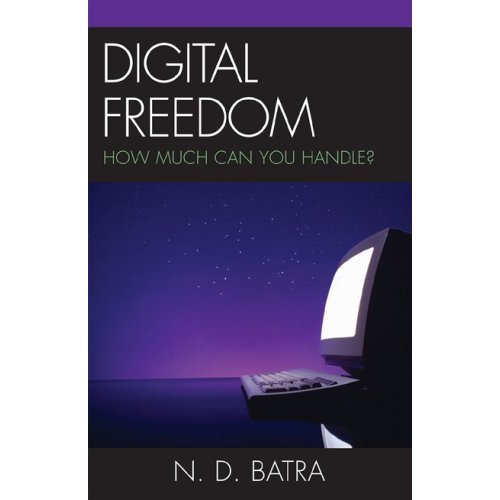
Digital Freedom

~ Lord Boyd Orr ~
Tuesday, May 15, 2007
Saving Pakistan
Heed the voice of Dawn’s Haroon
From The Statesman
ND Batra
Pakistan is undergoing political and cultural turmoil unnoticed by rest of the world, says Hameed Haroon, the publisher of the Dawn group of newspapers, in a piece published in the Wall Street Journal last week. People opposing the high-handedness of President Pervez Musharraf against “infringement of judicial independence” are lawyers, journalists and other “mainstream groups striving to bring Pakistan under the rule of law,” he says.
Since Musharraf removed Chief Justice Iftikhar Chaudhry on March 9 on allegations of misusing authority, there have been countrywide protests. Pakistan’s landscape is much more variegated and complex than the Western media has been portraying: that religious extremists are keeping the country under siege. Haroon says that Musharraf has victimized the Dawn group “precisely for exposing his failure to firm up the country’s security situation. We have reported on the pattern of ad-hoc deal-making between the Pakistan government and pro-Taliban militants along the Pakistan-Afghanistan border, not to mention the government’s continued covert support of Kashmiri militants.”
India should take note. The United States should redirect its resources in Pakistan.
Instead of depending upon the questionable political strength and commitment of Musharraf for war against terrorism, the United States should reach out to a wide variety of constituencies in Pakistan including the media, universities, businesses, non-profit organisations, tribal leaders and intelligence communities.
More than two months ago on a visit to Pakistan, Vice President Dick Cheney chided Musharraf for not doing enough to prevent Al-Qaida and Taliban from rebuilding and strengthening the infrastructure of terrorism in the safety of tribal areas from where they have been operating to carry out terrorist attacks against Afghan and NATO troops. The suicide bomber attack in Afghanistan during Cheney’s visit that killed 23 people provided enough evidence that the Taliban and Al-Qaida have been regaining strength.
Cheney is not known for his diplomatic subtleties but since he is the closest to President George W Bush, the Pakistani ruler should have gotten the message that US aid might be in jeopardy if the Taliban growth was not checked.
Pakistanis have never been enamoured of how Musharraf was forced into an alliance with the United States after the September 11 terrorist attacks. But in order to cooperate with the United States in its struggle against terrorism, Pakistan has turned itself into a country warring against the very elements, Islamic extremism and militancy, that its super intelligence agency, Inter Services Intelligence (ISI), nurtured as tools of foreign policy.
Musharraf has not been able, or may be he is not willing, to make a total break from the forces that have supported him in his hold on power and hence the reluctant approach toward helping the United States. Once again, especially after Musharraf cut the deal last year with tribal leaders virtually relinquishing sovereign authority over the tribal territory, Pakistan has become a safe haven for Al-Qaida and the Taliban.
John D Negroponte, Deputy US Secretary of State, told Congress in February that Al-Qaida was “cultivating stronger operational connections and relationships that radiate outward from their leaders’ secure hide-out in Pakistan to affiliates throughout the Middle East, North Africa and Europe.” Pakistani authorities have not challenged his statement.
In spite of what Dawn’s Haroon says about the administration’s attempt to control the media by withholding government advertisement, the question is whether Musharraf is indeed in full control of the forces operating in his fractured country. If not, what can the United States do about it?
First of all, the United States and NATO forces should not hesitate to cross into the tribal territories in pursuit of the Taliban, since Pakistan has virtually given up control over them. Lieutenant General Douglas Lute, chief operations officer for the American Joint Chiefs of Staff, told the Senate Armed Services Committee last March that “we have all the authorities we need to pursue, either with (artillery) fire or on the ground, across the border.”
The United States should think of establishing direct relations with tribal leaders in order to wean them away from the Taliban and Al-Qaida. The United States must keep pressuring Musharraf to break the nexus between ISI and the Taliban and other sectarian extremist groups. In many ways ISI works much like an independent power center, a state within the state, and it may become necessary for the United States intelligence to establish direct relations with its hierarchy, since nothing happens in Pakistan without its acquiescence.
The United States needs to do much more aggressive public and business diplomacy in Pakistan to reach out to the intelligentsia and middle classes, who have the same global aspirations as other countries with growing economies. The prospects of rapid economic growth and rising prosperity would present Pakistanis with an alternative future, one based on science and technology and globalization.
Last but not least, heed the voice of Dawn’s Haroon. He is saying something that the world has not heard before. He represents a future that might happen: a progressive, liberal, and more or less a secular Pakistan.
Topics
Diplomacy
Friday, May 11, 2007
Remembering Rabindra Nath Tagore
From Rajat Das Gupta
Calcutta (India)
Remembering Rabindra Nath Tagore
A few leaves from the letters/diaries ofRabindra Nath TagoreNobel Laureate 1913
(Second lot forwarded after the first one published on November 1, 2006)
Translator’s forewordLiterature of Tagore along with his songs is a vast ocean with inexhaustible treasures in it where paramount aesthetics, spirituality, philosophical insight, cosmic perception etc. abound. Very reasonably, this should not be a benchmark to assess Tagore’s letters and diaries behind which there was no creative goal neither these were primarily for the public eye. Yet, the Poet’s sparkling wisdom in scores of these letters/diaries is worth sharing by us even to-day when they have hardly lost their relevance.So far, about 4200 of the Poet’s letters both in Bengali and English have been classified, besides the numerous others lying in heaps in Visva Bharati (Tagore’s University at Santiniketan, West Bengal). ‘Shayan’ is a bi-annual magazine running for last 8 years. The January-June ’03 issue is a compilation from Tagore’s letters and diaries. Stress has been given on the letters which voice the question, how should we survive in this genocide afflicted world, which process had a great upheaval in early 20th century and is snowballing alarmingly even to-day. No letter has been produced in full. Only their extracts have been presented which have been found serving the purpose of the book.The editor of the magazine Mr. Pathik Basu has done this hard work with amazing dedication which has made these invaluable documents handy to us. One might opine, these documents, though originally meant for consumption at personal levels, their publication will give opportunity to all and sundry to have a glimpse of the Poet’s brilliant mind, though somewhat less than his creations purely with literary and aesthetic pursuits.It is my pleasure to translate a few selected passages from Mr. Basu’s 343-page book, at his desire, into English, hoping these will reach worldwide across the narrow Bengali circle. Here follow a few samples.
August, 2003 RAJAT DAS GUPTA (rajarch@cal3.vsnl.net.in)
1) The Beauty of Commerce
In the animal world, competence of man does not lie in his physical excesses. Man’s skin is soft, his muscles feeble and the power of his senses too falls short of the animals’. Yet, he has acquired such a strength which is not visible, not occupant of space, not based on a mass of soil, yet it is omnipotent all over the Earth. Man’s strength has dodged the boundary of his physique and has become powerful invisibility. Bible says, he who is modest will conquer the world. This means, strength of modesty is not external, but it is internal, less it hits more victorious it is. It does not fight in a battlefield, but earns its victory by accord with the powers in the world.
The demon of Commerce too must one day be humanistic by restraining its demonic havoc. This Commerce has little brain and no heart, so it is only increasing its burden on earth. It is aiming victory by extending its occupied area with its deadly resolve. But that which will be victorious one day, is humble in size with its simple procedures, that accepts Man’s heart, his aesthetics and religiosity. It is modest and not shamelessly greedy. Its stability is in its inner order, not in its external size, not by depriving others but by its harmony with all. Of all the human razzmatazz this Commerce is the ugliest. It has brought fatigue on Earth by its own weight, deafened it by its noise, blighted the Earth by its garbage, and wounded life by its greed. Coronation of this greed on the world’s throne and endorsing our slavery to this worldwide ugliness, this revolt against all beauty, aesthetics and human heart, is daily lashing the noblest human undoubtedly. This chess game, mad about ‘profit’, with man as its pawn, will continue how long? This game must be aborted – where in greed of ‘profit’ man is losing himself continuously.
[On voyage to Japan, on board Tosamaru- May, 1917]
2) Introversion of Indian religion
Dear Rani,
Our ship will go round two isles, so two days’ journey will elongate to three. Here Viswakarma’s (god of Engineering) holed bags have let out soil to scatter over the sea to form many an isle. Those are under Dutch command. The isle where our ship is anchored now, is known as Biliton. Population is sparse. There are tin quarries manned by their managers and labourers. It is a wonder how they are milking the entire earth. Once upon a time these people sailed off in swarms into the unknown seas. They had went round the earth to be familiar with it, to measure it. That history of familiarization is long and hazardous. I ponder, when they had first lowered their sail here at these coasts, far away from their homes, how full were those days of apprehension and expectation as well. The greenery, animals, humans here were all strange to them. But to-day, everything is known and vanquished!
They have defeated us, why, I ponder. The main reason is, we are static they are dynamic. So they could go round easily and that is why they have known and their appetite for knowledge has been further whetted.. That appetite is feeble among us because of our stagnation. Even our knowledge about our neighbors is vague neither we have urge to know them better. Because, our home encloses us too much. Those, whose vigour for knowledge is low, so is that for their survival. With the same vitality that enabled them to earn all rights over Java, is the dedication of their archeologists to explore this island. Yet, like this island, its archeology too was totally alien to them. We are indifferent about knowledge of our neighborhood while their urge to know the distant is limitless. Not only by muscle, but by vitality of their quest they are conquering the ins and outs of this world. But, we are domestic intimately. This means, we are mere components of our family, trapped in a thousand bondages. Our responsibility for a livelihood is entangled with that for the rituals, the redundant load of which has almost crippled our genuine duties. From caste related obligations up to the funeral rites, all the duties have burdened us throughout our mortal and post-mortem phases, have made our movement impossible and is only siphoning out our vitality. The offspring of such homes are bound to be lashed by others, which we are feeling inwardly.
…..But, if it is easy to demolish age-old orders, how long it will take to build the foundation for the new ones? About duty and non-duty, each society has habituated itself to certain principles, based on which the populace keeps going. By argument and logic only few can keep righteous. But it is not easy to replace one habituation by another. All our habituations are for cohesion of the myriad inane in our family life. It is easy to learn from Europeans their science, but not their social habituations.
[Letter to Rani Mahalnobis while on the way to Java – Sept 1927]
3. Islam and Mahabharata
Dear Amiya,
My visits here are nearly over. It was my wonder to observe their people’s theatre, clumsily integrating Indian fragments. I had written you before how Ramayana and Mahabharata are animated in their life. Because it is living, it is not a prototype of any documented literature. It had drastic metamorphosis through thoughts and imaginations of the people here. They did not get in store in any scriptural sermon all the principles of life, but had those embodied in the characters of these two epics. The yardsticks to judge good and bad in the humans are these characters. So, with dynamics of life its prerequisites have changed variously. It is like oral transformation of Vidyapati and Chandidas’ (poets of mediaeval Bengal) compositions relayed down by the Bengali musicians from age to age. Yesterday we went for a shadow show. Its typed story was given to us. I’m sending it for your eye. Translate it into Bengali and judge it vis-à-vis the original Mahabharata. The distinction of the story is, there is no Draupadi (the central polyandrous female character of this epic having all the five Pandava brothers as her husbands) in the story. The neuter Brihannala of Mahabharata has been named ‘Kenobordi’ as a female. Kitchaka was beguiled by her beauty and fell victim to Bhim (the 2nd Pandava). This Kitchaka is enemy of the fish-king in Javani Mahabharata. Pandavas, by exterminating him, earned the gratitude of the King Birat.
The balcony of the palace of the king titled as ‘Monkunagro’, where I am sitting now to write this letter, abounds with Ramayana stories beautifully drawn on silk to be seen all around on the foundation pillars. But, they are Muslims by religion. Yet, they know ins and outs of the Hindu deities. They have taken as their own all the ancient streams of the India narratives.. In fact, there is nothing wrong in it, as the characters of Ramayana and Mahabharata in abstraction are roaming around in their land. Rather, they do not have such all pervasive camaraderie in our country., where they do not figure in all their festivals as at every home here.
[Written to Amiya Chakraborty while on Java trip: 17 Sept. 1927]
4. About songs
For sometime, the debate on relative positions of ‘word’ and ‘music’ in a song is going on. I am not a maestro, but my common sense says this subject is not exclusively for a debate, but is very much inherent in Creation with its frolic. The high hand runs its steam roller on a fixed track to protect our rules and destinations. But, in the meantime, the Creator showers His creations in a myriad branches- where ‘words’ go alone and so does ‘music’ and, again, they go entangled too. In both this ‘isolation’ and ‘entanglement’ flowers joy. Those who advocate a ‘communal’ divide between the two, my appeal goes to them, to stop from hoisting these ‘class banners’ thus standing on the way of the creative streams only as a nuisance at the cost of peace. (Written to Dhurjoti Prasad Mukhopaddhay on 8 Oct. 1937).
I am inclined to equate the daytime with the Western music, a big medley of harmonized music and mal-music clubbed up in bits and pieces, and the night with our Indian music, an immaculate solemnity of unpolluted pathos. Both move us, though paradoxically. But what to do? There is an inherent contradiction in Nature, with splits between the King and Queen, day and night, varied and homogenous, spatial and infinite. We Indians live in Night’s domain. We are obsessed by the indivisible and eternal. Ours is a solo in solitude. Europe’s is the song for the public place. Our song transcends the listeners beyond the boundary of their daily weal and woe to transport them to a solitary land of recluse, whereas European music dances one variously through the endless ups and downs of life.
[Selaidah (now in Bangladesh). Chhinapatra (=stray letters) 10 Aug. 1894]
You were talking about senility of Hindustani music. What happened is, it has turned classic, which means an immaculate perfection, steadfast in format. Such fulfillment is suicidal. Fulfillment, along with accomplishment brings stagnation. But this is a stumbling block which can never crave liberation of art. So, you’ll find in history that catastrophe occurs when our fastidiousness beguiles us to this classicist archaism.
[To Dilip Kumar Roy, Baranagar (Calcutta), 26 Mar. 1938]
5. Form and value of literature
Values are of three types. One is for marketplace, the second for religion and the third for aesthetics, being purely personal. From the last intellect is not banished, but it is secondary. Here the main architect is the person building the image, who can observe form and shape it.. Form does not merely mean that which has area, weight and outline. Here, form attaches some aesthetics which provokes unnecessary interest. Unnecessary because, this interest is the ultimate goal without any more ‘why’ and ‘what’. In this world a ‘person’ is that type, his/her reality is my very own and no other verbiage is above it. My curiosity about a ‘person’ is entirely naïve – beyond question and last answer to all questions.
So I say, creation of form is art- through which with inane inquest I perceive the form of a good song, in rotation of music and rhyme it casts such a spell which from my heart I feel as truth; but don’t feel this ‘wall’ as such. What provokes this perception of truth is that form which has various components, the main being ‘emotion’. Because, through ‘emotion’ our consciousness knows ‘self’ deeply. Even ‘immaculate perception’ as propounded by the yogis is one of Anandam (divine joy), or an emotion to say. ‘Thoughts’ also may be component for creation for art, but not to transcend one to truth. But, the thoughts may be so arranged that will generate a nuance beyond ‘arguments’ into an aesthetic, to give us Anandam without reason, else those would be rabid elephants in a lotus garden.
Words and sentences convey literature. In words there is sound and meaning, both needed in literature, but not for the sole purpose of ‘information’. ‘Information’ will of course be there, but as a subordinate. If it gives a picture and aesthetics, then only it helps create an art. The word ‘empathy’ does not offer any music, picture or aesthetic. But somehow the word ‘compassion’ is accepted. Yet, on intellectual judgment ‘empathy’ is appropriate, accurate and explicit i.e. to be one with others to feel alike with them, which definition goes with the word. Yet, it did not work, as it has explanation but no form. Form embraces a ‘totality’ beyond analysis and does not lob in your mind in isolation.
If you want to build literature placing the intellectual bricks one upon another, each brick cannot contribute there more than its own quantity. But in a tree with life, each segment is superseding itself, possessing a charm which at once manifests the totality. In a literary work, if every word possesses such ‘form’, then the totality is available in each segments. This is called creation.
[To Sudhindranath Dutta, from Santiniketan]
Topics
Culture: Tagore
Tuesday, May 08, 2007
Cut and run from Iraq? No way
No way the US can abandon Iraq
From The Statesman
George Tenet, the former CIA director, who was awarded the presidential medal of freedom (for providing intelligence about Afghanistan and Iraq) has come out with a book in which he states that the Bush gang, Vice-President Dick Cheney and former secretary of defence Donald Rumsfeld, turned the intelligence agency into nothing but a propaganda machine for educating the US Congress into supporting the war against Iraq and bamboozling the international community into believing that Saddam Hussein had weapons of mass destruction and in fact he was the enemy of mankind (read the United States.)
Since his retirement from the cloak and dagger agency, Tenet has been a sort of an academic at Georgetown University; and now with a $4 million book advance, the former spymaster has been going from talk-show to talk-show peddling his own version of truth and washing his hands of all that had been said and done in his name. But every time he opens his mouth, the talk show host shows the picture of the former secretary of state Colin Powell showing fake satellite images of Saddam’s preparations for weapons of mass destruction. Behind Powell is seen Tenet with a “Slam Dunk” confident face.
Tenet’s book cannot undo the television images of his complicity in the war that has turned Iraq into a hellhole. Based on faulty intelligence about weapons of mass destruction, in 2002 the US Congress authorised President George W Bush to go to war in Iraq. Mission accomplished, said Bush four years ago on the deck of the aircraft carrier USS Abraham Lincoln off the coast of California; but instead of drums of freedom Iraq ironically exploded with ancient Shia-Sunni hatred. The United States has been trying to stamp out sectarian civil war with the help of an impotent government, albeit democratically elected.
There seems to be no way out. Americans did not expect a future of this kind, a bloody mess that has killed hundreds of thousands of the Iraqis and driven millions out of the country. Seeing the ceaseless daily carnage of civilians being blown off in streets and the marketplace we have become numbed. Why no one ever in the US Congress imagined the probability of this kind of scenario of hell? Having been complicit in the war, along with the US news media, Congress has no means of ending the raging sectarian violence, insurgency or civil war, by whatever name you call it, and bring peace to the region. With its funding power
Congress tried to force the president to bring troops back home but Bush vetoed the spending bill. Bush does not want to abandon Iraq. That will be an act of cowardliness and national humiliation. Supporting the US combat forces in Iraq while opposing the additional deployment represents the raging but impotent rhetoric in the country. Like most of the American people Congress wants troops back home but does not want to leave the Iraqi people to chaos; or at the mercy of their neighbor Iran or other surrounding Sunni Arab countries. Hence the political schizophrenia and confusion worse confounding at the Capitol Hill.
Iraq is splintered on ethnic lines among Kurds, Shias and Sunnis, and unfortunately there is no well-organized force strong enough to transcend sectarianism and impose order on the country and put it together again. The American people, though overwhelmingly opposed to the President’s Iraq policy, do not want troops to be denied of necessary funds. And probably there in lies the source of Bush’s persistence in pursuing his policy of troop surge in spite of the fact that repeated polls have been pushing him down the popularity ladder. He refuses to be a lame duck. He is still a man with a mission though you see the agony of failure on his face.
Increasing confrontation with Democratic controlled Congress is nonetheless compelling Bush to explore some other ways of mitigating the situation; for example, reluctantly recognising Iran and Syria as parties to the conflict and bringing them to the negotiating table as it was tried in the last week’s Middle East conference held in Egypt. A diplomatic breakthrough the kind recently achieved with North Korea, based on negotiations with regional powers, is a way out. But the search for diplomatic solution requires that the Bush administration must think about new strategies in dealing with Iran.
Congress can be very effective in using its power of the purse by stressing the importance diplomatic means of negotiating peace in Iraq. It must urge the Bush administration to shed its inhibition in talking with Iranian authorities and develop common grounds with Iran in ending ethnic conflict in Iraq, as Secretary of State Condoleezza Rice has been trying to do with Syria. In the meantime watch people like George Tenet getting out of the White House and run after mega-million book deals.
There is nothing more spectacular and pathetic than a former loyalist develop sudden pangs of conscience and begin telling kitchen and bedroom tales for a handful of silver.
Topics
Diplomacy
Wednesday, May 02, 2007
March of wirelessly mobile masses
Challenge of wirelessly mobile masses
From The Statesman
India’s phenomenal growth in cell phone users, now totaling to 166 million, will have tremendous political and cultural repercussions. Last year 67 million new users were added and by the year 2010, at this rate of growth, India will have more than 400 million cell phone users. Cell phones are not just for calling.
While we become used to picture taking, web surfing and photo and music sharing on cell phones, we should look forward to newer uses of the tiny handheld: live television broadcast, credit card purchases for airline tickets, and ID for security checks and data access. With the spread of WiFi hotspots and ability to roam wirelessly, cell phones will become, for some of us, better than (hmm!) our better-halves. Most of all cell phones will be used as a tool for mass political actions.
On 20 January, 2001, President Joseph Estrada of the Philippines became the first head of a state that lost power to a digitally smart mob in Manila, a million of them who used cell phones to exchange text messages and swarmed like bees for a peaceful demonstration at Epifanio de Santas Avenue (EDSA). The message was: GO 2EDSA, Wear black. It was impossible for Estrada to hold on to power in the face of the people’s mobile power. Whether that would happen in China or not is a matter of speculation. But the 2008 Summer Olympics is upon us and anything could happen.
Different cultures use the same technology differently. Koreans and Japanese use their cells for text messaging. Americans love to talk and listen to music. Music mobility is big in the United States and before long cell phones and mobile music devices would converge. Let’s see how Indian culture assimilates cell phones now that the technology is penetrating even rural areas. Millions of Indians cell users cannot chat idly all the time.
They will make money, they will change minds, and they will change the government. I wonder whether we would become more responsive to the human condition if we are able to surf the Web through wearable computers, eyeglasses or do instant messaging through picture cell phones. But there is no denying the fact that as wireless computer chips get embedded into various devices, communication ecology would change, so would society.
Wireless networks are collapsing space and time, turning Indian geographic space into cyberspace, and are bringing people together through digital presence for collaboration in the workplace and cultural space. The experience of the presence of others in a virtual environment created by networked communication is a new social experience for many. Virtual presence could become active political presence, as it might happen during the Beijing Summer Olympics. Terrorist networks too could organize virtually to strike anywhere. Every human activity from a child’s laughter to the most complex mathematical hypothesis is nothing but information in the binary format. Every human activity that takes place in an analogue world can be turned into digital data, and can instantly be distributed globally through computer networks, thus extending the reach of human communication.
Digital data can not only be stored and retrieved instantly anywhere but they can also be transformed into predictive intelligence about human behaviour regarding commerce, national security or any other social or political activity. Books, music files, love bugs or terrorist messages, for example, become indistinguishable as they converge in a digital stream and surge through cyberspace.
Convergence, instantaneity and feedback interactivity make the Internet the most powerful medium of communication ever developed. Since the traditional media including books, television, newspapers, magazines, radio, music and interpersonal communication are converging on the Internet as a multimedia stream into which anyone can plug in, their power increases manifold and in ways whose implications we still don’t understand. Outsourcing, for example, has given India a constant state of virtual presence in the American corporate discourse (Read the latest Wall Street Journal report, “Getting China and India Right”).
Unlike the offshoring of manufacturing, outsourcing of research and development and other forms of intellectual and professional work is bringing India, the European Union and the United states into a virtual world where brain power and creativity are shared and enhanced. The Internet thus is revolutionary in the sense that it is lowering barriers for cooperative co-existence of cultures.
Cultures prosper when they share boundaries, interpenetrate and cooperate with each other. Computer networks and the Internet have altered our view of space and time.
A networked organisation or an individual with instant messaging and e-mail has different feel of space and time than the people of the pre-digital era.
Cell phone is the new door to cyberspace; and once you are there, you are simultaneously in a synchronous and asynchronous world, a world that gives a greater illusion of freedom and control than the real world.
Today cyberspace has become a multi-dimensional virtual universe in which activities are as real as they are in physical space. With the rise of mobile digital power in India we will see the emergence of collective brainpower to solve complex problems. As more and more people experience activities in cyberspace through wireless presence, they will see that what is local is becoming global.
(ND Batra is the author of Digital Freedom: How Much Can You Handle? forthcoming from Rowman and Littlefield. He is working on a new book: This is the American Way)
Topics
Technology