Showing posts with label Globalization. Show all posts

Tuesday, January 24, 2012

Telepresence

“The 'Arab Spring' had its technological genesis in Silicon Valley-generated social networks such as Twitter and Facebook. But the same networking technology enables American jobs to be done by anybody anywhere. And so Arab authoritarian regimes see their bloody streets as nothing but an American conspiracy while many American politicians blame the continuous loss of American jobs on the rising tide of digital civilization…”

Read more …

Disconcerting Telepresence

Times of India

25 January 2012

http://timesofindia.indiatimes.com/home/opinion/edit-page/Disconcerting-telepresence/articleshow/11619069.cms

Wednesday, June 01, 2011

Offensive-Defensive National Security

COMMENT
The Devil Is In The Detail
May 28, 2011

TOI Crest Edition

Narain D Batra

America keeps a constant hawk-eye on potential terrorists. Less than two weeks after the Abbottabad commando operation, six people, including two imams of Florida mosques, were arrested for providing material and financial support to the Pakistani Taliban. For about two years, 2008 through 2010, according to the indictment, the accused provided money, financial services, and other kinds of support to the Tehrik-e Taliban of Pakistan.

It is the daily nitty-gritty intelligence work that has been keeping the United States safe since 9/11 rather than the shock-and-awe SEALs operation that killed and clawed Osama bin Laden out of his Abbottabad lair and sent him to his watery grave. This is not to diminish President Barack Obama's courageous decision;nor is it to take away from the valour of the Navy SEAL commandos trained for do-or-die missions and the hitherto unknown radarevading stealth helicopters that sneaked past Pakistani vigilance. But these are not foolproof measures.

Such daring missions do go bust. With one helicopter down, the Abbottabad mission got lucky. A similar audacious mission on April 24, 1980, authorised by President Jimmy Carter to rescue 52 American hostages held at the American Embassy in Tehran, ended in humiliating debacle. There have been other disasters too, for example, in Mogadishu, Somalia, in 1993, where the Navy SEALs' two Black Hawks were shot down, requiring a rescue operation.

Just as we admire the US Navy SEAL operators, it will be a mistake to underestimate the Pakistanis;they have created the indestructible Taliban, the progeny of a most ruthless secret service, the ISI, which through selfmultiplying lethal cells and self-sustaining charities dominates Pakistan and casts its deadly shadow beyond its borders. The former British prime minister, Gordon Brown, on a visit to Pakistan, called it "the chain of terror that links the mountains of Afghanistan and Pakistan to the streets of the UK and other countries around the world."

Ponder over the well-organised Pakistani sea-borne commando attacks in Mumbai in 2008. Not only did the Pakistanis do a tremendous job of training do-and-die commando-style terrorists but they also used some of the most modern means of communication including GPS, Google Earth, satellite cell phones, Skype, and Vonage. Somewhere in Pakistan, every movement of the terrorists must have been monitored in real time. President Obama and his team were doing the same in the White House situation room when the commando operation was in progress.

India should not think of fighting terrorism with USstyle commando attacks into Pakistan territory even if it is capable of doing so. And it should ask its military commanders to keep their cool and remain taciturn when provoked by the news media. Terrorism has to be fought with anticipation, intelligence, and persistence.

Every so often, the US Homeland Security authorities revisit and update their plans to meet new contingencies. In 2006, for example, authorities discovered a plot to blast and cripple the underground tunnel system that connects New Jersey with New York City. The discovery was not serendipitous. The security forces were on the lookout for terrorists in order to pre-empt any attack. Besides the Homeland Security, every state has contingency plans. Federal and state governments work meticulously, and closely, to fight terrorism.

In the United States as well as in Europe, there has been a paradigm shift in thinking about terrorism. The strategy is to eliminate terrorism at the neonatal stage by establishing an early awareness system, which is different from an early warning system. The guiding principle is: what can be anticipated can also be prevented. Preventing terrorism at the inspirational and "aspirational" stages is the goal. For example, the plot to bomb Sears Tower in Chicago was at a stage "more aspirational than operational, " according to the FBI, when the terrorists were nailed down in June 2007.

Following the preemptive policy of dealing with terrorists, former US Attorney (for the Northern District of Georgia) David E Nahmias said, "We no longer wait until a bomb is built and ready to explode. " That's what India should do.

Europeans have been following similar antiterrorism strategies. In December 2008, for example, the Belgian police arrested 14 people on mere suspicion of suspected terrorist links. Six of them were charged with being members of a Belgian branch of al-Qaida. What prompted the pre-emptive measure was a concern to secure the European Union leaders' two-day summit meeting, which might have become the terrorists' target. The federal prosecutor in Brussels, Johan Delmulle, was quoted as saying, "We don't know where the suicide attack was to take place. It could have been an operation in Pakistan or Afghanistan, but it can't be ruled out that Belgium or Europe could have been the target. " Instead of sending commandos into Afghanistan or Pakistan, they combed their own backyards and got them.

US security laws allow intelligence and law enforcement authorities to trawl through places of worship, activities of charities, communications of suspected militants, and even their shopping patterns. The strategy "provides a common framework" through which not only the federal, state and local governments work but also "the private and non-profit sectors, communities, and individual citizens" are actively included in Homeland Security's efforts.

Outstanding intelligence gathering, pre-emptive and preventive measures, and anticipatory disaster plans will go a long way in eliminating the scourge of terrorism in India. India needs to create a culture of preparedness and alacrity that pervades all levels of society instead of planning commando attacks against a country with which, in the long run, we have to develop working relations.

The writer is a professor of communications and diplomacy at Norwich University

Tuesday, February 22, 2011

Corruption in India

COMMENT

It's a matter of trust

Narain D Batra | January 8, 2011

Times of India The Crest edition

The challenge for India, a growing economy, a rising nation that wants to play a global role, is how to go beyond the trust based on family ties, old boys' networks, caste and religion - especially in a diversified and multicultural world - so that investors can repose their faith in the system.

The system must be so open and transparent that it creates verifiable trust and trustworthiness. There lies the future of India. 

Erosion of trust is a global phenomenon.

President Barack Obama sees the rebuilding of public trust as one of his major challenges and, therefore, the subject of transparency reverberates in his public communication. What is good for the government is equally good for corporate governance. 

Doing business is essentially building social trust, which is imperative for foreign direct investment (FDI), especially if a company is dependent upon global customers as many Indian companies are increasingly becoming. When enterprising families join hands with government, business growth can be rapid in the initial stages, because regulatory constraints and market accountability can be waived to access credit and investment.

The rapid growths of companies like Satyam, for example, was not due to the miracle of unique Indian entrepreneurial spirit but because of the government-family nexus of economic interests, contemptuously though rightfully called crony capitalism. 

Although crony capitalism is present in every society, it flourishes best where the flow of information, both economic and political, is limited.

This has been the pattern in most Asian countries and India fits into this pattern. India is a double-book nation and those in the accountingauditing profession do understand how big India's shadow economy is. The protected family-based business system reaches its limits of growth when it needs infusion of technology and capital for expansion, which can come from sources outside the family. Investors, especially now when they have many competitive opportunities available all over the world and can electronically transfer their investments instantly, demand sunshine, transparency, openness and accountability. You cannot separate business from politics, global corporate from global politics. 


It is possible to create trust beyond the family-based business system but it can be done only under the supervision of an independent watchdog authority that creates a level-playing field for all. In the United States, the Security and Exchange Commission (SEC) monitors business corporations and stock markets. Markets are complex but fragile systems, which do not thrive on family ties but on honest and open communication with investors. But even the best system is open to abuse, as we have been painfully observing what has been happening to some legendary banks and financial institutions. Trust is in deficit now. Rebuilding global trust is the biggest challenge for corporate and political leaderships in the age of uncertainty. And India is no exception. 


Economic growth of more than 8 per cent during the last several years had made us temporarily forget about corruption until the slew of scams that were outed last year. Ordinary Indians pay a bribe of about $5 billion (Rs 21, 068 crores) a year for "availing one or more of the eleven public services in a year" according to a 2005 Centre for Media Studies/Transparency India Report. Can you imagine how much people of the super class - those who breakfast in New York, lunch in London and have dinner in Mumbai - must be paying to speed up their business deals? 

Initially, as the legend goes, the foreign exchange crisis of the early 1990s forced India to open up its doors to market economy. But India was pushed into globalisation by the information revolution.

The other India, its diaspora, especially in the IT field, began to show ingenuity for developing new products and services as well as for solving complicated problems, including the killing of the millennium bug. Bangalore was able to liftoff in spite of its poor infrastructure and in the process transformed itself into a cyberspace module that expertly docked with the emerging digital universe, partly thanks to Indian satellite technology, which was paradoxically seeded during the era of self-reliance. 

While the spectacular success of Bangalore and India's IT industry showed how much the Indian entrepreneur could do for the world, it also exposed India's vulnerabilities, its sluggish rural economy, massive shortfalls in investment for infrastructure development, high illiteracy levels, and a high rate of underemployed and unemployed people. The world began to look at India's underside. Indian policymakers and intellectuals began to grapple with the problem of economic growth, but they did not pay attention to the culture of corruption, a yoke on the poor. 

Sadly, the news media in India has not been playing its watchdog role robustly enough. Public accountability through news media exposês and relentless investigative reporting, especially through internet blogging and television shows, as the American experience shows, is a strong antidote to corruption.


What would make politicians and bureaucrats more accountable and responsive to public needs? Individuals who exercise political power should be made answerable for not only how they use the power vested in them but also whether they achieve goals with clean hands. Some problems facing India are systemic and call for structural changes. The system as a whole has to be geared up for growth, which means the development of a Grand National Strategy that covers every region.

Booming Gujarat and a depressed North-East cannot be part of the same country. 

If India were to build global trust and take its rightful place in the world order, it must fight corruption as seriously as it is fighting terrorism and insurgency. 


The writer is professor of communication and diplomacy at Norwich University

Saturday, December 18, 2010

The surveillance society

Printed from The Times of India
TOP ARTICLE
The surveillance society
N D Batra, Dec 13, 2010, 12.00am IST

Air travellers in the US have been protesting about the humiliating choices they have to make: full body electronic strip searches that leave nothing to imagination, or bodily pat-downs by security agents that some feel amount to sexual assaults.
Even people with orthopaedic shoes, appliances or medical devices - insulin pump, feeding tube, ostomy or urine bag, or exterior component of cochlear implant - have not been spared the screening or pat-downs.
Secretary of state Hillary Clinton has said that she would avoid it, if she could. But topmost US public officials are not subject to such enhanced screening procedures. The experience of Indian ambassador to the US Meera Shankar has been different: she faced a pat-down at an airport in Mississippi. Whether you live in New York, Amsterdam or Mumbai, the fear contagion is everywhere. Fear has become a constant travel companion, thanks to newer and more ingenious methods terrorists have been using lately.
Experts say that eventually we will become used to newer physical intrusions into our privacy as it has happened in other aspects of our lives. In fact, we have been slipping into a low-intensity surveillance society since the 9/11 terrorist attacks. Our sense of insecurity, both physical and economic, has increased manifold and we have been quietly submitting to whatever brings us a feeling of certainty.
Protests against intrusiveness by employers and businesses into our personal lives have, in fact, become muted. Employers watch us all the time. Since most office workers use the internet and communicate via email, companies watch closely how their employees use office electronic resources, including whatever they save on their laptops, iPads or access through their smart phones. Several court decisions regarding workplace privacy confirm that, in the US, employees have very few privacy rights if information is stored in the company's system.
Employers do have legitimate concerns especially regarding the confidentiality of trade secrets; ongoing contractual negotiations; sexual harassment messages exchanged among employees that might lead to legal liabilities for the company; and whistleblowing activities that may affect the reputation of the company. These concerns are not new but the speed with which transactions are done on the internet has created a state of constant mistrust. There has always been some multitasking in the workplace.
But mobile web has created new avenues for multitasking, which is now becoming a common occurrence. With continuous restructuring and layoffs, many working people keep networking and looking for new opportunities. Companies, especially in the field of information and communications technology, fear brain drain and are watching who is applying for jobs. If anyone is trying to cross over to a competitor, he should not expect the boss to be sympathetic. Some contend that subjecting employees to digital surveillance generates a coercive environment and might eventually affect productivity negatively.
If monitoring is being done for preventing fraud, protecting intellectual property and trade secrets, or maintaining a harmonious workplace environment, the rational must be explained to employees and the policy clearly stated. Web bugs and other online surveillance devices are being increasingly used by businesses to track users when they surf their websites.
Advertisers surreptitiously place small software programmes called cookies on our hard drives to track where we surf so that they can customise the most appropriate advertising message for us. It's called target marketing, reaching the right person with the right message.
But web bugs are different. They can be programmed to collect data without the knowledge of the user. For example, a web bug can be programmed to look at a data file on a networked desktop without leaving a trace that the data has been touched at all. When you look at your bank balance online, the web bug too could be monitoring it. Some companies use web beacon, a single-pixel picture, to identify users.
A beacon can track whether a particular message, including junk mail, has been opened, acted upon or not. Any electronic image that is part of a webpage, including an ad, can be programmed to act as a beacon and spy on the user. Companies claim that the information enables them to personalise the surfing experience when a frequent user visits their portal, but they assure us that no personally identifiable information gathered from the beacon research is shared with the clients. Unfortunately, that is not always true.
Some companies use biometrics, face recognition, radio frequency identification (RFID) and global positioning system (GPS) technologies to keep a watch on their properties and track clients. Car rental companies in the US use GPS to keep track of their rental cars. If a car is stolen or is involved in an accident, the company would know the exact location of the car.
Do you see the future? Along with our luggage, we too might have to wear RFID tags so that we can be monitored via GPS as we move from one airport to another, from country to country. Perhaps it would enhance security but surely it is going to be a multibillion-dollar business. Homeland security and corporate global will determine how much privacy we will have whether at the airport or office, in mobile devices or our homes.

The writer teaches communication and diplomacy at Norwich University.

Read more: The surveillance society - The Times of India http://timesofindia.indiatimes.com/home/opinion/edit-page/The-surveillance-society/articleshow/7088007.cms#ixzz18VAT6x8I

Saturday, December 11, 2010

The age of naked transparency

The age of naked transparency

From The Statesman
Narain D. Batra
11 December 2010

A few weeks ago, secretary of state Hillary Clinton, when asked about the physical pat-down at the airport for security check, told CBS News’ Bob Schieffer in “Face the Nation” that, if she could, she would avoid it. But the sari-clad Indian Ambassador to the United States, Meera Shankar, could not escape the degrading body search at Jackson-Ever International Airport when she was returning to Washington DC after a guest visit at the Mississippi State University on 4 December. Ambassador Shankar was cherry-picked from a group of 30 passengers for the “special treatment” even when the electronic screening set off no alarms and despite asserting her diplomatic status and request for a private check.
This might happen to foreign secretary Nirupama Rao when she visits the United States next time unless external affairs minister SM Krishna means what he said: “Let me be frank, this is unacceptable to India. We are going to take it up with the government of US that such unpleasant incidents do not recur." Ah! But this has happened a second time in three months. Indians protest too much and do nothing. I wonder how China would have reacted to this kind of humiliation. Perhaps that is the difference between a rising power and a country that is dreaming of becoming a global power.
Not that “Mississippi is burning” with racism. After all, neighbouring Louisiana has an Indian American Governor Bobby Jindal and South Carolina has elected another Indian Nikki Haley (Namrata “Nikki” Randhawa Haley) as its next governor. But saris, hijabs and unusual appearances (Did I say un-American?) do raise suspicion, though David Headley who has pleaded guilty for aiding the 26/11 Mumbai terrorists attacks, would have easily passed muster as a gentleman traveller.
Since before the Thanksgiving vacations, air travellers in the US have been protesting against the humiliating choices they have to make: full body electronic strip searches that leave nothing to imagination; or bodily pat-downs by security agents that some feel amount to sexual assaults. Even people with orthopedic shoes, appliances or medical device such as insulin pump, feeding tube, ostomy or urine bag, or exterior component of cochlear implant have not been spared from the screening or pat-downs.
Whether you live in New York, Amsterdam or Kolkata, the fear contagion is everywhere. Fear has become a constant travel companion, thanks to newer and more ingenious methods terrorists have been using lately. Experts say that eventually we will become used to newer physical intrusions into our privacy as it has happened in other aspects of our lives. In fact, we have been slipping into a variable low-high intensity surveillance society since the 9/11 terrorists attacks. Our sense of insecurity, both physical and economic, has increased manifold and we have been quietly submitting to whatever brings us a feeling of certainty, though we keep protesting. It is not only the government that has become too nosey; the businesses are also culpable. They want to know everything about us albeit for different reasons.
It is fair to say that protests against intrusiveness by employers and businesses into our personal lives have in fact become muted, perhaps because we have no choice. So our employers keep watching us all the time, clandestinely of course. Since most office workers use the Internet and communicate via e-mail, companies watch closely how their employees use office electronic resources, including whatever they save on their laptops, iPads or access through their smart phones. Several court decisions regarding workplace privacy confirm that in the United States employees have very few privacy rights if information is stored in the company’s system.
Employers do have legitimate concerns especially regarding the confidentiality of trade secrets; on-going contractual negotiations; sexual harassment messages exchanged among employees that might lead to legal liabilities for the company; and whistle blowing activities that may affect the reputation of the company or expose their wrong doings. These concerns are not new but the speed with which transactions are done on the Internet has created a state of constant mistrust, paranoia, especially in the age of multitasking.
There has always been some multi-tasking in the workplace but mobile web has created new avenues for multi-tasking, which is now becoming a common occurrence. With continuous restructuring and layoffs, many working people keep networking and looking for new opportunities. Companies, especially in the field of information and communications technology, fear brain-drain and are watching who is applying for jobs; and if anyone is trying to cross over to a competitor, he should not expect the boss to be sympathetic. Some contend that subjecting employees to digital surveillance generates coercive environment and might eventually affect productivity negatively. If monitoring is being done for preventing frauds, protecting intellectual property and trade secrets, or maintaining harmonious workplace environment, the rational must be explained to employees and the policy clearly stated. But who cares? Bugs are everywhere.
Web bugs and other online surveillance devices are being increasingly used by businesses to track users when they surf their websites. Advertisers surreptitiously place small software programmes called cookies on our hard drives to track where we surf so that they can customize the most appropriate advertising message for us. It’s called target marketing, reaching the right person with the right message. But web bugs are different, more sinister. They can be programmed to collect data without the knowledge of the user. For example, a web bug can be programmed to look at a data file on a networked desktop without leaving a trace that the data has been touched at all. When you look at your bank balance online, the web bug too could be monitoring it.
Some companies use web beacon, a single-pixel picture, to identify users. A beacon can track whether a particular message, including junk mail, has been opened, acted upon or not. Any electronic image that is part of a webpage, including an ad, can be programmed to act as a beacon and spy on the user. Companies claim that the information enables them to personalize the surfing experience when a frequent user visits their portal, but they assure us that no personally identifiable information gathered from the beacon research is shared with the clients. Unfortunately, that is not always true. It’s a liar’s poker.
Technology keeps growing and our privacy keeps shrinking. Consider this: Some companies are using biometrics, face recognition, radio frequency identification (RFID) and global positioning system (GPS) technologies to keep a watch on their properties and track clients. Car rental companies in the United States use GPS to keep track of their rental cars. If a car is stolen or is involved in an accident, the company would know the exact location of the car. On the other hand, a speedy reckless driver may be denied a rental next time.
Do you see the future? We are under a candid camera forever. Along with our luggage, we too might have to wear RFID tags so that we can be monitored via GPS as we move from one airport to another, from country to country. Perhaps it would enhance security but surely it is going to be a multi-billion dollar business for some. Homeland security and global corporations are determining how much privacy we are going to have whether at airports, offices, parks and public rest areas, mobile devices or our own homes. Should we blame Al Qaeda for everything?

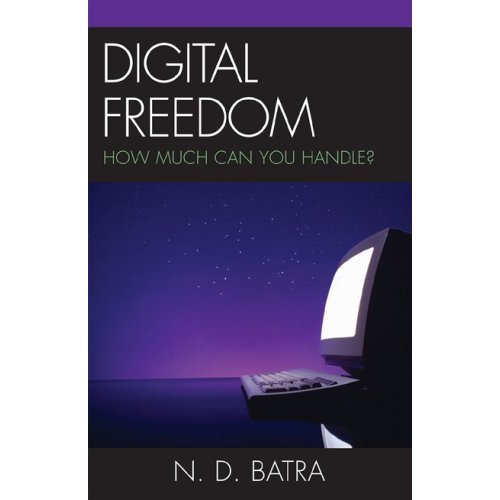
The writer, the author of Digital Freedom, is professor of
communication and diplomacy
at Norwich University
Monday, August 09, 2010

Open up India

Printed from
TOP ARTICLE
Open Markets, Open Minds

N D Batra
Aug 10, 2010, 12.00am IST
Times of India

Every year, India waits for a bountiful monsoon not only to cool people from the sweltering heat but, more importantly, to chill food prices so that the common man can feed his children healthy meals. A good monsoon can make a difference of 7 to 10 per cent in food prices and that means a lot to a middle-class Indian family with school-going children or a day labourer working on a construction site. Last year's bad monsoon spiked food inflation by double digits this year.

But since India cannot always depend upon the generosity of the rain gods, it can certainly use the efficiencies of organised retailers like Carrefour, Tesco, Walmart and others to bring down the prices of daily essentials including groceries. A few years ago, West Bengal chief minister Buddhadeb Bhattacharjee asked at a meeting of business leaders in Kolkata, "Why do we need Walmart to come?" The answer is simple: bringing down prices of daily essentials is good for every politician, regardless of ideology.

Food subsidies through rationing create a feeling of dependence and hurt the poor's self-respect. Moreover, as a recent discussion paper by the ministry of commerce and industry emphasised, "The bill on food subsidies is rising. In spite of such heavy subsidies, overall food-based inflation has been a matter of great concern. The absence of a 'farm-to-fork' retail supply system has led to the ultimate customers paying a premium for shortages and a charge for wastages."

Eliminating wastage through a modern cold storage and supply chain system that an organised retailer like Walmart can provide will bring down prices by 5 to 7 per cent. But the question is: will Walmart eat up the lunch of millions of entrepreneurs, middlemen and small shopkeepers? Very unlikely, for the simple reason that the retail space in India is growing at a very fast rate. According to the BMI India Retail Report for the third-quarter 2010, retail sales are likely to increase at the annual rate of 11.4 per cent for the retail industry to grow from $353 billion in 2010 to $543.2 billion by 2014. India is not a dog-eat-dog world. In a growing India, everyone can grow.

The world's biggest retail and grocery giant, Walmart, sells almost everything and at the lowest prices, providing low-income and middle-class people affordable access to goods which would be otherwise beyond their tight budgets. Small entrepreneurs are, of course, the backbone of the Indian economy but instead of being overly protected, they should be gradually exposed to the challenges of marketing innovations of Walmart, Carrefour and others. Entrepreneurs thrive best in an environment of challenge-and-response. In the process, some creative destruction as economist Joseph Schumpeter termed it is inevitable.

Due to the fact that incomes are rising and the middle and upper middle-class consumer is eager to use a credit card, retail opportunities in India are expanding rapidly even in second and third-tier cities, according to the BMI report. Even if India's huge retail market grows modestly, let's say at the same rate as India's GDP (8-9 per cent), modern retailing practices must be built up to satisfy the demand of the growing populace. The government allows 51 per cent foreign direct investment to companies that sell goods through single-brand stores. Through its Bharti franchise, Walmart, for example, found a narrow passage to India but time has come to open India's doors more widely and let the competition begin so that even the poorest can benefit from its "always low prices". Open markets create open minds.

India is not only a huge growth market for Walmart, but it is also a fast-growing outsourcing market, with an expected $1.6 billion merchandise export to Walmart International this year. But that is puny compared with what Walmart buys from China $28 billion according to some estimates and, besides, it has created many entrepreneurial opportunities in China by establishing a most modern supply chain system.

Policymakers should focus their attention on not only how Walmart will trigger a retail revolution in India but also whether India could become another outsourcing hub for the hungry global giant which has 4,008 stores worldwide, including 66 in China. The retailer is able to achieve efficiencies by buying massive quantities from inshore and offshore sources. It helps farmers to provide better produce to meet its international standards, as it is doing in Punjab.

Walmart hires workers at competitive wages, though some say at the lower end, especially women employees (a sex discrimination class-action lawsuit has been allowed to proceed against the retailer in the US). Discrimination is an unacceptable practice in American society and that's how it should be in India, whenever a foreign company is allowed to do business. Just and fair labour practices established in the US should be followed when the government allows Walmart and other multinationals full entry into India. Low prices, non-discrimination, technology transfer, if that's Walmart, Carrefour or Tesco, welcome to India.

The writer is professor of communications and diplomacy at Norwich University, US.

Read more: Open Markets, Open Minds - Edit Page - Opinion - Home - The Times of India http://timesofindia.indiatimes.com/articleshow/6282594.cms?prtpage=1#ixzz0w8ogY7ka

Thursday, June 10, 2010

Lure Of Social Networking

Lure Of Social Networking
N D Batra
THE TIMES OF INDIA
11 June 2010

In the United States and Canada, recruiters invariably do Google search on their prospective candidates and trawl social networking sites such as Facebook, MySpace and LinkedIn to cross-check before they hire anyone. With millions of young people eager to share their spur-of-the-moment opinions, risque photos and outrageous experiences with others including strangers, the danger of compromising one's digital identity, privacy and social reputation and, consequently career prospects, is tremendous.

In a free-floating social network environment, users unfortunately forget that the delete key provides a deceptive and illusory function because someone might have already accessed the information and passed it on to others. Once information goes viral, we cannot recall it a curse of the digital age as many American politicians have been discovering. Or maybe it is a public blessing because now no politician can hide from us. Since the internet has taken up the centre stage in our lives, opting out of it is not an option. Our digital past cannot be undone and can haunt us.

According to a recent report from Pew Internet & American Life Project, 46 per cent online adults in the US have uploaded their profiles in virtual networks, which they keep monitoring and updating. And a majority of adult Americans use search engines to find information about themselves no, it's not digital narcissism but a modern-day necessity because maintaining one's reputation and privacy has become difficult in the age of social networks. How ironic that you have to keep checking yourself online to know who you are!

More than older people, it is the younger generations, the 18-29 career-making age group, according to the report, that are keen to limit their personal information available online; they change their private settings, delete unwanted comments and remove their names from any photos tagged to identify them. There is a growing distrust of social networking sites, in spite of the fact that their use is increasing everyday. Since most cameras now come with instant YouTubing capabilities, one gets paranoid seeing a person clicking in public places.

The Pew Centre reported that nowadays most Americans do thorough online search about an expert whose professional services they seek. And this is certainly true about doctors, surgeons and financial experts, people so important to us today. Dating partners do online research about each other before they get into deeper waters. Even neighbours do digital social network snooping on neighbours.

A few days ago a Facebook friend of a friend in India posted a dreadful hate cartoon about a most revered prophet, which i had to delete promptly, not out of fear but out of sheer disgust. Earlier, someone had posted on my Wall a picture of an armed Maoist group, mostly gun-slinging women with children, which drew lot of comments from the friendly strangers on my Facebook. India's Facebook population at about eight million is tiny in comparison with 112 million in the US, but it is growing at a double-digit rate. And the potential is immense, especially when Indian cellphone users, 500 million and growing, the second largest after China, leapfrog fixed-line internet connections and begin to use mobile Web for social networking via the cellphone. It's hard to say how much openness Indians can stand once the country becomes one giant digital fish bowl but the lure of social networking is irresistible.

Today, a man is known by the company he avoids rather than that which he keeps, but in the digital age barriers are so low that sometimes it is difficult to know who is entering your cyberspace. Friends recommend friends and, sooner than you realise, you have a hyperactive communal space where everyone is buzzing and posting something: from a new mom about how her lovely one-year-old warrior is growing so fast, to the most recent conspiracy theory about the railway accident that was engineered to malign the good woman of Kolkata, the redoubtable Mamata Banerjee.

I had to reset my Facebook privacy settings to restrict entrance but i am still not sure how secure the firewall is. Facebook voraciously collects personal information which it utilises for profiling users to enable advertisers to target them more productively. Facebook makes money out of our digital footprints. Under severe public protests, Facebook promised better privacy protection but few trust the network. Nonetheless, its 450 million users worldwide keep socialising perhaps because the benefits of serendipity outweigh the risks.

Online serendipity indeed can be a blessing. For example, sometime ago a Kolkata writer friend, a translator of Tagore's poems and songs, sent me a piece which i published on my website more like a message in a bottle than for distribution. But to my great delight the piece was picked up by the Bulletin of the Ramakrishna Mission Institute of Culture, as part of the 150th anniversary celebration of the poet's birthday. Nothing is lost once it is in cyberspace and an obscure piece in a blog or social network can reach a universal audience.

The writer teaches communications and diplomacy at Norwich University, US.

Tuesday, May 25, 2010

America in danger

When the devil has no horns

Fighting The Outside-Inside Enemy
From The Statesman
25 May 2010

By ND Batra
IMMEDIATELY after the serendipitous discovery of the car bomb at Times Square on 1 May by vigilant onlookers, the New York Mayor, Michael Bloomberg, issued a stern public warning: “We will not tolerate any bias or any backlash against Muslim New Yorkers.” In times of crisis, politicians must put up a brave face and reassure the public that everything is under control. Preventing mass hysteria and violence spilling into Muslim communities as well as maintaining civil liberties has been the biggest challenge for law enforcement authorities wherever terrorists have struck whether in New York, London, Madrid or Mumbai. More so now when a new breed of smart, well-educated and socially assimilated young terrorists, with American accent, with American passports, some with American wives, have begun to appear on the scene, people so normal in their daily lives that you won’t mind helping them; even having a beer with them. What do you do when the devil does not look like a devil?

The Times, London, showed a picture of Faisal Shahzad, the accused New York failed bomber, as a young smiling father holding his new-born child in his arms with a cutline that created what psychologists call cognitive dissonance: “Faisal Shezad has admitted to receiving explosives training in Waziristan.” The self-contradictory picture of a most ordinary naturalised American Muslim young man coming from an elite Pakistani family - the son of a retired Pakistani Air Marshal - has created diffused and widespread anxiety in people’s minds as to who to trust and where the next terrorist attack might hit. Can a visitor to New York take a cab driven by someone who looks like a South Asian Muslim?
Potential target
UNSURPRISINGLY this kind of attack was not totally beyond the radar. The New York Police Commissioner, Raymond Kelley, told CBS “60 Minutes” correspondent, Steve Kroft, that although a car bomb attack was not unexpected, it’s worrisome nonetheless because “they’re mobile…. relatively easy to put together…. You can do it by yourself.” A car bomber can park his vehicle anywhere in New York and time it for a later blast as Shahzad did in Times Square. Not far from it is the Penn station, the busiest railroad hub in the United States that serves 600,000 passengers every day. It too must be a potential target for terrorists. Can one live in New York without being paranoid? But the mind of a jihadist cannot grow on its own; it needs nourishment, psychological reinforcement and the moral conviction to carry out terrorist attacks regardless of the consequences. And Pakistan has been a haven for terrorist ideology and training since long. New Yorkers got lucky this time, but such an attack could happen anywhere in the world, especially in a democratic and open society which by its nature is porous and vulnerable. For example, in spite of the 13 February Pune restaurant bomb blast, no one in India can say that another attack won’t happen.

Nor should the long-drawn out trial, conviction and death sentence of the sole surviving Pakistani gunman, Ajmal Kasab, for the 2008 Mumbai terrorist attack give Indians any assurance that another attack of this magnitude would not happen again, especially when the state-supported terrorist groups continue operating in the neighbourhood. So long the Al Qaida and its surrogates such as Tehrik-e-TalibanPakistan (TTP), Jaish-e-Mohmmed, and Lashkar-e-Taiba (LeT) with their Internet recruiting campaigns and terrorist training camps continue thriving in Pakistan, the likelihood of another terrorist attack in the United States, Europe or India is very high.

Last year 41 Americans were accused of plotting or abetting terrorist attacks against the US or abroad, including some that caught the headlines. For example: David Headley, a Chicago American Muslim of Pakistani origin charged with helping the Pakistani militant group responsible for the Mumbai attacks; Colleen LaRose, a Pennsylvania woman, also known as “Jihad Jane,” who was charged with plotting to attack a Swedish cartoonist who had caricatured the Prophet; Nidal Malik Hasan, a US Army major who went on a shooting rampage killing 13 people at Fort Hood Army base in Texas; Daniel Patrick Boyd, a North Carolina man who was charged with conspiring to attack the US Marine Corps Base in Quantico, Virginia and Najibullah Zazi, a permanent US resident from Afghanistan, who plotted a suicide attack on the New York subway system in February but lost his nerve and was arrested. What is the United States going to do? Connecticut Independent Senator Joe Lieberman would go to the extreme and revoke citizenship. “If you’ve joined an enemy of the United States in attacking the United States and trying to kill Americans, I think you should sacrifice your rights of citizenship,” he told the media. Even if it passes constitutional hurdles, Senator Lieberman’s proposal would not solve the immediate problem of uncovering Shahzad’s involvement with Al Qaida-Taliban networks in Pakistan. It might be a warning to some aspiring terrorists but to those who have already been brainwashed and become committed to carry out terrorist acts, American citizenship has no meaning. There is a certain Paradise over there, waiting to receive them.

Some American politicians are considering a move to suspend the Miranda warning in case of terrorist suspects. The Miranda warning is given to a criminal suspect to remind him of his Fifth Amendment right against self-incrimination before he is interrogated by the police. It is a protection against confession by police torture and is deemed a very important fundamental right. The warning reads: “ You have the right to remain silent. Anything you say can and will be used against you in a court of law. You have the right to an attorney. If you cannot afford an attorney, one will be appointed to you. Do you understand these rights as they have been read to you?”
Warning to Pakistan
TAKE the case of Umar Farouk Abdulmutallab, a Nigerian Muslim who attempted to detonate plastic explosives hidden in his underwear while on a flight from Amsterdam to Detroit, Michigan, on 25 December 2009. Soon after his arrest when he was read his Miranda rights, he stopped talking and refused to cooperate with the police. Nonetheless, he is in custody on charges of murder and use of weapons of mass destruction, and is awaiting further legal procedures. Some people argue that doing away with the Miranda warning in exceptional cases would facilitate confessions and save lives especially when dealing with terrorists. But creating exceptions to the Miranda warning is a slippery slope; eventually it might disappear. Americans have much greater faith in technological and diplomatic muscle than plodding legislative solutions to tackle the growing threat of outside-inside terrorism. As Secretary of State Hillary Clinton unambiguously warned Pakistan: “We want more. We expect more. We’ve made it very clear that if, heaven forbid, an attack like this that we can trace back to Pakistan, were to have been successful, there would be very severe consequences.” The United States might go beyond drone attacks, may even land boots on the ground, however savage they may be. Although the Obama administration plans to reduce its military presence in the region beginning July 2011, nothing is carved in stone. The United States is not going to run away in a hurry, as Afghan President Hamid Karzai was assured on his recent visit to the White House. It is time for the Pakistan military and ISI, the powers behind the democratic facade, to heed the voice of Uncle Sam, Pakistan’s major financial benefactor, who will brook no existential threat from any quarter. But this is also in Pakistan’s own national interest, a nation that has suffered so many self-inflicted wounds in order to spite and to inflict pain on its neighbours.
The writer is Professor of Communication and Diplomacy at Norwich University

Thursday, March 18, 2010

Ode to Singapore

Printed from
The Times of India
Some Creative Messiness, Please
N D Batra, Mar 19, 2010, 12.00am IST

Singapore is an obsessively orderly and tidy society. You begin to feel the difference as soon as you disembark at the Changi airport and smoothly glide through Immigration for a taxi that zips through the city under unobtrusive and ubiquitous security cams. If there is an accident five miles ahead of you, i have been told, you would be alerted. The city knows who is doing what; nonetheless, it gives you a genuine feeling of openness, safety and comfort, if you follow the rules. Law enforcement is another obsession here.
A Malaysian-Indian family who recently moved to Singapore told me that this is the safest place for women. In many ways, the measure of a civilised society is how safe its women, whether in hijab, sari or miniskirt, feel when they use public transportation, taxis or walk its city streets at night.

Singapore is perhaps the only country in the world that has banned chewing gums, whose discarded messy blobs are a disgusting public nuisance. Since the unintended and terrible consequences of the 1920-33 prohibition experiment, it is unthinkable that Americans would ever accept this kind of draconian law. But Singapore is different. Unsocial behaviour (chewing gums, spiting paan, etc) and unruly people that disturb social harmony and tarnish the Singapore brand are unacceptable. If it could, the city-state would like to get rid of foreign workers from South and South East Asia, whose nasty social habits, drunkenness, littering, spitting, loud music and public urination are intolerable to Singaporeans.
Many Singaporeans shun the lowly work that foreign workers do and look down upon them from their highrise air-conditioned homes. So auxiliary police officers (APO) patrol areas where foreign workers live and congregate - areas such as Little India, the Golden Mile Complex and other places - in spite of the fact that there is no evidence that foreign workers commit more crimes than local Singaporeans. The arrest rate, according to police figures for 2007, for foreign work-permit holders, was 227 per 100,000 as against 435 for Singaporeans; nonetheless, the country's largest newspaper recommended that "labour contractors and employers make it a contractual duty to brief guest workers thoroughly on the dos and don'ts of life in a tidy society".
Foreign workers in construction, manufacturing and service industries are vital to the Singapore economy, and there are 856,000 of them out of a total foreign population of 1.25 million. But the new budget being discussed now in parliament would impose a progressive levy on companies hiring foreign workers, hoping that hiring restrictions would motivate companies to automate and innovate, thus, increasing productivity.
Higher productivity would require fewer unskilled foreign workers and more highly skilled Singaporean workers. It is doubtful Singapore will ever be able to do without foreign workers, whether high-skilled professionals or low-level construction and domestic workers.
For many Singaporeans, 1.25 million foreigners are too many but the trouble is that Singaporeans are not making enough babies. The fertility rate is one of the lowest in the world. Educated Singaporean women are career-oriented; and, besides, they are professionally extremely competitive with male workers. What makes child-rearing so difficult in Singapore is the paucity of infant care for which the going rate is, in Singapore dollars, $1,000 to $1,500 per month for two to 18 months toddlers. The government gives $600 to full-time working mothers. Some expectant mothers reserve a seat in an infant care facility as early as two months into the pregnancy. The most impressive achievement of Singapore is the mutual acceptance - not merely tolerance - of each other among its various ethnic and religious groups.
Commenting on inter-religious harmony, senior minister Goh Chok said, "Singaporeans are also blessed because many religious organisations reach out to (the) larger community, not just cater to their own flock." The self-congratulation was prompted by the decision of the Ramakrishna Mission to offer 60 parking spaces to Bartley Christian Church worshipper next door for their Sunday services for which the mission built a special gate on its compound. Inter-religious and inter-ethnic recriminations are almost absent.
Recently when a pastor criticised Buddhism and Taoism, whose practices are followed by most ethnic Chinese constituting Singapore's overwhelming majority, his remarks were regarded as socially unacceptable. Singapore politicians, city planners, architects, educators and think-tankers aspire to make the city a hi-tech global hub of trade and commerce that competes with Tokyo, Hong Kong and Shanghai, a goal that is not difficult to achieve.
But to become a great centre for the arts and culture, like New York or London, Singapore needs unbridled freedom of speech and expression, and some tolerance for the creative messiness that accompanies it. It is freedom of speech in all its manifestations that enables a nation to generate an abiding grand narrative or a myth that binds its people. Today Singapore is a very neat, prosperous and liveable city. It is free from civic violence but its civic life is dull. The city-state has no great heroes. It has no grand story to tell the world.
(The writer is professor, communication and diplomacy, Norwich University, US.)

Friday, February 19, 2010

Atlas Must Not Shrug

9 February 2010
The Statesman

The American fantasyMr Obama And The Dream Of Exceptionalism
By
ND Batra

THE hope that Barack Obama the presidential candidate raised in the hearts and minds of his ardent supporters, who saw in him a redeemer like Abraham Lincoln, has begun to fade.
Mr Obama has turned out to be more like Cardinal Barberini in Bertolt Brecht’s play Life of Galileo, who unlike the Church would not “set myself up against the multiplication tables” and “the physical facts.” And when he is elected to become the Pope, he raises hope not only in Galileo, but the whole scientific community. But as Barberini gets ready to make a public appearance, and gracefully assumes the vestments of the Pope, he acquiesces in the demands of the Inquisitor. Barberini, the Pope, embraced the Church fantasy of the earth-centric heavenly order as Mr Obama, the President, has embraced the Bush rhetorical fantasy of saving the Homeland from evil doers. There is little difference between Mr Bush’s determination to break the “the axis of evil” and what Mr Obama said during his Nobel Peace Award acceptance speech, “Evil does exist in the world. A non-violent movement could not have halted Hitler’s armies. Negotiations cannot convince Al Qaida’s leaders to lay down their arms. To say that force is sometimes necessary is not a call to cynicism -- it is a recognition of history, the imperfections of man and the limits of reason.”

Mr. Bush would have been equally comfortable with these words. As Galileo was let down by his hero Barberini, many Americans must be feeling let down by Mr. Obama, who has now become part of the system that must fight evil.

The governing mythsGREAT historical crisis have to be mythologized in order to make them and their resolution acceptable to people in a “morally significant way.” The persuasive power of the overarching and governing myths, the meta narratives, like the Virgin Land, Ground Zero and Homeland, comes from their ability “to produce and conserve national traditions”. Therefore, they “function as unacknowledged legislators that regulate people’s thought and behaviour” says Donald E. Pease, a distinguished literary scholar and social critic at Dartmouth College in his thought-provoking book, The New American Exceptionalism.

The myths of the Virgin Land, the Wild West, the New Frontier, and American Exceptionalism, reverberate throughout American history, giving rationale and moral significance to the domestication of Native Americans into reservations, as well as nation building at home and abroad, says Mr. Pease. “The Virgin Land” stands for an America that is an “open national landscape that fostered the construction and realization of self-reliant individualists,” a fundamental bonding fantasy that melded the people with their land. Divisiveness is natural to humans. The sudden end of the Cold War and the consequent disappearance of the “Other,” the Soviet Union from American consciousness exposed a terrifying geo-political faultline in American society, which though not visible during the George HW Bush administration due to Operation Desert Storm, subsequently found a strong expression in two contesting visions: Newt Gingrich’s Contract with America enclosing the red states and Bill Clinton’s multicultural New Covenant, covering the blue states.

The government’s mishandling of the fundamentalist Branch Davidian church at Waco in 1993 and two years later the Oklahoma City bombing exposed a nation violently divided against itself. The traumatic events of 9/11 closed the faultline in the nation’s geopolitical psyche and provided the state with an opportunity to mythologize the World Trade Center site as “Ground Zero,’ a thumbnail glimpse of Hiroshima, what the “Other” might have done to America if it had WMD. “The Shock and Awe” was a brutal response to the attack on the Americans’ self-image of being an exceptional people, people of the Virgin Land. The horrific event restored to the American people their meta-narrative as a “collectively shared state fantasy,” which united them once again, as they had been during the Cold War. The Bush-generated state fantasy of protecting the Homeland by waging a global war on terrorism nullified the Clinton-Gingrich divisive fantasies and reunited America, but transformed the nation from citizenry into a domestic protectorate, much like what Supreme Court Justice John Marshall in 1830 had done to Native Americans’ homelands. In order to fight the enemy who wanted to destroy the fantasy of American Exceptionalism, Mr Bush ushered in emergency rules by enacting the US Patriot Act that suspended the rule of law and abridged freedom, the very rule of law to protect which he wanted to fight the enemy in the first place. Re-conceptualizing Guantanamo Bay as a foreign country enabled the Bush administration to put it outside the jurisdiction of US courts, thus, turning the inmates into “unlawful enemy combatants,” beyond the protection of the Geneva Conventions. By creating such “master fictions,” the administration succeeded in engineering public consent, thereby making the American people complicit in the state’s violation of the rule of law, according to Mr. Pease.

By expropriating “We the people” into Homeland Security State, it also deprived the people of their right to citizenship. But how the administration’s fantasy work or propaganda succeeded in doping the tri-part structure of co-equals in power and the news media for so long is not explained. The news media nonetheless asserted its freedom on 28 April 2004 when “60 Minutes” broadcast the horrific pictures of Abu Ghraib prisoners that shocked the world. Americans learned that they were repeating the acts of violence that had been committed against the slaves as if the past they had been trying to disavow had suddenly surged up through the subconscious terrain. The hatred and cruelty never went away, it seemed. “Man on the box” looked a figure of sacrifice as well as a slave being lynched. “The images mobilized opposition to the occupation in the name of Abu Ghraib prisoners who had been victimized by this oppression,” says Mr. Pease. Abu Ghraib was a turning point in American consciousness. Exceptional people do not do such things. The war against terrorism was being fought through culturally degrading images.

Shame and sorrow
ALTHOUGH “the pictures of these repugnant forms of violence” created a deep sense of shame and sorrow amounting to compassion, the support for war would continue, argues Mr. Pease, “as long as US public remains captivated by the spectacles of violence the state had erected at the site of Ground Zero.” And Mr. Pease issues a prescient warning: “If US enemies were so “barbaric” that they would not surrender even in the face of these acts of degradation, US troops were in it for a long haul.” Such has been the hold of the Homeland-the Virgin Land on the people’s imagination that they went on supporting the war until they heard the heart-wrenching cry of Cindy Sheen, the mother who lost her son in the war but refused to accept the war in Iraq that “redefined maternity as sacrifice for the cause of nation.” Support for the war had been declining. How much it was due to Cindy Sheen, whom Mr. Pease compares with Sophocles’ Antigone, it is difficult to say; but along with Abu Ghraib and the non-existence of WMD, the Bush-created rhetorical fantasy had begun to dissipate. “The order to come,” Mr. Pease says, “will not begin until the global state of emergency is itself exposed as the cause of the traumas it purports to oppose.” But that would still leave us with Af-Pak and Yemen; North Korea and Iran. Some would strongly disagree but the fantasy of American exceptionalism, which Mr. Obama has embraced ~ “the American dream, the perfectible Union, and the land of promise “ ~ needs a fourth grand theme: America ~ like Atlas ~ must accept the responsibility of “having the weight of the world on his shoulders.” Otherwise who will take care of poor Haiti? Atlas must not shrug.

(The writer is the author of Digital Freedom. He teaches communication and diplomacy at Norwich University)

Information Curtain

Beating Cyber Insecurity
ND Batra
The Times of India
10 February 2010

Just when I was wondering whether to entrust my research work to a "cloud" computing website Evernote, a service which i could access anywhere, or get MyPassport, a portable drive the size of an iPhone so easy to slip into my pocket, i received a jolt. A sudden malware hacker attack crippled my desktop. Panic-stricken, i felt that all my work would be gone and i would have to do it all over again.
Unlike a powerful company like Google that could trace where the recent hacker attacks had come from, what was stolen and who to blame, i could do no such thing. When i called the company that was the vendor, it was someone in India who told me that for $59 they would rid my computer of the malware. All i had to do was to hand over to them "virtual" control over my computer, which in good faith i did by just clicking "yes", and in about three hours i was able to resume my work, nonetheless without any assurance that it wouldn't happen again. When i asked the Indian geek whether the confidentiality of my files remained inviolate during the remote cleanup process, and would be respected in the future, he assured me that the company concerned had no malevolent interest. But who knows? My files, my work, my privacy, have been exposed to strangers.
Maybe I became an accidental victim, or perhaps some hacker tried to use my computer as a trap door to hack others. Everyday millions of people involuntarily expose themselves during their online searches to marketers whose major interest is profiling them for precision ads that match their gender, income level and lifestyle; but also to hackers, who steal identities including passwords to hijack their e-mail and bank accounts. Last year it happened to a Kolkata friend whose e-mail was misappropriated by a hacker. He did not know until i alerted him, something i was able to do because someone from Kuala Lumpur using my friend's name and e-mail asked me to wire him money to a hotel where he had checked in to attend a conference on AIDS. Somewhere, he had lost his wallet including his credit card. The writing style and the way the name of my friend was spelt raised a red flag and i held back on the impulse to rush.

It was a set-up. Not every fraudulent act can be traced, especially when the data thief could be anywhere. According to the FBI, individuals in the United States lost $264 million in 2008 to cyber thieves. Hacking for robbing money from bank accounts and stealing credit card numbers is seldom reported in the media lest it should cause panic in the public. Nonetheless, it is a widespread international crime. But that's not what Google has been worried about. Nor is it so much the question of free speech and censorship or hacking the Gmail accounts of dissidents that drove Google to come out openly and flatly accuse China of ignoring China-originated hacking. It is widely acknowledged by security experts that internet hackers, clandestinely supported by some home governments, are hunting for bigger assets including valuable source codes, intellectual property and military and corporate secrets.

Google is a global brand name but in its fundamental digital reality it is nothing but a source code. If you steal the source code, you can clone Google or even build a better Google. That's why Microsoft jealously guards the Windows underlying code though it allows programmers to build hundreds of applications on its platforms, as do other software companies. Code is the Thing, to paraphrase Lawrence Lessig of Stanford Law School. Software architects and code designers control the creation and flow of knowledge necessary for everything from developing new life-saving drugs to iPhone and missile interceptors.

Between China and the US, there is a tremendous knowledge gap that cannot be bridged without massive appropriation of technology, whichever way it might occur. Sami Saydjari, a former US National Security Agency (NSA) official, told the media that China's military may be a most important source of hacking skills for which it is said to support "hacker hobby clubs with as many as 100,000 members to develop a pool of possible recruits". China has 380 million Web users, a massive pool from which arise footloose hackers who steal credit card numbers, conduct corporate espionage and attack military installations.

The all-knowing Chinese authoritarian government cannot be innocent about its citizen hackers. Google is in the knowledge business and is technically capable of uncovering where the attacks emanated but the problem is so serious that the internet giant has decided to seek the help of the NSA to prevent further assaults on its network. Besides, Google has the political clout for mobilising the power of the US government and the international community in confronting China on the issue of free speech and of intellectual property misappropriation. The foundation of the knowledge society is trust, not "the information curtain".

The writer is professor, communication and diplomacy, at Norwich University.

Monday, January 18, 2010

Unbowed and unafraid

Unbowed and unafraid
ND Batra
18 January 2010
From The Statesman

The biggest challenge to China’s one-party authoritarian rule comes not from its peripheral regions, Tibet or Xingjian-Uygur, but from its heartland, writes ND BATRALIKE Chinese dissident and democracy advocate Liu Xiabao who, on Christmas Day, was jailed for 11 years for “incitement to subvert state power”, many Chinese intellectuals must wonder, perhaps like TS Eliot’s J Alfred Prufrock, “Do I dare… Do I dare disturb the universe?” Most would rather make money than risk their lives for political freedom.

But those who dare must keep in mind that whoever disturbs social harmony and the peaceful rise of China’s becoming a dominant global super power with his seditious and insidious ideas must be silenced. China has little tolerance for the noise and chaos of democracy. Last year, human rights activist and environmentalist Hu Jia was sent to prison for three-and-a-half years for his subversive writing. In 2005, another writer, Shi Tao, was convicted and sentenced to a 10-year jail term for leaking a Communist Party internal memo to an outside non-Chinese website. And foreigners must behave if they want to do business with China, or borrow from its trillion-dollar kitty, or want to use its diplomatic leverage with North Korea and Iran, or plan to do something about global climate. China can do all this and much more.

In fact, whatever China does or does not do at home or abroad impacts the rest of the world. Many countries in Asia and Africa envy China and would like to emulate its freedom-neutral, export-based model of rapid economic growth.But in spite of this, China is terribly afraid of upsetting its delicate applecart, afraid of the power of ideas of men like Liu, who refuse to bend and bow before the might of the one-party authoritarian rule. It has been much easier for China to condemn the Dalai Lama, a “splitter” of the motherland and a “devil in a monk’s robe”; but is undecided on what to do with Liu who, at the time of 1989 Tiananmen Square massacre, was a visiting scholar at Columbia University but returned post-haste to China to participate in the protest, for which he had to spend 20 months in prison.

While the rest of China has been going from economic peak to economic peak to dazzling Olympian heights, it must be puzzling for Beijing to understand why the 54-year-old Liu still talks of human rights and democracy. For his persistent writing about socio-political conditions in China and his contribution to Charter 08, Liu was held in custody for more than a year before a formal indictment.

Charter 08 asks for fundamental rights, the rights to which people in Europe, the USA, India and other liberal democracies have become so accustomed to that they seem so natural, including, for example, separation of legislative, judicial and executive power, legislative democracy, an independent judiciary, freedom to assemble and form groups, freedom of expression and religion, civic education, protection of private property and, most of all, a federated republic. Ten thousand Chinese who are reported to have signed the document since its inception on 18 December 2008 form only the tip of the iceberg.

In December 2009, Liu was subjected to a hasty trial from which not only his wife was excluded but also the news media. Liu, who has received international accolades for his fearless human rights advocacy, will not be allowed to write anything during his prison term because under current Chinese law he will lose all his political rights.International protests do not matter to Chinese authorities, who are determined to maintain their hold on power in the name of social harmony and economic growth. Since Liu’s arrest in early January last year, several organisations, including Human Rights Watch, Amnesty International, Reporters Without Borders, Poets, Essayists and Novelists as well as many prominent writers (Salman Rushdie among them) and Nobel laureates have appealed to Chinese President Hu Jintao, but to no avail.

Even President Barak Obama raised the issue during his meeting with President Hu Jintao in Beijing last year. But having declined to meet with the Dalai Lama, Obama’s commitment to human rights in China seems rather dubious in comparison with his predecessor, George W Bush’s call for democracy and human rights.Secretary of state Hillary Clinton, thanks to her new found political pragmatism, seldom talks about Chinese human rights, though as First Lady, when she visited Beijing in 1995 to attend the UN Fourth World Conference on Women, she forthrightly told her Chinese audience, “Freedom means the right of people to assemble, organise and debate openly. It means respecting the views of those who may disagree with the views of their governments.” Liu Xiabao and the Charter 08 signatories are asking for the same thing; and they won’t go away.

The biggest challenge to China’s one-party authoritarian rule comes not from its peripheral regions, Tibet or Xingjian-Uygur, but from its heartland, from people like Liu Xiabao.

(The writer teaches communication, media law and diplomacy at Norwich University. He is also author of Digital Freedom and is working on a new book, This is the American Way)

Saturday, December 12, 2009

Obama's War and Peace

Obama’s Afghanistan war and India
ND Batra
India has vital interest in the success of President Barack Obama’s surge-and-exit strategy for destroying the Al Qaeda-Taliban nexus and plexus in Afghanistan and Pakistan.

The Af-Pak region is not a passive sanctuary for the Taliban-Al Qaeda; it is the global supply-chain hub of terrorism.The US Federal prosecutors have charged a US citizen David C. Headley for aiding and abetting Pakistan-based Islamic terrorists who perpetrated the honorific bombing in Mumbai last year that killed 170 innocent people. Five more American citizens of Pakistani origin have been arrested in Pakistan for their suspected links with the Taliban-Al Qaeda and for planning to commit jihadist terrorist acts. Mr. Obama reminded the American people at West Point that the paramount goal is “to disrupt, dismantle, and defeat al Qaeda in Afghanistan and Pakistan, and to prevent its capacity to threaten America and our allies in the future.”

It is an existential war against a global menace from which no one, not even Pakistan can escape, despite the fact that it nurtured the Taliban and has been providing safe havens to Al Qaeda. Although Mr. Obama strongly disagreed with the Iraq War which he regarded as a war of choice, the lessons of the war and insurgency cannot be lost, especially how the Bush administration’s well-planned troop surge worked enabling the US to handover security responsibilities to the Iraqi government.

Mr. Obama is not looking for a closure or an endgame because there can be none so long the United States remains an indispensable global power. Finishing the job does not mean quitting. Sixty-four years after World War II, the US maintains a significant military presence in Germany and Japan, as it does in South Korea since the armistice in 1953.

Central Asia is too important to be left to jihadists; or any aspiring power to dominate the region. Other countries may be rising but the United States is not declining. In fact the United States too is rising, even during the recession. Since the new surge-exit strategy announcement, Secretary of State Hillary Clinton and Secretary of Defense Robert Gates, two most powerful cabinet members who have played a decisive role in shaping the new military thinking, have been going around on public forums to explain how the job will be done and how much flexibility is built into the exit date which the president set as middle of July 2011.

Secretary Gates, who also served the Bush administration in the same capacity and was responsible for the successful surge strategy in Iraq, told the Senate Armed Services Committee that the mid-2011 exit strategy would be the beginning of transfer of security responsibilities to the Afghanistan government keeping the ground actualities in mind, nonetheless, with continuous partnership with the United States.

Success is not being conceptualized in binary terms—success/failure—but rather as a continuum, for which there will be assessment outcome metrics. Exit strategy is not abandonment, as Secretary Clinton told the Armed Services Committee, “We will help by working with our Afghan partners to strengthen institutions at every level of Afghan society so that we don’t leave chaos behind when our combat troops begin to depart.” This sounds a tall order to the naysayers, who wonder: Can Afghanistan secure itself? Can it govern itself?

Can it manage its borders? Again, these questions do not require yes or no answers but rather how much Afghanistan can do on its and how much help it would need from the US and the 43-nation NATO-led coalition in Afghanistan, which committed another 7000 troops in addition to the 30,000 troop surge announced by Mr. Obama.Except for Tony Blair’s reluctant Britain, Europe showed little enthusiasm for the Iraq War. But for fighting the Taliban-Al Qaeda in Af-Pak, European countries, who have been victims of terrorism, London, Madrid, Paris, for example, are absolutely committed.

A day after Mr. Obama announced the troop surge, the Nato Secretary General, Anders Fogh Rasmussen, spoke unequivocally, "What is happening in Afghanistan is a clear and present danger to our citizens. Instability in Afghanistan means insecurity for all of us."

When the United States and Europe work together in solving international security problems, the probability of success increases as it happened in the Bosnia-Herzegovina War (1992-1995), the post-Yugoslavia break up tragedy that led to international conflict resulting in the ethnic killing and massacre of more than 100,000 people. Though belated, the Nato intervention brought the war to an end.

The hope of bringing peace to Af-Pak rests on the US-Europe strategy and concerted action, in which India must play a constructive role to protect its own national self-interest.

(ND teaches communications and diplomacy at Norwich University, US)

Sunday, July 26, 2009

US New Diplomacy

Times of India
Top Article:
Exercise Of Smart Power
N D Batra
27 July 2009, 12:00am IST

Recently, US defence secretary Robert Gates, a no-nonsense seasoned hand from the Bush administration, stated explicitly in Foreign Affairs that "to fail - or to be seen to fail - in either Iraq or Afghanistan would be a disastrous blow to US credibility, both among friends and allies and among potential adversaries".
US secretary of state Hillary Clinton - who recently visited India to reaffirm the strategic and economic bonds built by the previous administration - wholeheartedly endorses Gates's views when he said that because of its grinding poverty and unfriendly neighbourhood, "Afghanistan in many ways poses an even more complex and difficult long-term challenge than Iraq - one that, despite a large international effort, will require a significant US military and economic commitment for some time". Read "some time" as a long, long time, even though it has been often said that Afghanistan is the graveyard of empires. Gates has asked for an additional 22,000 troops for the army, for the next three years. An extra 17,000 troops and 4,000 military trainers are being sent to Afghanistan. Do not expect the US to leave the Af-Pak region to its own devices; nor will US presence be against India's national interest.
Gates's national defence strategic vision goes far beyond what has ever been attempted anywhere. A most serious problem that the US military confronts is how speedily it can move forces from one danger zone to another. Gates's solution: build a swift and lethal force fitted with precision-guided weapons, on-the-spot intelligence-gathering by a network of satellites; troops that can be airdropped to a battle zone bypassing existing bases or beachheads. Networked with GPS, unmanned aerial surveillance vehicles and remotely controlled drones that can provide real-time battlefield view, a lighter and speedier force can end the war quickly with fewer civilian casualties.
In the early days of Iraqi operations, swiftness was achieved through maximum cooperation among Special Forces, army, navy, marines and air force, enabling them to act as one cohesive yet flexible force. This strategy that the Pentagon should incorporate into its war manual, according to Gates, will nevertheless not be enough. The army must be trained for the unconventional war carried out by a dispersed and networked enemy that draws its sustenance from many non-state actors sheltering in failing or unfriendly states. Besides, 'GI Joe' should be ready for doing social reconstruction and building civil society for which much more than a smart military doctrine is needed. Neither the Rumsfeld doctrine of 'shock and awe' nor the Powell doctrine of massive force application to serve a well-defined public-supported national interest is enough for the Af-Pak situation.
The al-Qaeda-Taliban asynchronous warfare strategy has made nonsense of every military doctrine. The US needs a new model for dealing with the enemy. "Terrorist networks", Gates has said, "can find sanctuary within the borders of a weak nation and strength within the chaos of social breakdown. A nuclear-armed state could collapse into chaos and criminality. The most likely catastrophic threats to the US homeland ^ for example, that of a US city being poisoned or reduced to rubble by a terrorist attack ^ are more likely to emanate from failing states than from aggressor states." The new defence strategy must take into account "the lethality of state conflict with the fanatical and protracted fervour of irregular warfare" and "wars...in which Microsoft coexists with machetes and stealth technology is met by suicide bombers," added Gates quoting defence scholars. That has been India's dilemma.
While Pakistan's nuclear threat has held India back from taking defensive-offensive measures, ISI-backed and professionally-trained terrorist groups under the disguise of charities and civic societies have been causing mayhem from India's heart of democracy, the majestic Parliament, to its city of palaces Jaipur to its most cosmopolitan corporate and cultural nexus and plexus, Mumbai. The Taliban-al-Qaeda in Afghanistan-Pakistan cannot be eliminated by traditional military strategies. The enemy has to be tracked down "hilltop by hilltop, house by house, block by bloody block", argues Gates, for which "the United States needs a military whose ability to kick down the door is matched by its ability to clean up the mess and even rebuild the house afterward".
Addressing the Council on Foreign Relations before her India trip, Clinton called it the exercise of "smart power...the use of all means at our disposal, including our ability to convene and connect. It means our economic and military strength, our capacity for entrepreneurship and innovation...The question is not whether our nation can or should lead, but how it will lead in the 21st century...America will always be a world leader..." As the Pentagon is "re-programmed" and recalibrated to become a new effective global force, the US cannot forget the much larger potential threat emerging: China's growing mastery of outer space and cyberspace, satellite warfare and cyber warfare. That is where the future US-India strategic dialogue should begin.
(The writer is professor, communications and diplomacy, at Norwich University, US.)

Tuesday, April 28, 2009

India's Challenge


Imagining post-election India
ND Batra
From The Statesman

India’s elections might seem a trivia pursuit to some observers in the West — just an exercise in ritualistic vote casting by 714 million voters driven by narrow considerations of caste and creed or, maybe, monetary benefits. It is true that most political parties, especially at the regional level, are not motivated by any big ideas or ideological agendas except to jockey for a piece of the pie when the post-election government formation begins to take shape. Neither of the two major national parties, the ruling Congress and the BJP, however, can be accused of having no ideology or lacking a political and economic platform; nevertheless, it is most unlikely that either of them would have a dominant position in Parliament after the election.

Localism and regionalism have been dominating Indian politics for several years and there is nothing particularly wrong with this state of affairs. National parties must reflect and accommodate regional needs and aspirations so that no one is left behind; but they cannot do so if they cast themselves up in ideological straitjackets. Even if a great national leader like Jawaharlal Nehru rises again, India would remain a country divided against itself, which would not necessarily be a disaster. In fact these divisions create opportunities for greater economic and political freedom; and experimentation. You can see the cultural differentiation between West Bengal and Gujarat. That is the beauty of the federal system. You can see how India’s culture of differentiation and the abiding spirit of free enterprise (the Gujarati-Marwari spirit) have been gradually transforming the country into a dynamic economy. In spite of the global slowdown, the economy is still likely to grow 6.5 per cent for the year ending March 2009 and according to Reserve Bank governor Duvvuri Subbarao, “India will be one of the countries that will recover fast.” About a decade ago, India reached the tipping point when economic growth became irreversible, regardless of who would govern the country.

After the post-election realignment of political forces when the new government takes office on 2 June, disciplined liberalisation of the economy ushered in by the Manmohan Singh government would continue. The need for steady economic growth and the role of the marketplace have begun to dominate thinking, which would subsume as well as transcend everything else including local and religious interests. More and more Indians have come to accept the view that the way to prosperity is through well-regulated banking and financial system, free marketplace economy and bold entrepreneurship.

An entrepreneur seeks innovations, builds networks and breaks barriers, and in the process he enriches society as you can see it happening in India’s burgeoning health industry that has begun to draw global attention. In spite of Satyam and the global slowdown, India continues to excite the world’s imagination and investors keep exploring its possibilities. For many global investors India offers another avenue of growth and diversification where they can put their resources to alternative productive uses. Tata, Reliance, Infosys, Tech Mahindra and Wipro are not the only companies for which India has become famous. There is also the growing field of auto industry, biotechnology, petrochemicals and pharmaceuticals, where Indian companies have built international brand names. The global buzz that India is full of talented young people who can perform competitively in knowledge economy continues undiminished. Knowledge economy depends upon extracting and creating new knowledge from existing knowledge databases.

Although India is far from becoming a full-fledged knowledge economy, this is the trend. Other developing fields such as genetic engineering and high-tech healthcare will hasten the transformation of India in the next decades. But much more needs to be done to “go back to nine per cent... we need the world to recover fully. Private investment demand has to pick up”, said Mr Subbarao. One of the biggest hurdles for rapid economic growth in India is the red tape, which takes myriad forms such as expectations of under the table money; fear of the loss of bureaucratic power due to privatisation; and the fear of foreign direct investment.

The primary goal of rapid economic growth and its ultimate measure is poverty reduction by generating opportunities for employment, especially for the rural people, who mostly depend upon agriculture. Even today rural India is being held hostage to nature’s uncertainties.Technology can break nature’s stranglehold on poor farmers, many of whom have committed suicide. Most rural workers need to be absorbed into agro-industry, manufacturing and service industries; and that again will necessitate massive investment in building rural and urban infrastructure and upgrading the existing one.

Rising expectations at home and abroad would create compelling conditions for the new government, regardless of its ideology, to put its act together and become pro-active in anticipating crisis and solving problems. India has become an integral part of the globalised economy and the country has flourished on the synergy between multinational corporations and the ingenuity of its people for innovative solutions to complex problems. Ingenuity means transcending a system’s limitations by finding an alternative route to reach the same goal. When a creative and ingenious mind hits a block, he gets energised to find another way and improvise by transferring intelligence from one application to another.

The challenge is whether India’s ingenuity can be tapped to undertake collective action to build reliable highways, ports, railroads, power plants and airports speedily enough to handle future growth. Corruption is a serious problem in every society but more so in India. The source of corruption is the unchecked exercise of power. Elected officials can be removed, though one might say cynically, only to be replaced by another bunch of hoodlums. But democracies do have methods of dealing with corrupt people in high places.

Public accountability through the media, including television disclosures as well as social networks and blogs, is the key to fighting the menace. If laws are enforced rigorously, the corrupt will find their rightful place in jail. War against corruption and poverty will never come to an end but the media can play a great role in fighting the scourge through courageous reporting. It is the moral responsibility of leaders to create conditions that encourage risk-taking and reward entrepreneurship. It is only through free spirited and full-blooded entrepreneurship that the post-election India can meet the challenge of national, local and regional aspirations.

(ND Batra is Professor of Communications at Norwich University. He is taking time off from the weekly column “Cyber Age,” which he has been doing since 1995, to complete a book about the American spirit of ingenuity and innovation. He will be back with a new column of ideas soon after the book is done.)

Copyright ND Batra 2010