Thursday, November 01, 2007

Tagore as historian

Tagore the Historian


Thou Hast Made Me Endless- Part VIII

RAJAT DAS GUPTA

[Translator's note: Historians have recorded, interpreted and analyzed
the historical events/developments. Tagore, through a number of his
poems, has extracted and presented us hot the human emotions, ego,
uprightness, virtuosity, malice, evil etc. which had propelled our
history. Our students have to cram their history lessons upon
compulsion. Could Tagore's poems anyway supplement their lessons to
enable them to understand the humans of the yore beyond their mere
historical silhouettes? They may find at least some of the chapters of
Indian history e.g. those on the struggles of the Sikhs, Marathas and
Rajputs, the Buddhist period etc. animated by virtue of a good number
of inspiring poems of Tagore based on historical facts and legends
related to these periods, inter alia. Our teachers may give this
proposal a thought. Following are a few examples.]

Poem: Bandi Bir (The Captive Hero} of the book Katha (Legends) written in 1899.

[Notes: This poem is based on the anthology of the British historian
Todd. The facts narrated by Todd have not been distorted in this poem.
However, this is one of the poems where Tagore upholds that the
seeming defeat of the Sikhs was a victory in the test of history. It
was the victory of their spirituality over the brutal force they had
to encounter. That is why Sikh ideal survives as a dynamic force, one
of the noble heritages that will propel the Indian nation forward. And
what happened to the omnipotent rulers (Mughols) who had let the hell
loose on this beautiful earth, cultivated cruelty and inhumanity at
its highest and appeared invincible? In the words of the Poet –
"With blood stained sword in hand, with their bloody look,
They hide face in the children's lesson book……………"]

On the banks of the five rivers,
Up rise the Sikhs spontaneous;
With hair coiled above their head
Inspired by the Mantra their Guru spread
Fearless and unyielding…..
"Glory to Guruji" – thousands of them
Resound the horizon;
At the rising sun of the dawn
The Sikhs stare with deep emotion
With new awakening.

"Alakha Niranjan!" (means 'Holy Spotless'= God)
The war cry of the rebellion;
Let loose their chilvalry;
On their ribs clank swords luminary;
In wild joy was Punjab's insurrection
"Alakha Niranjan!"

There came a day,
Thousands of hearts were on their way
Without any binding or fear,
Life and death at their feet slaves mere;
There on the banks of those rivers
The tale of that day still shivers.

At the tower of the Delhi palace,
Where the Sikhs are apace –
The Badshajada' s (*) drowsy spell (*= Emperor)
Time and again they quell;
Whose voices there, the dark sky tear?
Whose torches set the horizon afire?

On the banks of the rivers five,
For supreme sacrifice was their dive,
Unleashed there was the flood
Of the devotee's blood.
From thousands of hearts torn apart
For destination divine in their lark –
The heroes putting their sacred blood mark
On the forehead of their motherland
There around the five rivers so dear and grand.

In the Mughol and Sikh battle
Their embrace to each other throttle
Like the fight between the eagle and snake,
Deep bruise one to the other did make.

In the fierce fight of that day –
In blood craze "Din Din" the Mughols bay,
"Glory to Guruji" – was the Sikh's commotion
In their divine devotion.

At Gurudaspur castle
When Banda was captured amidst all bustle
In the hands of the Turani troop,
As if a lion fettered with his group;
To capital Delhi they were taken,
Alas, at Gurudaspur Banda was beaten!

The Mughol soldiers march ahead,
Kicking up the road dust in sneer,
Hoisting the Sikh's chopped head
At the blade of their spear.
Follow them Sikhs seven hundred,
Tinkles their chain,
Throng people on the road widespread,
Windows open – a glimpse they fain,
"Glory to Guruji", the Sikhs roar,
For fear of life none is sore,
Sikhs with the Mughols to-day,
Stormed the Delhi road all in gay.

Started the scurry,
For lead in the carnage was their hurry;
They line up at the dawn
Defiant till their execution.
"Glory to Guruji" was their slogan
Until they were done.

Thus over a week,
The arena turned bleak;
With seven hundred lives gone –
Upon the martyrs' immortalization.
On the last round of cruelty
Banda was ordered by the Kazi
To kill his own son,
At ease to be done.

In mere teen was the boy,
With hands tied thrown as a toy
Into the lap of Banda and without a word
He drew him close to his heart.
For a while he put his hand on his head,
Just once kissed his turban red.
He then draws his dagger,
Whispers in the child's ear –
"Glory be to Guruji – fear not my son"
A virile in the boy's face did burn –
In his juvenile voice the court did ring
"Glory to Guruji" as he did sing.
With his left hand Banda held the boy,
With right struck the dagger in his ploy,
"Glory be to Guruji", was all he did implore
As he took to the floor.

Silence fell in the court,
Guruji's inspiration still not abort.
Then with tong red hot
Banda's body was pieced apart;
A word of moan he uttered not
And all in calm did he depart.
As stopped his heart throb
Witnesses closed eyes – silence choked pin drop.

• * * * * * * * * * * * * * * * * * *

Poem Prarthanatit Dan (Gift Beyond that Begged) of the book Katha
(Legends) written in 1899.

[Translator's note: So far I have read Sikh history, Taru Singh was
taken a prisoner by the Mughols on the charge of treason for helping
the fugitive Sikhs in the jungles in various ways and eventually had
to face death sentence in the cruelest way, with his head forcefully
shaven, for refusing to take to Islam. So, if this poem will raise
eyebrows of the hardcore historians and pundits as to the authenticity
of the Poet's presentation of Taru as a prisoner of war, a scholarly
debate may indeed follow. But we, humbler people, will be least
interested in that and remain happy with the poem so touchingly
flashing the uprightness and holding on to one's faith and
convictions, the highest of human virtues for which the Sikhs stood
during the severest crisis in their history.]

When the Pathans brought them chained
All in calm they remained
The captive Sikhs – though at Sahidgunj town
With their comrades' blood the soil was brown.

Says the Nawab, "Look Taru Singh –
I want to forgive you without misgiving."
Says Taru, "Why for me so much slight?"
Nawab says, "A great warrior you are
That you proved in your fight;
So, to you I bear no anger;
Only I beg of you the gift of your Beni (*)
And you will be spared harm any."
Taru replied, "I owe you as your mercy's nominee;
So offer a bit more, my head with my Beni (*)

(*) Note by Tagore: "To shave off Beni is as good as forsaking
religion for a Sikh".
"Beni" in Bengali means the coiled hair the Sikhs keep.

• * * * * * * * * * * * * * * * * * * * * * * * * *

Poem:: Nakalgarh Poem (False Fort)- of the book KATHA (Legends) written in 1899.
[This poem touchingly reflects the heroic character of the Rajputs and
yet their various factional ego which was the cause of their downfall
at the hands of the Muslim invaders.]

"I'll touch not water"
Thus did the Chitore Rana (*) swear
"Till the Bundi fort
Standing there I can't abort".
"Alas! What an oath;
Impregnable it is" – the ministers quoth;
"You can venture it
But for ignoble defeat".
The Rana says, "If so,
My oath will go".

Chitore and Bundi fort are asunder
But only six miles from one to the other.
The Harabansi tribe there
Dare devil as tigers they are.
Random is their king Hamu's raid
Of any hazard he is not afraid;
All these the Rana heard about –
Evidences now leave him no more doubt.
And it is only six miles away,
So the Rana will no more sway.

Calls all his subservient the minister –
Thus all of them confer –
"Let's build a false fort to-night
That like Bundi will sight;
Let the Rana with his hands own
Hit the fort and see it blown.
Else, just his words to abide
He is heading for suicide!"
So the minister with his aides
The false fort near Chitore lays.

Kumbha a Harabansi, Rana's vassal
Yet with his bravery tribal
On return from his stag hunt
Shoulders with archery load stunt
Smells foul in the hearsay
Early in the day –
Cries aloud, "Who's there!
With a false fort dare
Abase the Harabansi Rajput –
I'll guard the fake castle astute."

Comes Rana amidst bustle
To smash the clay castle –
"Keep afar Your Highness" –
Uproarious Kumbha says,
" A fake Bundi for a fake fight
Never I'll endure this slight;
To defend that clay mound
To-day I'm duty bound".
So does Kumbha thunder –
"Your Highness, keep afar!"

On the ground sets his knees
Shoots arrows in whiz;
Kumbha alone wards off
Their sly plot to scoff
The Harabansi glory
In full fury.

Rana's troop slay his head
All round surrounded
Near the gateway
Of the fort for play.
He drops dead,
His blood crimson red
Sanctifies the castle clean
In ablution of all vicious sin.

Note: "Rana" was the title of the King of Rajputana (now Rajasthan)
whose capital Chitore was once upon a time
* * * * * * * * * * * * * * * * * * * * * * * * * * * * * * * * * * **

Thou Hast Made Me Endless- Part VIII

Rabindranath Tagore (1861-1941 AD) the Nobel Laureate of 1913 was
introduced to the West primarily through the collection of English
translation of some of his poems/songs captioned as 'Gitanjali'
(=Offering of Songs).
More translations of his works followed by the poet himself and others
after he had won the Nobel, including poems/songs, dramas, short
stories etc. However, such efforts were sporadic and sluggish, mostly
on individual initiative, which still remain so.
As a result, a vast volume of the poet's works remains un-translated
while, it appears, it is an impossible proposition to translate even a
substantial part of the poet's total works to permit those, not
privileged by the knowledge of Bengali language, a reasonably broad
view of his myriad creations where unfathomable perceptional depth of
top grade aesthetics runs through, literally true to his song "Thou
hast made me endless / Such is Thy pleasure".
Notwithstanding this, an upsurge of Tagore translation took place in
the last decade of the twentieth century by virtue of a good number of
eminent poets/translators e.g.
William Radice, Joe Winter, Ketaki Kushari Dyson, to name a few, all
of whom left their valuable contribution to this oeuvre and my book
THE ECLIPSED SUN , published in 2002, is a modest addition to this. I
have put stress on a few aspects of the poet's works, particularly
those in his twilight years, which seemed to me quite inadequately
covered so far. The followings are presented mostly based on this
book.

RAJAT DAS GUPTA: Calcutta: e-mail: rajatdasgupta53@yahoo.com

rajarch@cal3.vsnl.net.in

Corporate Leasdership

What are some of the contributions of charismatic and transformational
leaders to organization, with special reference to Lee Iacocca (CEO,
Chrysler 1980s) and Sir Howard Stringer
(Chairman & Chief Executive Officer, Sony Corporation)?

Wednesday, October 31, 2007

Pull down the digital walls

In cyberspace, disciplinary zones need not become impenetrable
barriers. But in order to turn them into an asset, it is necessary to
develop
a user-friendly IT system that provides reliable and uniform services,
which can be adapted to ever increasing complex environment across
academic disciplines, divisions, and schools.

Do you know Oliver Goodenough?

From Filter
Q & A with new Berkman fellow Oliver Goodenough

Q. In your latest paper on why good people steal intellectual property,
what is the key message? Do you view intellectual property infringement
as an ethical issue or a technical one?

The technical and the ethical are inextricably linked. In a world of
difficult copying, a legal standard could be enforced without the
necessity of deeply held ethical buy-in from the general population.
Once copying becomes trivial, then the standard needs that kind of
buy-in, which hasn't occurred.

Q. How do you view intellectual property rights on a cyber platform? How
would you advise entrepreneurs who wish to utilize this online platform
for their business?

Intellectual property rights has a place in the cyber world - not all
things make sense in an open source configuration (of course the reverse
is true as well - IP isn't appropriate in all cases either - that is
what makes the debate so interesting). In advising cyber platform
entrepreneurs, I would urge them to decide on their goals - both as to
society and as to their individual financial return. They should also
make distinctions between those areas where propertization will actually
work - and those where it won't - and plan accordingly. Radiohead's
experiment with distributing their new album through request for
voluntary payment is a very interesting approach to a new idea where the
old property approach wasn't working.

Q. Do you believe that intellectual property and corporate laws that
apply to 3D virtual environments should be governed by a new set of
international laws since that space is free of physical boundaries?

The idea has merit, but there is a chicken and egg problem. There really
isn't an international law-making body at this point - it may need a
wide-spread adoption of 3D virtual environments to create such a body.
See Linden Dollars.

Q. How do you view the phenomena of the rising demand of real-life
lawyers to deal with virtual problems?

As a law professor, it sounds good to me. But they will need training
that is a bit different from the current standard, involving
understanding the general approaches to cooperation, security, property,
etc., and not just a particular legal standard.

Q. Do you know of the game Second Life? If so, could Second Life be used
as a tool in which to practice game theory in relation to law or
business problems?

I do know of Second Life (see the first question), and believe it does
have potential for the kind of "practice" you describe - indeed,
although my direct experience is quite limited, it looks to me as if
variations are in full swing as a natural outgrowth of social
interaction through the web.

Q. Is the hybrid game theory + institutional economics cooperative model
part of what you consider is cultural evolution?

It certainly has application in cultural evolution - the emergence of
cooperative structures can - and often does - occur through cultural
means - see the law. The possibility of making such structures available
through institutions like the law is a major advance in human
productivity. Means of electronic interaction both expand the reach of
these institutions and create new challenges for them.

Q. What is your latest project at the Berkman Center?

I have two projects going - the first is using the insights of cognitive
neuroscience to better understand the limits of intellectual property
approaches to allocating rights in creative and technical innovation;
the second is the exploration of digital institutions - both at the
theoretical level and at the level of legal and societal application.

Q. How does the Berkman Center support your studies? What kind of
improvements/changes do you want to see?

Berkman gives me an intellectual "room of my own" within which to work
and, slightly paradoxically, a vibrant community and network with whom
to work. Both are great assets. Improvements and changes? A less cramped
fellows office.

Q. Do you find it difficult (or necessary) to juggle multiple projects?
How do you keep up with so many issues?

It is a bit difficult - and also necessary. First of all, I used to
practice entertainment law, and the model of my producer clients was
that you had to have 10 projects cooking to get a couple brought to
fruition. Secondly, many of the really interesting problems have to be
solved using a number of different tools and knowledge basis sets - so
my multiple projects are in fact really just different aspects of one or
two central projects, each with a lot of somewhat diverse sub-tasks.
Finally, my experience of Berkman is that most players there are taking
a similar approach.

_________________________________________________________________

Tuesday, October 30, 2007

Global Civic Engagement


Global civic engagement through technology

From The Statesman
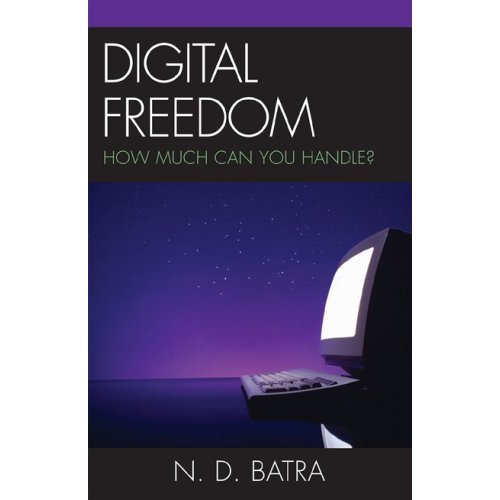
ND Batra

As the ravaging fires in California burnt hundreds of homes and killed several people, a small public radio satiation KBPS-FM San Diego, which was knocked off the air, used its ingenuity and decided to serve the public by publishing on its website maps of places where fires raged, evacuations were ordered, roads were closed, and the places to go for shelter and the best way to reach there.

Using Google’s My Map, its online managing editor Leng Caloh created a virtual map of Southern California, which was continuously updated and has been visited by more than 1.25 million people, giving up-to-date information about the developing situation. KBPS also used the social networking web service Twitter for text updates for cell phones. Twitter is a micro-blogger that allows short text messages to be sent to its site and it is mostly used by people who just want to exchange brief tit-bits, say, what the heck are you doing now? But KBPS used it to update the information on the status of the howling firestorm. Google Maps Website allows users to overlay information about weather, photos and places to go; but the company couldn’t have imagined that its service My Map will be ingeniously used for planning for public safety.

The use of technology for a purpose different from its original intent is called bricolage. It is the practice of tinkering and using the available material to create something new or solve a problem in a unique way. Americans are not the only bricoleurs, though they are most fertile and creative.

The Wall Street Journal carried an interesting story about a Hong Kong newspaper publisher Jimmy Lai who stealthily sent his reporters to Myanmar to report about the brutality of the military regime against the anti-government protesters, including thousands of Buddhist monks.

The use of cell phone cameras by Lai’s newspaper Apple Daily reporters made it possible for the world to see the bloody carnage in the otherwise closed country and prompted First Lady Laura Bush to write an op-ed piece about Myanmar in the Wall Street Journal. President George W Bush took a stand and imposed sanctions, which seem to be working. You see: the generals are talking.

A few weeks later in October, President Bush and the Dalai Lama met in advance of the ceremony to award the monk the Congressional Gold Medal, a unique honour for a homeless man. Although China huffed and puffed loudly like a helpless dragon warning that these events would be bad for US-Chinese relations, the television images of a man of compassion sent a powerful message of American support for Tibet’s autonomy that China has never honoured.

In many ways we see ourselves and know the physical world through our narratives and descriptions. Our nervous system and our personal and historical memories limit our abilities, our sense and sensibility, to describe and capture reality. But communications technology enhances our natural abilities and enables us to see other dimensions of reality.

Millions of words, for instance, have been written about Mahatma Gandhi whose birthday was celebrated on 2 October and yet it’s doubtful if the truth about this complex man has been completely captured.

If somehow we could know a way of tuning up and enhancing the nervous system to a higher level, the reality would change. Think of the time when zero was discovered and the subsequent development of decimal system; and how that might have changed the perception of reality by subjecting physical phenomena to measurement.

Measurement is actuality, which can be enhanced by technology. When Galileo’s telescope was embedded into the human nervous system, the view of the universe changed and the earth ceased to be a stationary planet.

Or consider some modern political events. Had satellite pictures not revealed the existence of the Soviet’s missiles in Cuba in the 1960s, Americans wouldn’t have perceived the threat to the country.

If the remote-sensing technology could pick up sights and sounds of human sufferings, it would become possible to know how the Chinese have been brutalising the Tibetans and their culture. The Tibetan cultural pogrom will find full description. Description either leads to action or generates guilt. Guilt demands action and atonement. That’s how human consciousness has been evolving, perhaps. Through communications technology, the human nervous system extends itself and gives a better or a fuller account of reality, and a feeling of liberation from the constraints of earlier description of reality.

New reality demands new laws, ethics, and social relations; and it creates new lifestyles, as one can see happening in the burgeoning economy of Kolkata, where the communist party is a dead man walking albeit still ruling. Communications technology — satellites, radio, television, cell phones and the Internet — which made free flow of information possible, has castrated communism.

History teaches a lesson that it is through the control of narratives that the powerful, the ruling classes, exercise their hegemony. I have always wondered how Britain ruled so successfully over India for about two hundred years. The British succeeded to a great extent by supplanting the native stories and narratives with their own literature and legends, so that knowing the legend of King Arthur was deemed more civilised than knowing the legend of King Asoka.

China has begun to transplant its own stories and historical descriptions upon the young Tibetans, and by the time they grow up into adulthood, their reality will clash with the truth held by their parents — unless modern communications technology, including wireless Internet, shortwave radio and miniature antenna dishes, keeps them alive as Tibetans. By denying the Tibetans access to their language and culture and access to communications technology, China is doing unto Tibetans what Americas have done unto Native Americans.

Don’t you agree that there is something remarkable about the Jewish people, in the sense that from the Old Testament through Steven Spielberg, they have been natural born story-tellers? Because of the anecdotal and photographic accounts of the concentration camps and documentaries like Shoah and docudramas like Schindler’s List, it is impossible to deny the truth of the Holocaust, in spite what Iran’s President Mahmoud Ahmedinijad and other nay-sayers might say.
Most of us feel guilty for not having stopped it.
The Tibetans have no great film-makers, no story-tellers, and no access to communications technology. They might perish in the unheard silences of the Himalayas unless world leaders keep raising their voices, as President Bush and German Chancellor Angela Merkel did recently. It is time for global civic engagement through all available means of diplomacy and technology.

(ND Batra, the author of Digital Freedom, teaches communications and diplomacy at Norwich University and is working on a new book, This is the American Way. He blogs at http://corporatepower.blogspot.com )

Tuesday, October 23, 2007

PAKISTAN HAS A FUTURE, YES


What can India do for Pakistan?


ND Batra

Benazir Bhutto represents a future that must happen: a progressive, liberal and secular Pakistan that should become a model for rest of the Islamic world. That is in India’s national interest. Weak and unstable neighbours cannot make India strong. Pakistan’s problems are India’s problems too because the patterns of behaviour of the two people are not dissimilar.


“The attack was not on me. The attack was on what I represent. It was an attack on democracy and it was an attack on the very unity and integrity of Pakistan,” Bhutto told the global news media after the dastardly bombings that turned her triumphant return into an unmitigated tragedy. “We believe democracy alone can save Pakistan from disintegration and a militant takeover,” she said with firm conviction even when others were wondering, “whodunit”?


Pakistan is undergoing political and cultural turmoil that has of course not gone unnoticed by rest of the world. People opposing the authoritarianism of President Pervez Musharraf have been lawyers, journalists and other open-minded moderate groups trying to bring Pakistan under the rule of secular law. But the situation is much more complex; religious extremists’ attempt at keeping the country under siege, for example, is certainly not without the support of some strata of the all pervasive military.


The “pattern of ad-hoc deal-making between the Pakistan government and pro-Taliban militants along the Pakistan-Afghanistan border,” according to Dawn’s publisher Haroon Hameed, the CEO of the Dawn Group of newspapers, has been destroying the internal security of Pakistan. The solution to the problems does not lie in the imposition of emergency or martial law, but rather reviving the moribund democratic processes.


Unlike most other Muslim countries, Pakistan is no stranger to democracy. It has a vibrant Press, free and bold judiciary, and an intellectual class that is envy of the Muslim world. It is unfortunate that Pakistan is caught up between democratic aspirations at the top and religious obtuseness at the bottom. Instead of depending upon the questionable political strength and commitment of Musharraf alone for war against terrorism, the United States has been reaching out to a wide variety of constituencies in Pakistan including the media, universities, businesses, non-profit organisations, tribal leaders and intelligence communities.


Bringing Bhutto and Musharraf together to share power in a democratic framework has been so far the Bush Administration’s great diplomatic achievement. The democratic initiative will succeed if Bhutto and Musharraf accept each other as co-equals and co-dependents and realise that the enemy of Pakistan is embedded within the country and must be eliminated whatever it takes.


On a visit to Pakistan sometime ago, Vice-President Dick Cheney urged Musharraf to do a lot more to curb the growing influence of Al-Qaida and Taliban and prevent them from rebuilding and strengthening the infrastructure of terrorism in the safety of tribal areas from where they have been operating to carry out terrorist attacks against Afghan and NATO troops. As the recent Karachi bombings show, Al-Qaida-Taliban groups have spread their tentacles more pervasively in the country.


It is tragic that Pakistan has turned itself into a country warring against the very elements, Islamic extremism and militancy, that its super intelligence agency, Inter Services Intelligence (ISI), nurtured as tools of foreign policy. Musharraf has not been able to make a total break from the forces that have supported him in his hold on power and hence the reluctant approach for fighting terrorism.


Since Musharraf cut the deal with tribal leaders relinquishing sovereign authority over the tribal territory, Pakistan has become a safe haven for Al-Qaida and the Taliban. John D Negroponte, Deputy US Secretary of State, observed before a Congress committee in February that Al-Qaida was “cultivating stronger operational connections and relationships that radiate outward from their leaders’ secure hide-out in Pakistan to affiliates throughout the Middle East, North Africa and Europe.”


Since Musharraf is not in full control of the forces operating in the divided country, what can be done? First of all, the United States forces should cross into the tribal territories in pursuit of the Taliban and Al-Qaida. Bhutto, once she assumes political power, may be open to this idea since these forces threaten the integrity of Pakistan.


Bhutto-Musharraf must break the nexus between the ISI and Taliban and other sectarian extremist groups. The ISI works like a powerful state within a weak state and it is necessary for the United States intelligence to penetrate its hierarchy with the ultimate goal of subduing this monster that terrorises the country.


India should join hands with the United States and do a well-planned public and business diplomacy in Pakistan to reach out to the intelligentsia and middle classes, who have the same global aspirations as other countries with growing economies. The prospects of rapid economic growth and rising prosperity would present Pakistanis with an alternative future that is founded on science and technology and globalisation, the future that Benazir Bhutto has come to symbolise.


(ND Batra who teaches communications and diplomacy at Norwich University is the author of Digital Freedom and is working on a new book, This is the America Way)

Tuesday, October 16, 2007

China and America


Behold the power and glory that is China!


ND Batra


Earlier the salesman pitch used to be: “You cannot afford not to be in China.” But now corporate CEOs are so eager to apologise to China for its own egregious behaviour. Last month Mattel’s executive vice-president Thomas A Debrowski delivered a well-structured diplomatic apology: “Mattel takes full responsibility for these recalls and apologises to you, the Chinese people, and all our customers who received the toys.” It is just like a rape victim apologising to the rapist: Pardon me for tempting you, sir.


Cleverly staged mass media propaganda and lobbying by people in high places, including some of the top CEOs of major US corporations and university professors, has helped the Chinese authorities in blurring facts with fiction, creating the perception of China’s relentless and inevitable rise as a global superpower. China fascinates corporate America with its myth of bountifulness but more so with its ruling party’s collective mind that controls the obedient masses that produce cheap goods for American markets and whose 1.3 billion worker-consumers would one day buy every branded product made in the United States.


You have heard the drumbeat, repeated ad nauseam, which China has come to believe that since Americans cannot do without its cheap goods, so why to worry about intellectual property thefts, currency manipulation to fuel exports, humongous trade surplus, defective toys, and tainted food products.


Consider, for example, 2008 Olympics, which the Wall Street Journal childishly put it as an event “to refashion the Olympics from a sports and merchandising extravaganza to an engine of political and social change.” That’s expecting too much from an organisation like the IOC that has been paying little attention to its own widespread problems, bribery scandals and drugs, for example.


If human rights were the deciding factor in determining the choice of the host city for the Games, Moscow under the Soviet Union and Berlin under the Nazis would not have been selected to host the Olympics.


China will be showcasing the Games in spite of its abominable record of suppression of human rights of the people of Tibet, the followers of the banned spiritual movement Falun Gong, political dissidents and scholars rotting in its jails without recourse to a fair trial.


In an Op-Ed piece in The New York Times, Slavoj Zizek wrote last week that in Tibet, the Chinese authorities “in addition to military coercion, they increasingly rely on ethnic and economic colonisation. Lhasa is transforming into a Chinese version of the capitalist Wild West, with karaoke bars and Disney-like Buddhist theme parks... in a decade or two, Tibetans will be reduced to the status of the Native Americans in the United States.” He forgot to mention gambling casinos, drugs, booze, and obesity.


Doing business with China is more important than human rights, though Americans along with rest of the world go on paying lip service to the problem. Trade and the Olympics had no civilising effect upon the Nazi Germany or the Soviet Union; therefore, to expect a miracle to happen in China because of the Olympics in 2008 or increasing international trade is puerile and silly. Rising prosperity would not force China’s Communist Party to give up its monopoly over power and become democratic. Since Deng Xiaoping took the road to capitalism, replacing communist brutality with capitalist brutality, about three decades ago, China’s economy has been opening up and growing rapidly with its gross national product (GNP) rising to more than two trillion dollars. The rate of annual economic growth has remained above 9-10 per cent.


Made-in-China goods, apple juice, toys, shoes, electronics, and even golf clubs and handguns are found in every shopping mall of the world. Huge economic benefits are expected from the 2008 Games because it has necessitated an investment of billions in infrastructure and information technology to modernise and showcase Beijing for the events. Millions of tourists who would pour into China, perhaps take a train to Lhasa and visit the Three Gorges super-dam, nonetheless, are expected to remain silent observers.


The Deng Xiaoping market economy revolution unleashed China’s vicious capitalist energies, but not without the help from the outside world, especially the United States, which magnanimously opened its markets to China.


Today China is a healthier, better-fed and better-educated nation than most other developing countries but it remains a closed society ensconced in pollution.


Who needs freedom? That’s why George W Bush never preaches freedom to China though he repeatedly asks that it should let its currency rise. China feels that it can compete with the best, but can it tolerate the noise and chaos of an open society like the multicultural and multiracial United States, where the people demand accountability from their political leaders? Beijing with the help of Google, Yahoo!, Microsoft, and Cisco has been trying to expand its control into the digital domain and expects to have the same control over cyberspace as it has over Tibet. The Internet might bring about tremendous political upheavals in China, so be warned: Don’t move my cheese. Large centralised political systems break down due to internal pressures triggered by communications technology, unless they have built-in capabilities for adjustment, which China does not have at present. And so it is difficult to say what might happen in China in the age of the Internet, satellites, cell phones and hosts of other wireless, digital, and interconnected sensing devices that are becoming available. China wants to control the uncontrollable, the digital generation swapping billions of text messages on cell phones, the generation that could self-organise itself into a smart mob. Look at Myanmar’s recent Buddhist monk uprising, which must be giving the Chinese rulers sleepless nights.


The authoritarian regime is getting ready to open its doors, skies, and cyberspace to a worldwide audience during the 2008 Olympics. But will it be able to close the skydome once the crowd is gone? Yes, of course, with the help form corporate America, which one day might become a dancing bear for China, if others follow Mattel’s obsequious behaviour?

(Dr ND Batra is working on a new book, This is the American Way)

Tuesday, October 09, 2007

Hey Bangalore! Are You Listening?

When our daily lives become hyper-personal

From The Statesmsn

ND Batra
Google knows whether a person is a dirty trickster, an older man trying to seduce a younger woman; a gender-swapping woman playing with big boys in a cave in Second Life; or a teenager posing as a medical expert.

Google is becoming the keeper of surfers’ personal history, well, at least for 18 months after which it makes it anonymous, or so it promises. The idea behind surf & search record-keeping is to create patterns that anticipate the searcher’s behaviour and provide the information quickly next time he looks for an item. More than that, based on searching patterns, Google, according to CEO Eric Schmidt, could answer hypothetical questions, for example: Where should I invest my bonus, in mutual funds or a savings certificate? Freedom in cyberspace is becoming “curiouser and curiouser,” as Alice in Wonderland would have cried. The more you have it, the more you lose it.
The Internet has created a new media environment that not only enables people to communicate, discuss and exchange information, give and receive feedback, but it also provides an interactive collaborative experience, doing things together, when words become deeds and speech becomes action. Networked computers, the building blocks of the Internet, are much more than mere productivity tools and informatics systems. Unlike the traditional media, they are capable of creating cyber-environment that can be designed to be persuasive, and can motivate people to disclose personal information and change their social behaviours. Social engineers, especially those who serve authoritarian governments, know the potential of the Internet for creating an illusion of boundless freedom only to entice people in digital chains.

The next challenge for software programmers whether they work for Google, Yahoo or some authoritarian regime is to build a network architecture that enables the designing of virtual environment to motivate people, for example, to buy, sell, invest; obey the supreme leader; or even induce good social and personal habits such as not to drink and drive, not to have unhealthy sexual behaviours. Computer codes have the potential force of law, according to Stanford Law professor Lawrence Lessing, and programmers could bypass the government and, in a manner of speaking, take law into their own hands. Or the government could also use programmers to stifle dissent. Give the monks of Myanmar computers and free access to the Internet. They may not come out of cyberspace to protest in the streets. But the rhetoric of software design, the persuasive code that entices, builds relationships, arouses and fulfills desires and keeps the users coming back, has not been fully explored in areas other than cybersex and virtual reality Internet games. There is a great fortune in developing codes that persuade the user to change his attitude, behaviour and actions.

Hey Bangalore! Are you listening?

The strength of the Internet is its interactive immersion, its ability to respond and give instant feedback and gratification. Feedback not only regulates the flow of communication but also gives some of the control back to the receiver of the message, in fact an illusion of freedom. Two persons in conversation establish a dynamic relationship to create shared meanings, of which a Web portal might keep a record. Human communication is essentially a transaction that takes place effectively if people have or can create a common field of experience. Internet communication can transcend face-to-face communication, can be very enticing, and in certain circumstances is even more desirable as many patients and therapists are finding. Lack of face-to-face cues, physical appearance and vocal inflections, which might arouse skepticism are absent in Internet communication, especially when it is time delayed (asynchronous) such as in e-mail or question-answer Websites.

Selective self-presentation makes it possible for people to open themselves up to others, which they would hesitate to do in face-to-face conversation for fear of contradiction and lack of control. But Google, Yahoo and the ilk keep digital footprints of what is going on in your hearts and mind. Even in chat rooms and instant messaging, communication can become what JB Walther, a professor at Michigan State University, calls as “hyper-personal,” that’s, socially more desirable than we are likely to experience face-to-face. It allows the play of fantasy partly to compensate for the absence of aural and visual information that gestures and voice create in interpersonal encounters. Fantasy lowers our guards and makes cyberspace so seductively persuasive ~ and dangerous. So many teenagers go astray in cyberspace because it lets them assume fake identities and gives them freedom to pretend what they fancy themselves to be. Some of them become victims of con-men and predators, who too assume identities desirable for their teenage victims.
An Avatar can be very deceptive.
The playfulness of virtual environment, an environment of “Be what you want to be,” creates a pleasurable experience, a sensuous flow, in which we feel in control of our environment that real life might deny us. Those who spend too much time in Second Life might forget what real life is. In search of a fake identity, we are in danger of losing our real identity.

(ND Batra, the author of Digital Freedom is professor of communications and diplomacy at Norwich University. He is working on a new book, This is the American Way: An Intellectual Travelogue)

Sunday, October 07, 2007

A supply-chain of knowledge?

Building a global supply-chain of knowledge

From The Statesman
The challenge for information technology guys from Bangalore, Silicon Valley, and other knowledge hubs is to create a system that is capable of aggregating and accessing available sources of knowledge and mining all modes of information, whether audio, video, pictorial, textual or in the form of a spreadsheet. The system should create a protocol, much like TCP/IP protocol, that transcends cultural, semantic and computer language/format barriers. And finally, as Gupta suggested, the IT system should be capable of customizing knowledge as per individual or group needs. For example, the IT system should be capable of automatically converting a report about Mynamar protests into various formats, such as newspaper, radio, television, and mobile devices such as cell phones to which editorial value could be added subsequently.
The world of collaborative knowledge seeking and innovation has just begun.

Saturday, October 06, 2007

Digital Natives

Facing the YouTube generation

From The Statesman
August 1, 2007

By ND Batra

Hardly has the conspiratorial expression “Let’s Google him” settled in as a sizzling hot potato on the American tongue-in-cheek civic discourse when there is another linguistic gatecrasher “YouTubing” into American culture and consciousness, as last week’s Democratic debate showed. The YouTube questioning began with a street expletive, “Wassup?”

It was a remarkable event technologically speaking since this is certainly the beginning of a new era when television and the Internet have begun to converge into a seamless medium used by the Internet hoi polloi and potential voters who asked all kinds of questions ranging from gun control and global warming to healthcare, sex education for children, gay marriages, Darfur (Sudan), and Iraq war.

Experts could not have asked better questions of the candidates, and as author James Surowiecki might have said, it was a sample of the wisdom of the crowd made visible by YouTube. Therefore, to say that it was nothing more than another digital town hall meeting is to miss the point: the challenge of the emerging new media to traditional media gatekeepers and professional pundits. It was a surge from the earth gone flat; and there will be more to come.

The questioners it seemed had already “Googled” the Democratic presidential candidates’ past track records on various issues and using their home videos equipment they personalised controversial issues and uploaded them to YouTube for the debate, which was in actuality candidates’ reactions to questions rather than they debating among themselves.

But there were faces, ethnically heterogeneous, the Democrats could not ignore. Nor will the Republicans when they confront the YouTube generation on 17 September at St. Petersburg, Florida, though one of them, Mitt Romney, former Governor of Massachusetts, said in an interview: “I think the presidency ought to be held at a higher level than having to answer questions from a snowman.” But Republicans cannot escape the tech savvy YouTube generation or they will be left behind. Out of 3,000 questions ranging from the serious to the absurd, CNN, the all news cable network, selected 39 for hosting to Democratic presidential hopefuls, who had gathered on the campus of the military college, Citadel, South Carolina, deep in the Bible belt.

An animated video clip of Snowman with his snowball kid created a stir when it asked a question about global warming, which even former Vice-President Al Gore’s documentary An Inconvenient Truth could not have done better. Then there was a gun-toting wise guy who held an automatic guerrilla-style gun and calling it “my baby” asked whether it would be taken away if a Democrat were to occupy the White House. “He needs help. I don’t know if he’s mentally qualified to own that gun,” said Senator Joe Biden of Delaware, one of the eight candidates on the stage. After the 9/11 terrorist attacks, the issue of gun control receded into the lower depths of American consciousness, though gun violence has not abated. But Senator Biden missed the irony: The assault weapon guy was mocking the Second Amendment, the American people’s right to bear arms like “my baby.” Regarding questions about Iraq war and withdrawal of US troops, Democrats as expected were united in condemning President George W Bush in misleading the country and mismanaging the post-war operations.

Moreover, they were equally united about how soon to withdraw, soon enough but in a phased and gradual manner in order to protect the troops and not leave a hellhole behind, which Iraq has already become. Some set tentative dates while others were judiciously ambiguous, which showed once again how deeply confused and divided Americans are about Iraq. In response to a question whether he or she would meet with the leaders of Syria, Iran, Cuba, Venezuela, and North Korea in his or her first year as President in order to promote diplomacy, Democratic candidates took this as another opportunity to hit at the Bush administration’s reluctance to use diplomatic tools for advancing national interest.

Senator Barack Obama, a leading candidate among Democrats and the biggest challenge to Senator Hillary Clinton’s ambition to go to the White House, sharply rebuked the Bush administration saying that it’s nothing short of ridiculous to believe that not talking to countries is a kind of punishment to them. He said he would readily talk to them as John F Kennedy and Ronald Reagan continuously did with the Soviet Union.

Senator Clinton’s thoughtful and measured response to the question made her look and sound presidential. She said that she would not rush to meet with them in her first year without knowing what their intentions were and certainly she would not like to give them a chance to use the meeting for propaganda purposes. The President of the United States cannot behave like a used car salesman ready to talk to anyone. The reason why some Republican candidates are reluctant to face the YouTube debate format is that they are not sure what kinds of questions might get into the YouTube pool and what questions CNN might select. To minimise the CNN effect, questions could be randomly selected. Politicians are control freaks and do not want to lose control over their professionally designed, customised and controlled messages, which they can drumbeat through television commercials and for which they have to raise millions of dollars. In this sense, the Internet is a very different medium because it empowers people. In the future instead of holding a Press conference, politicians might be asked to hold a YouTube conference.

(Dr ND Batra teaches communications and diplomacy at Norwich University and is the author of Digital Freedom)

Saturday, September 29, 2007

The laughing broom


Thou Hast Made Me Endless- Part VII

From RAJAT DAS GUPTA, Calcutta

[The following poem is the preamble of the book Prahasini (Satirist) in Bengali by the Rabindranath Tagore written in 1939, two years before his death at the age of 80. While the poet endowed us with his superb literature, music and philosophical thoughts, albeit being a personality of highest dignity, he could easily come down to the level of lesser mortals around him and amuse them with the sparks of his brilliant wits whenever occasion would arise. The Poet was a guest of Mrs. Maitrayee Devi at Mangpu (a hill station near Darjeeling) a few times towards the end of his life. She collected all the wonderful dialogues of the poet as she could in her book ‘Mangpute Rabindranath’ (Rabindranath in Mangpu) translated by herself from the original Bengali into English with the title ‘Tagore by Fireside’. As the book records, the Poet was amazingly mobile between the highest aesthetic/philosophical thoughts and the lighter humor.]

The laughing broom of the comet at times
Sweeps fun down the Universe to our climes
Speeding past the bewildered Sun’s dominion
With flashes of wit to lose into oblivion
Takes leave the Universal jester.
Along my life’s orbit, I know not why
The crazy comets at times do pass by.
Rushing in the void the tail of rigmarole
With momentary frolic without a goal
Shaking up the hood of the somber.
At times the world relaxes
Either in hilarity or amuses
Glitters laughter brilliant,
Yet not lasting, in an instant
Blots out its trail;
The night in meditation on its dark seat
Scatters meteors in its freakish beat
Countless sparks of wit it does fling
That booty beyond reckoning –
Discharges in a few hours’ frail.
In this Universe there are matters crazy
Creator’s amused affection thereon I do fancy,
Mirth and frolic, God’s gift so
Inscribed in my dignity do go;
At heart I know, it is precious;
So much senile I shall be never
To call caddish fun and laughter;
If so the old will grunt
With God I’ll merrily share its brunt;
Grant it forthwith and not turn serious.

* * * * * * * * * * ** *** *** * ** * ** ** * ** * *

Poem from the book ‘Khapchara’ (Crazy) written to the Poet’s friend Rajsekhar Bose in 1937.
[Translator’s note: Rajsekhar Bose of Tagore’s time is still popular among the Bengali literati for his spoof literature which he wrote under the nickname Parasuram (a legendary sage of ancient India, notorious for his bad temper). The poet here upholds nonsense as a valuable part of human life as a design of God. In Hindu mythology Brahma is considered as the God of Creation, having four faces. In other words, man is of myriad character encompassing humor and frolic. In this poem the Poet gives a witty explanation of the four faces of Brahma.]

If you find this senile
Shedding his pretensions awhile-
Naughty seems to be,
Blabs successfully,
Notice his childish fruition
And lapses in dedication
Towards Vedas (*), not solemn (* 4000 year old scripture)
Like the Atlantic Ocean,
His words
Tend to farce;
Brain crazy,
Mind borders lunacy,
And so you condemn
His education as vain –
Why the Creator, I’ll ask
Has four faces, for what task?
One for philosophy
To preach homily;
The other for Veda accent,
That too well meant;
The third is for poetry profuse
Our mind in emotion to muse;
Then, the last one you must know –
Is the preserve for “Ho! Ho!”. (=laughter)
Wild folly all fences to overflow;
At its push
In my brain all nonsense ambush,
And spiral up to rigmarole
Without a goal.
A disciple of that four faced
I happen to be; so has been said;
However much that may amuse you
Support documents, not a few;
Creation plays my fancy, you may see
Yet, I tilt for ramble with no less glee.

* * * * * * * * * * * * * * * * * * * *

RAJAT DAS GUPTA: Calcutta: e-mail: rajatdasgupta53@yahoo.com
rajarch@cal3.vsnl.net.in
Rabindranath Tagore (1861-1941 AD) the Nobel Laureate of 1913 was introduced to the West primarily through the collection of English translation of some of his poems/songs captioned as ‘Gitanjali’ (=Offering of Songs).More translations of his works followed by the poet himself and others after he had won the Nobel, including poems/songs, dramas, short stories etc. However, such efforts were sporadic and sluggish, mostly on individual initiative, which still remain so.As a result, a vast volume of the poet’s works remains un-translated while, it appears, it is an impossible proposition to translate even a substantial part of the poet’s total works to permit those, not privileged by the knowledge of Bengali language, a reasonably broad view of his myriad creations where unfathomable perceptional depth of top grade aesthetics runs through, literally true to his song “Thou hast made me endless / Such is Thy pleasure”.Notwithstanding this, an upsurge of Tagore translation took place in the last decade of the twentieth century by virtue of a good number of eminent poets/translators e.g.William Radice, Joe Winter, Ketaki Kushari Dyson, to name a few, all of whom left their valuable contribution to this oeuvre and my book THE ECLIPSED SUN is a modest addition to this. I have put stress on a few aspects of the poet’s works, particularly those in his twilight years, which seemed to me quite inadequately covered so far. The followings are presented mostly based on this book.

Tagore the wag:
Preamble: While Tagore was an embodiment of supreme dignity, spirituality and aesthetics, his mobility between that height and the mundane, including very refined practical jokes, was indeed amazing. I am tempted to refer here quite elaborately to Maitrayee Devi’s ‘Tagore By Fireside’ (a translation by herself of her original book in Bengali ‘Mangpute Rabindranath’ i.e.’Rabindranath at Mangpu’, a hill station near Darjeeling which was the workplace of her husband) based on her diary she maintained while Tagore was her guest intermittently between 1938 and 1940. Her book is a unique literature of its kind. In no other writing one gets the poet so closely as in this book, through the eyes of Maitrayee Devi. The undernoted incidents/quotes from this book will hopefully be found relevant to the following two poems.
There was no dearth of scandal mongers against Tagore which disturbed very much Maitrayee, a great devotee of the Poet, whenever she would hear all these. Once, when the Poet was in Mangpu, she heard the scandal that the poet must have champagne every evening (the fact is, the Poet was a teetotaler and also that wine & alcohol are taboos even now among the hoi polloi in India). Overcoming her inhibition one day, she reported the Poet about this baseless scandal. The Poet answered, “Ah, no less than champagne! But even after hearing all these, I find no improvement in your hospitality!” Maitrayee’s reply was- “Hell!”
Another such scandal was that the Poet never allowed those women to come near him who were not beautiful. Having this report from Maitrayee, the Poet said, “But those who speak thus, must not have seen you!’. Indignant Maitrayee said, “Such insults on appearance and age is intolerable!’. The Poet said, “But I never told you anything about your age! (It seems, on some earlier occasion he did.) I know well that you can’t be older than 45!” (At that time Maitrayee was only 25 years old). Now, thus he mollified the still indignant Maitrayee – “But why are you still cross? Just think how nice an arrangement it would have been had I been really so (i.e. averse to women not beautiful). Santiniketan would have been free of the womenfolk there!” (Only Tagore could be intrepid enough to dismiss all of them as ‘not beautiful’!)
Once again in Mangpu, Tagore conspired with a few of his associates to play a practical joke on a female relative of Maitrayee, whom all of them (including Tagore) addressed as Mashi (which in Bengali is the address for one’s mother’s sisters, but may be applied to any woman around their age. For jest it is applied to much younger girls also, as in this case). Mashi was terribly afraid of insects which were then abundant while it was monsoon time. In the morning the poet predicted the girl that it would be a bad day for her, pretending that it was his astrological reading. On persistence of the girl for more details of the impending mishap, the Poet replied that it might be of any kind which could not be precisely foreseen. Then, in the words of Maitrayee Devi:]

“Early in the evening, at about dinner-time, I was waiting to give the Poet some medicine, when I suddenly heard a piercing shriek and a loud crash of falling crockery. I ran into the dining room to find Mashi standing on a chair, thoroughly distraught, with the dining table in complete disorder, while the others, whom the Poet used to call his three lords, were eating a huge beetle with much gusto. Then it came out that the beetle was made of chocolate. The great lord had ordered it from a confectioner’s in Darjeeling, and then by previous unanimous agreement it was placed ready on Mashi’s plate neatly covered with a serviette. I came back to the Poet’s room and found him laughing to himself to his heart’s content.
‘Mashi, didn’t I predict that the day would end badly for you?’
‘Amazing! You were also in this conspiracy?’
‘Really, I am also in it, am I? That is too bad, it really has gone too far – please do not release the news to the Associated Press, for the Poet Emperor (The poet is referred in India as the Poet-Emperor, The World Poet, The Great Poet etc.) would lose his prestige altogether, specially in our Guru-ridden country! Had I sat on a high pedestal, behaving like a proper preceptor and now and then showered sermons from the high, who would have been the loser? Those who fix themselves on the top do not realize how much they lose.’
Words, that are limited by fixed meanings, seem inadequate to express how all the fine and sensitive touches of his personality revealed themselves to us, how we found him at once detached and absorbed. Even when absorbed in deep thought, engrossed in serious writing, he would return to us in a moment. He was interested in our smallest pleasures and pains, our trivial problems of our everyday life, watching over us with affection and anxiety. He did not stand like an onlooker on the bank, but came right into the middle of our life stream and felt its flow. Yet, in a moment, he would be off on a voyage to some far away region. At one moment he would talk on ordinary topics and regale everyone with humorous conversation, but the next moment he would relapse into a silence that would change the whole aspect of his personality, as if a door had closed, leaving us outside it, to gaze into a mystery we could never aspire to reach. Sometimes, in moments like this, we have felt, at least I have felt, that I should not speak at all, even if there should be something urgent to say. The tranquility that emanated from him at such times cannot be transmitted to my readers through the medium of language. Sometimes he would sit for hours without moving a hair, a hush would descend over the trees, over the dark masses of bushes; at such times all noise, even the voices inside the house, would disappear from consciousness, something would reach out to me from that absolute stillness. I longed to sit at the feet of my Guru in those tranquil hours, but it was not an easy thing at the beginning; for ordinary persons like us to be able to sit in perfect stillness for a while needs training. One’s back would start itching, or toe would go to slip, something or other would tickle somewhere, making it absolutely necessary to change position. In the beginning, I was amazed to see him sit in the same position for hours, forgetting the existence of a body. Sometimes in the early hours of dawn, I have found him sitting thus, quite unmindful of the centipedes that were crawling up and down his arm. And then I would be confronted with a problem, not knowing whether to brush them away or leave them undisturbed. I find it impossible to express not only what he was, but also how I saw him. I can take down a little of his conversation, but how I can explain that eloquence of his silence, which was a deeper expression of his personality, as I felt sitting there in an ineffable companionship, filled with a glow of well-being that baffles all description?”

Tuesday, September 25, 2007

Living Digitally

Shamelessness or transparency?

From The Statesman
ND Batra
Last week a flamboyant student Andrew Meyer raised a ruckus at a meeting held at the University of Florida by Senator John Kerry, who in 2004 lost the presidential election to George W Bush. During the question answer time, Meyer in a length tirade accused Senator Kerry of being a wimp for not challenging the results of the election.
“There are multiple reports of disenfranchisement among black voters on the day of the election in 2004. There was also voting machines, electronic voting machines in Volusia County Florida that counted backwards… Didn’t you want to be president?”
The campus police took the unusual step of using electronic stun gun to subdue Meyer, who went on shouting, What have I done, what have I done, let me go… Soon the video was YouTubed and has been seen millions of time.

The world is becoming a digital theater, a place of grand and cruel and some time comic gestures in cyberspace. A well-rehearsed and structured tableau of victims and perpetrators in action, for example, could be uploaded for instant global spontaneous reactions, of curses and condemnations, of revenge and retributions. Anyone who wants to make an impact would develop a digital strategy to be on the centre-stage.

Terrorists digitise gruesome killing and let loose the images in cyberspace. In 2004 American television withheld from the public how the 26-year-old American telecommunications contractor Nicholas Berg’s head was chopped off in one fell swoop. But sooner or later those who loved the macabre and heinous surfed the net and discovered on their own the digitisation of terror. And millions did, as if it were another reality show.

In times like these when we are deluged with unceasing barrage of commentaries from talking heads and pundits, digitally capsulated significant moments tell the real story with telling effects. Whether you hear the click or not, somewhere a cell camera might have taken a snap of the moment that might become a witness to an atrocity or crime; but before the image finds its way to an inquiry commission or a court, the public would have the chance to see it in cyberspace, where court gag orders don’t always work.

Shortly after the picture of the abuse of Iraqi prisoners by the US troops were published in 2004, the Daily Mirror, a London tabloid, published photos of Iraqi prisoners being abused by British soldiers, which subsequently turned out to be fake. Instead of verifying the accuracy of the pictures in the light of mounting public criticism, as a responsible editor should have done, the Mirror’s editor insisted that the pictures were genuine and the newspaper’s account of the abuse was accurate. Though the editor lost his job for publishing fakery, there’s a lesson to be learned that in the Internet age the responsibilities of media gatekeepers, anchorpersons and editors, have become all the more crucial. Sometimes the camera blinks and lies: digital distortion and manipulation is easy. By the time the Daily Mirror realized its error the damage had been done. Apologies cannot erase digital memories.

Databases exist in perpetuity. In the pre-digital era too faking photo was not difficult but now cut-and-paste can be done with a few clicks and uploaded for the world to see. Imagine if that had been done during the Nazi concentration camps, Holocaust might have been a different story. The Vietnam War is enshrined in two images: A little Vietnamese girl running scared and stark naked on a highway after a napalm bomb attack; and the other, a Viet Cong prisoner being shot point blank. If instead of a digital camera, which has no negative and needs no development, an analogue camera had been used at Abu Ghraib prison, someone probably would have stopped the picture development for fear of exposure. The words wouldn’t have captured the sexual humiliation and degradation of Iraqi prisoners whose only fault was that they were captured and wouldn’t respond to military intelligence experts’ extreme interrogations. Torture of prisoners of war and others has been an ignored but universal practice, regardless of Geneva Conventions, but now that unobtrusive cell cameras can not only capture the outrage but instantly put it on into cyberspace, thanks to wireless satellite uplinks within the reach of most of us, transparency and instantaneity have become a modern condition and a diplomatic hazard.

When Abu Ghraib prison atrocities were uncovered, some practitioners of dark humor said that the torture chambers of Saddam Hussein were under a new management, the United States Management, and it’s business as usual. The liberators have become torturers, instead of spreaders of democracy in the Middle East. Probably this kind of reaction was uncalled for and excessively vituperative, but you might say, what better way to tell that Americans had lost their way in Iraq.

Republican diehards were shocked that someone allowed those sadomasochistic pictures of prisoners to be shot at all. And worst still, they bemoaned why no one ever stopped them from finding their way into the media. They forget that in the digital age, it is impossible to stop information or images from being shared.

The Internet is a shareable, collaborative and un-censorable medium. Whatever can be digitised will find its way on the Internet, where brazen shamelessness, some call it transparency, is the norm.

(ND Batra, professor of communications and diplomacy at Norwich University, is the author of Digital Freedom. He is working on a new book: This is the American Way.)

Tuesday, September 18, 2007

A total surveillance society

China surveillance copies USA

From the Statesman
ND Batra

George Orwell’s 1984 failed to materialise, but Keith Bradsher of the New York Times recently wrote how Wall Street has been colluding with the Chinese authorities to turn China into a total surveillance society.

Bradsher wrote: “China Security and Surveillance Technology, a fast-growing company that installs and sometimes operates surveillance systems for Chinese police agencies, jails and banks, among other customers... has just been approved for a listing on the New York Stock Exchange... the latest signs of ever-closer ties among Wall Street, surveillance companies and the Chinese government’s security apparatus.” Another company that trades its shares on Wall Street is China Security and Surveillance.

Just as China is supporting genocide in Darfur through its oil trade with Sudan, the United States is supporting the suppression of human rights by allowing Wall Street to funnel funds to “install surveillance systems providing Chinese police stations with 24-hour video feeds from nearby Internet cafes... Hedge fund money from the United States has paid for the development of not just better video cameras, but face-recognition software and even newer behaviour-recognition software designed to spot the beginnings of a street protest and notify police.”

China says something similar is happening in the United States too. Search companies like Google, Yahoo, AOL and others collect and archive huge amounts of personal data from which can be profiled the behaviour of the user.

Last year, America On Line (AOL), an Internet search company, inadvertently released from its archives millions of search queries done by more than 600,000 users during a three-month period. Thought their names were not released but it would not have been difficult to put together the profile of searcher #167845, for example, and what possessed him or her. The American people are quietly submitting to whatever brings them a feeling of assuredness. Protests against intrusiveness by the government and businesses into our personal lives have become muted.

We are slipping into a low-intensity surveillance society. Every time there is a terrorist attack, we feel that the government might be right. Chinese are no different. Online surveillance devices are being increasingly used by businesses to track users when they surf their websites. Tracking is done unobtrusively and the user can never suspect that he is being watched; nonetheless, the practice is questionable, especially when the website does not declare in its privacy policy.

But who cares in China or Tibet?

Most of us are familiar with cookies, small software programmes the advertisers put on our hard drives to track where we surf so that they can customise the most appropriate advertising message for us to achieve target marketing, reaching the right person with the right message. But a web bug can be programmed to collect whatever data is required without the knowledge of the user. When you look at your online mutual fund statement, or a pornographic site, the web bug too could be monitoring it. So when a Chinese searches for Falun Gong, Catholic Church or the Dalai Lama, do you know what might happen to him? Some American companies claim to inform their visitors about the tracking devices they use and for what purposes. Users can opt-out, but most of them don’t know whether the option is available, nor do many of them pay attention to the privacy statement.
In China, you cannot opt-out.
Surveillance technologies are not limited to the Net. Several companies are using biometrics, face recognition, radio frequency and global positioning system (GPS) technologies, to keep a watch on their properties and track suspects. Many car rental companies in the United States use GPS to keep track of their rental cars. If a car is stolen or is involved in an accident, the company would know the exact location of the car. GPS also enables them to check the speed of a rental car.
Many airports have started using digital fingerprint identification technology to conduct background checks without any protest from employees. Face recognition technology is being extensively used not only in airports but also in ballparks, banks and other business establishments. If a suspect turns up, his face is digitally matched in seconds with the image database.

The US Customs and some airports are using low-dose X-ray machines, such as Body Search, to electronically scan a person for drugs, bombs and contrabands. Body Search electronically strips a person naked and projects the image on the screen for scrutiny without the person being asked to take his/her clothes off - all in the name of security. Hundreds of air travelers, including women, are randomly subjected to electronic Body Search.

An interesting security tracking technology is the radio-frequency identification tag (RFID), which is attached to a suspect’s baggage as he checks in. The tagged baggage is automatically routed to a security area where it is screened with special cameras and sensors for explosives and other hazardous materials. Along with our baggage, we too might have to wear radio-frequency ID tags so that we can be monitored as we move from one airport to another, from country to country via GPS.

Only if we could put an RFID tag on every terrorist!

Nonetheless, the United States is an open society. One can always go to court to seek a remedy against the state as well as corporate America. What can the Chinese do? Go to the Olympics, of course. Or McDonalds.

(ND Batra teaches communications and diplomacy at Norwich University and is the author of Digital Freedom. He is working on a new book, This is the American Way.)

Thursday, September 13, 2007

Sweet is the Earth's Dust


Thou Hast Made Me Endless- Part VI


Poem: “Madhumay Prithibir Dhuli” (Sweet is the Earth’s dust) of the book AROGYA (=Recovery) written on the 14th Feb. 1941, the year of the Poet’s death at the age of 80.

[Translator's (Rajat Das Gupta) note: In his various essays marvelously interpreting the perceptions of Upanishada (the oldest scripture written/compiled by the sages in India 4000 years back), Tagore illustrates us that everything from the dust of this earth to the stars and planets of the cosmos are imbued with Anandam (Divine Joy) and Amritam (Immortality). This poem conveys us the same message.]

Sweet is the Heaven; so the Earth’s dirt
That I’ve lifted close to my heart –
As my supreme hymn
Life’s ultimate to deem.
All gifts of Truth day by day
That I had, have no decay;
So at Death’s threshold
Resounds the Mantra (*) age old (*= religious hymns)
With the joy of eternity
Resplendent, defying all losses petty.
With Earth’s last touch
For final flight as I’ll perch –
“My forehead I’ve anointed” – I’ll declare
“With Your dust; seen the eternal glare
Beyond the havoc of the tempest
Deluding the Immortal’s joyous form truest;
In Your dust that is manifest –
So on it my head I rest.”

* * * * * * * * * * * * * * * *

Poem No: 18 of the book Sesh Saptak, written in 1935.

[Translator’s note: The following quote from the Poet’s essay Dukkha (Sorrow) from his book Santiniketan will explain well the implication of this poem – “The hymns of our prayer include – ‘I bow down to the Euphoric and the Benevolent’. But, our homage is to the former and not always to the latter. Because, the Benevolent is not necessarily euphoric always, but also grievous. We accept only happiness as His gift and count our sorrows as the result of ill luck.

So, we, the grief fearing , like to hide in various shells of our creation to save ourselves. But, the result of it is, we deprive ourselves of a full exposure to Truth.

If we always coddle our mind from the blows of grief, our living on this earth is then incomplete which never nourishes our health and vigour. The man who on this earth never had a grief, has not received his total dues from God, and his subsistence for his journey remains deficient.

Our dues of grief is not necessarily justified always. We shall have to accept also whatever we call wrong or unjustified. Man cannot develop himself on a refined calculation of his legitimate due and even if one can, it is not to one’s ultimate welfare. We should be capable of gracefully accepting even wrongs and injustices.

But, are all the advantages that come to us are calculated ones? There are occasions when we get more than the price we pay. At that time we don’t think that we don’t deserve it, but usurp the undue advantage without hesitation. Only in case of sorrow we try to balance justice and injustice. The fact is, our recompense is never based on refined calculation.

Process of life is based on acceptance and rejection; centripetal and centrifugal, both the instincts are equally glorious to us. Our faculties of intellect, aesthetics, welfare and all that comprise human superiority, go on the maxim that we should accept as well as sacrifice…..Those who accept all injustices, pain and grief without hesitation, not only strengthen themselves but also become serene, fully exposed to the abrasions of this world, all unchaste in them wear out.

So, be prepared heart and soul – bow down to Him who causes sorrow; only then you will gain health and strength; that will mean bowing down to Shiva (Lord of Destruction) and the neo-Shiva.”

To strive for such a mental male up is the way out of the distress which we tend to cherish when we feel that we have been wronged.]

Do we desire our grief to terminate?
Is it our pride or hate?
But our pain most intense
Carries not Truth’s permanence –
Such a confession true though,
Only hurts our Grief’s ego.

Life scatters all its hoard
On Time’s charioting road
Under its ceaseless wheel
Faint out the severest woe or weal.
Death of our dearest,
Leaves only demand earnest –
“Forget me not” –
While passing into naught.

But countless are demands of life
Which put our minds in strife;
Amidst the present day babel,
That past appeal rings not a bell.

Though the words might remain,
Gone is the pain,
Yet, the pride of Grief
Denies Life its leave –
In its impertinent ardour
Bolts door to Life’s messenger;
In the sprouting soil of Life
Distressed Grief in its hype
To precinct the benefice will assert
To coddle its beloved desert.

With Death’s hoard piled,
His suit against Time filed;
Only to compound frustration
In this futile petition;
Burial in self dug sepulcher
Becomes its intense desire.

All ego is serfdom;
Grief’s is a hard one;
Society, wealth and fame,
In love of these is addiction same,
But it is deepest indeed
In our grief morbid.

* * * * * * * * * * * * * * * *
Poem No: 10 of the book Prantik (At The Border) written on 8 December 1937

[Translator’s note: Following quote from the Poet’s book Santiniketan well explains the underlying philosophy of this poem –

“One day gods were terror to man. To please whom for a comfortable life or whose displeasure brings disaster, could not be decided by man. To please the power with which there is no spiritual link, humans gathered to worship it with animal sacrifice and such rituals. That worship out of fright is not a festivity. Just as when we are in the hands of the dacoits, we say, ‘we give you whatever I have, but please spare our life’; similarly, to keep pleased the invisible power, on earth man said that day, ‘We’ll give You everything, please don’t put us in crisis’. But that is not a gift of Joy. Once you perceive the God of Joy, there will be no fear. This God of Joy means ‘More’ – that surpasses all; whatever I had or understood, He is more than that; whatever I had not or had lost, He is more than that too. He is greater than wealth, honour and comfort. So, in the worship of ‘More’ man has joyously said, ‘take my wealth, life and honour’. To know this ‘More’ within one’s heart and outside, is not for mundane comfort. The day man has realized that he is not a beast neither his God is, that he is great and so is his God, he has accepted utmost sorrow. That day man became victorious, a hero and so it was celebrated. Just as a bird on the verge of darkness founts its song of joy at the very touch of the sunrays, so does man when divinity touches him; he declares, ‘I am the son of the Immortal’; says he, ‘I have got it!’, with the strength of which he perceives the Immortal within himself, fears no more, and death cannot daunt him; facing the danger he says, ‘my journey is ahead; stop I won’t; I have no defeat; O Terrible, Your grace is boundless’.”]

O Lord of disaster, from your court
The messenger of Death came all to abort.
Snatched me up to Your vast domain
Through dense dark, naught to remain.
In the folds of the dark deep
I noticed not the invisible lights peep,
That illumine awake all inborn
From the shade of Self’s blinding vision. (*)
The holy song of that light
From the depth of my being to radiate bright
I had my invitation
To resonate at the border of Creation.
In my strive to poetize the Ultimate,
My songs on the life’s stage could not vibrate
Creation’s music of dreadful pain, (**)
Thus I returned in vain.
But some distant day it may be so pliant,
The poet’s message will drop silent
As a ripe fruit in heavenly joy
In the basket of eternity free of his ploy;
As life’s last price for ultimate redemption
On final journey for final revelation.

++++++++++++++++++++++++++++++++++

(*) It seems to imply that Man’s ego obscures his vision of the total truth.
(**) It seems, the poet’s remorse is that he could not capture in his literature the
mysterious intent behind God’s creation to culminate into the animation
world through dreadful cosmic metamorphosis.


Rabindranath Tagore (1861-1941 AD) the Nobel Laureate of 1913 was introduced to the West primarily through the collection of English translation of some of his poems/songs captioned as ‘Gitanjali’ (=Offering of Songs).More translations of his works followed by the poet himself and others after he had won the Nobel, including poems/songs, dramas, short stories etc. However, such efforts were sporadic and sluggish, mostly on individual initiative, which still remain so.As a result, a vast volume of the poet’s works remains un-translated while, it appears, it is an impossible proposition to translate even a substantial part of the poet’s total works to permit those, not privileged by the knowledge of Bengali language, a reasonably broad view of his myriad creations where unfathomable perceptional depth of top grade aesthetics runs through, literally true to his song “Thou hast made me endless / Such is Thy pleasure”.Notwithstanding this, an upsurge of Tagore translation took place in the last decade of the twentieth century by virtue of a good number of eminent poets/translators e.g.William Radice, Joe Winter, Ketaki Kushari Dyson, to name a few, all of whom left their valuable contribution to this oeuvre and my book THE ECLIPSED SUN is a modest addition to this. I have put stress on a few aspects of the poet’s works, particularly those in his twilight years, which seemed to me quite inadequately covered so far. The above are presented mostly based on this book. RAJAT DAS GUPTA: Calcutta: e-mail: rajarch@cal3.vsnl.net.in

Covergence

Blabbermouth blogger star of new web series - web - Technology - smh.com.au


'The social network announced today it had secured the exclusive international distribution rights for Quarterlife, a new series from Emmy award-winning producers Marshall Herskovitz and Edward Zwick...'

Inserted from <http://www.smh.com.au/news/web/blabbermouth-blogger-star-of-new-web-series/2007/09/13/1189276881132.html>

Tuesday, September 11, 2007

Women in Cyberspace

Oh dear, you’re so valuable in cyberspace

From The Statesman
ND Batra

Savvy businesses see cyberspace as a repository of valuable information left by surfers that could be turned into databases for target marketing, which eliminates wasteful advertising and lowers costs.
A company like Google is much more than a search engine; it is a gigantic information sucking and manipulating device, a global mind that profiles people and places and cultures.
Cyber profiling is emerging as an important business tool for reaching the right customer through narrowly focused and targeted popup and banner advertising and e-mail marketing. But since most of the domestic buying in the United States is done by women, data miners and cyber profilers are concentrating on websites aimed at women, which has been raising some serious concerns in academic circles about information privacy. Nevertheless, users don’t seem to care much about their privacy. Convenience is all.
Once cyberspace held so much promise for women, wrote Ann Bartow in University of San Francisco Law Review, that it was the closest women could come to be accepted as equal to men in brainpower. “In cyberspace, we would not be judged by our bodies. No one would know when we have bad hair days. We would not have to wear make-up and high heels. We could be even ‘men’ without hormones or expensive surgery. Then we began shopping and chatting over the Internet. Shortly thereafter, we learned that anyone in cyberspace could ascertain our gender, ages, incomes, education levels, marital status, sizes, consumer purchase proclivities, aspects of our health, and employment histories, and the number, ages, and genders of our children, and that this information could be used to sell us goods and services. Now, instead of brains in boxes, we are ‘eyeballs with credit cards’.”
That’s a great disappointment for women who thought that the anonymity of cyberspace would enlarge their freedom and empower them vis-à-vis men. But what is true of women is equally true of men. Instead of reaching new thresholds of freedom and equality, both men and women are giving up privacy through profiling.
May be privacy has become an overrated virtue in cyber age. It is no great surprise that advertisers and marketers have begun to use the Internet in befriending women because they control effective spending at home. Only in the matter of high expenditure items like buying a new house, car or going on a vacation, men throw their weight around.
Mostly the woman’s voice is decisive. Advertisers of course have known the truth about women all along. In the 1920s radio began to develop as a mass medium with a potential to reach millions of women, most of whom did not have jobs and stayed at home with children and extended families. Companies like Proctor & Gamble that sell household products developed daytime serial dramas to entertain and keep women listening to soap commercials. That’s how daytime radio dramas came to be called soap operas. In the 1950s when television started to dominate American homes, soap operas moved on to the new medium and they have continued to retain their popularity, in spite of the fact that most women work today.
“The Guiding Light,” the oldest daytime serial drama, began in radio in 1937 and was transferred to television in 1952. You can see the last seventy years’ visual history of American women in this remarkable soap opera, which along with other daytime dramas is moving to the Internet, YouTube and other platforms. Soap operas dramatise women’s problems ranging from date rapes and workplace harassment to raising children and keeping up with husbands in a culture where sometime “I Do” is quickly followed by “Now I Don’t”.
Those who do not succumb to the charm of slow moving daytime dramas cannot resists the temptations of Oprah Winfrey, her talk show, her “O” magazine, and her Oxygen Media, where TV and the Web converge. She has become probably the most glamorous and sexy platform where women come and go talking of democratic presidential candidate Senator Barack Obama today and Islamic jihadists’ guiding light Osama bin Laden tomorrow. But every time they log off her website, they leave an immense stream of date behind. Women are incredibly desirable not only in cyberspace but also in the media because ultimately they control the shopping cart. It’s that simple. Women love to shop and they shop for everything. Men do not know even the size of the shirt they wear, though they may be particular about their beers and wines and vodkas. Home Shopping Network and other interactive television shopping malls run on the power of women, which is increasing everyday as more women enter the global workplace.
The future of cyberspace as a medium of e-commerce is growing.
More and more businesses are building high quality websites where women feel comfortable and do not mind shedding valuable data that can be aggregated and collated into reliable individual profiles.
Imagine every woman having her own personal boutique in cyberspace where everyone knows her tastes and preferences and where all her problems can be solved. So when Jane enters iVillage.com or Oxygen Media portal, she could join women’s chat group and make new virtual friends; explore fitness and beauty, food, working from home and parenting; find advice about her job and tips about marriage, dating and love; and publish her personal story on the Web.
As women become comfortable in their own personal cyber retreats, they will be scanned lovingly of all their personal data, including the size of their breasts, but unlike at the airport, where touching and probing and electronic scanning can be so humiliating, in cyberspace it will be so entertaining that they would love it. If women are turned into databases, can men be far behind?

(ND Batra is the author of Digital Freedom and Professor of Communications and Diplomacy at Norwich University)

Tuesday, September 04, 2007

India and terrorism

Something like US Patriot Act will save India

From The Statesman

An Indian minister was quoted in rediff.com, as saying: “Do you want us to keep vigil on all the chaat-eating people? How many chaatwallahs can we guard?” What a contemptuous disregard for the hoi polloi! How shameful!

Terrorism is a local and national scourge and it must be fought at every level with imagination, intelligence and persistence, with all the available resources, as the United States has been fighting. Americans are convinced that terrorism can and must be prevented whatever the cost. The Indian minister would not have survived a day in the United States. Nor should he in India.

Whenever an attack occurs anywhere in the world, the US Homeland Security authorities redouble their vigilance, and update their plans to meet any contingency. It could happen here, they acknowledge the reality, but it must not; and that’s the steely determination writ large on their faces.

Days before the Mumbai train attacks last year, for example, the authorities had discovered a plot to blow up the underground tunnel system that connects New Jersey with New York City. The discovery of the plot was not a serendipitous occurrence. The Homeland Security is always on the lookout for terrorists in order to pre-empt any kind of attack. Apart from the Federal government, every state has a list of potential terrorist targets for which there are contingency plans. The Federal government and state governments work hand-in-glove to fight crime and terrorism.

Islamic terrorists in India whether they belong to Harkat-ul Jihad Islami, Students’ Islamic Movement of India, Lashkar-e-Taiyaba or some other terrorist group know that nothing serious would happen to them even if they were apprehended. Politically and financially they must be well provided for; otherwise they would not have been in business so long. Uncover their local supporters, most of who will be politicians, and eliminate them. In the United States and increasingly in Europe, there has been a paradigm shift. The policy has been not only to nip the evil in the bud but also to eliminate the evil at the prenatal stage by establishing an early awareness system. An early awareness system is different from am early warning system.

Unless India adopts and ruthlessly executes a policy of total elimination of terrorists and their local supporters, which means using all the available means to hunt them under the law, poor Indians will be wondering where the next target will be. India needs to re-balance its priorities, human rights and domestic security.

The idea that what’s anticipated can be prevented especially applies to terrorism of which the Hyderabad bombings were the latest manifestation. Pre-emption is preventing acts at the inspiration, aspiration, thinking stage before they become a concrete reality. Al-Qaida and other Islamic terrorists have not given up on the United States. They keep trying. Last year the US Congress renewed the Draconian anti-terrorism law, The US Patriot Act. The Department of Homeland Security’s constantly changing alert system has made life somewhat uncomfortable. Personal liberties have been affected, especially in big cities, though most of the United States is as free as ever. Airline travel security checks take longer. But on the whole there is no fear mentality in the United States. You wouldn’t feel afraid of walking in the streets of New York or elsewhere. Living in the United States is safer than anywhere else in the world.

The US Homeland Security doctrine is very coherent, pragmatic and highly ethical; and it is simple: choose the lesser evil. It is better to put a few thousand people in jail than let terrorists strike, which might put thousands and thousands of people into a state of constant fear. By protecting a chaatwallah, you protect everybody. Think of a chaatwallah as a canary in the mine.

The Patriot Act, which allows intelligence and law enforcement authorities to go into places of worship, the working of charities, telecommunications of suspected militants, and libraries is not what a free society should do; but it is a lesser evil than letting Islamic terrorists take advantage of constitutional freedoms to commit mass murders.

Fighting terrorism is not a saintly act, as President George Bush knows. Superb intelligence gathering, pre-emptive and preventive measures and anticipatory disaster plans could go a long way in minimising the damage, if India wants to take terrorism as seriously as the United States does, and politicians are prepared to pay the price. President Bush’s popularity is down the gutters but he keeps fighting terrorism. He wants to protect everyone.

Although its origin lies in religious fanaticism and a blind hatred of non-believers, at an organisational level terrorism must be considered as an enterprise that manufactures dread, customised for each city and town. Hit and disrupt the terrorists’ supply chain anywhere, if it is a decentralised operation.

In the United States, law enforcement authorities have been given expanded powers of surveillance including wire-tapping and e-mail scrutiny. Most Americans approve President Bush’s domestic surveillance practices to fight terrorism, though his overall approval rating has sunk very low.

Open societies need not be handcuffed by their enlightened doctrines when law enforcement authorities try to locate and destroy terrorist cells functioning openly or clandestinely in their own backyards.

The struggle against terrorism is going to be a long drawn-out relentless campaign from which India cannot escape. India has no choice but to keep fighting, but it must fight both with political will and intelligence. Unless India vows to protect every chaatwallah, India will never be safe.

(ND Batra, the author of Digital Freedom, is working on a new book, Dr Apu Comes to America)

Copyright ND Batra 2010