Tuesday, November 11, 2008

THE FLIGHT OF THE BLACK SWAN


The flight of the black swan

From The Statesman
ND Batra

The whole world is waiting for President-elect Barack Obama, one of the most inspiring orators of modern times, to hear what he will say to the American people, now in deep economic distress, as he enters the White House on 20 January 2009. Perhaps no one could have been more gracious than President George W Bush, who said, “It will be a stirring sight to watch President Obama, his wife, Michelle, and their beautiful girls step through the doors of the White House.”

I see him hugging and folding his wife and children in his huge embrace with a broad smile, waving to the milling, swaying crowd, as if to say, “Thanks for the company, we have arrived, at last.”
A generation ago, it would have been unthinkable that the American-born son of an African immigrant married to a White woman would have the courage, “the audacity of hope”, to dream of sitting in the Oval Office. By winning the presidency, Mr Obama has elevated the White House and uplifted the American people. He might transform the US into a moral force, once again a great power for good.From the White House the Obama family will survey the past, from the coming of Kunta Kinte (Arthur Haley’s fictional-historical character from Roots) to the US in a slave ship to work in the cotton fields of the South to his liberation after the Civil War, which soon mutated into the utter degradation of segregation through the Jim Crow laws; his slow march through judicial and legislative processes, for example, the1954 Supreme Court decision in Brown versus Board of Education declaring segregation as inherently wrong and the 1964 Civil Rights Act outlawing racial segregation; and his final assertion as a human being and the dreaming about a new US where one’s character and merit, as the non-violent civil rights movement leader Martin Luther King, Jr. prophesied, would matter more than the pigment of one’s skin.

In a manner of speaking, the history of the US is the history of the Black man rising and being accepted as a fellow American by the White man. Now that Kunta Kinte is entering the White House, it’s the end of history. And a new dawn of possibilities, as Mr Obama said.It is the beginning of new possibilities at home for regenerating the US through innovation, invention and entrepreneurship, of establishing a new system of universal healthcare and financial security, of re-democratising and re-dedicating the American dream so that there will always be a second chance and failure is no stigma, and yes, you can do it.
Mr Obama built a remarkable grassroots Internet-based meta-party political machine to win the hearts and minds of the young and the old, of the entire racial and ideological spectrum, and almost got a mandate to bring about transformation in American society. But as the ravaging global financial crisis shows, Americans are so densely interconnected with the rest of the world that no meaningful change can occur unless the rest of the world is willing to cooperate, a lesson the US should have learned after the 9/11 terrorists attacks. The US cannot go it alone even in its attempt to set its own house in order without help from others, whether it is the Chinese moneylender or the Pakistani badlander.
So the question is how Mr Obama will transform his campaign slogan, “Yes, we can”, into reality.On Friday, Mr Obama, surrounded by some of the best and the brightest economists and financial experts, gave his first post-election press conference. He was cool and measured in his remarks about the state of economy and sounded much less exuberant about the prospects of turning things around than when he was stumping for the election. “I do not underestimate the enormity of the task that lies ahead,” he said. “Some of the choices that we make are going to be difficult. And I have said before and I will repeat again: it is not going to be quick and it is not going to be easy for us to dig ourselves out of the hole that we are in.”
He urged Congress and the Bush administration to pass a stimulus package, which, apart from the $700 bailout already approved for reviving financial markets, would cost anything between $150 billion to $300 billion and would help families with tax-relief, extended unemployment insurance benefits and food stamps. It would also bolster the crumbling budgets of cities and states, without which some of the essential services would be adversely affected.

A similar stimulus package of $107 billion was given in the beginning of the year to mostly lower- and middle-class families but it worked more like a small drink of brandy for a depressed man than an energiser of economic activity.The most sobering lesson a US President has to learn is that he can’t do much about global markets. Being the leader of the free world can create a dangerous delusion. Whether there will be an opportunity for finding a new leadership role for the US in an interdependent world of rapidly emerging economic powers ~ China, Japan, the EU, Russia, and, perhaps, India ~ no one knows.

But when a reporter asked how Mr Obama would respond to Iranian President Mahmoud Ahamdinejad’s letter of congratulations, he said with a determined finality that Iran’s nuclear ambitions were absolutely “unacceptable”. I hope Mr Obama will also have the courage to say, “The decline and fall of the US is utterly ‘unacceptable’.”

But look! What a cornucopia lies in wait for Kunta Kinte in the White House: a global financial meltdown; the Israel-Palestine decades-long deadly dance; Iran’s “peaceful” nuclear ambitions; the Afghanistan-Pakistan implosion; and let’s not forget the dessert: China’s mountain of a $2-trillion foreign exchange reserve. All served up by your favourite waiter, Joe the Plumber.

(ND Batra is professor of communicationat Norwich University)

Tuesday, November 04, 2008

Bailing out Joe the Plumber

Everyman America too needs a bailout

CYBER AGE - ND BATRA

From The Statesman

Joe the Plumber, America’s Everyman fictionalised and popularised by both Senator John McCain and Senator Barack Obama during their fiercely contested presidential elections, cannot pay his credit card bills. After the elections, he will be forgotten but not his problems. American consumers are defaulting enormously on their credit cards and banks are bleeding red ink coast to coast.

The credit card industry and consumer advocates are asking the Federal regulators to let them write off as much as 40 per cent credit card debts for some consumers, according to Associated Press. Cash-only lifestyle in the United States has long been gone.

Barring a minuscule minority of old-fashioned people who still believe and practice what Polonius said in Hamlet, “Neither a borrower nor a lender be,” most Americans have become accustomed to living on credit. It was so wonderful when the going was good. Banks were eager to loan money to anyone who had a minimal threshold of credit-worthiness. Before the financial tsunami hit the country, the industry used to mail billions of solicitations to people offering credit cards.

There are more than 650 million credit cards in circulation in the United States for a total population of 300 million plus. American economy depends on consumer spending. Even today in spite of the credit crunch, when you enter a store a pretty girl would greet you with the solicitation: “If you open the credit card account now, you will get 10 per cent discount on all your sales today.” And then she would whisper: “You can cancel it any time.” With very little background check, instant credit would be issued to the customer and thus would begin the spending spree, for which the whole world is paying the price.

A few years ago it was thought that the American model could work for a growing economy like India; so credit cards were issued as generously and foolishly as they were done in the United States. But as they have pursued the American way of life, the rising middle-class Indians too have been sucked into the consumerism tidal wave with unforeseen consequences for the economy.

A middle class Indian would live in perpetual debt, as would Joe the Plumber for many years to come, making monthly payments for the mortgage, home equity loan, car loan, and his children’s college education. And if Joe the Plumber faces divorce, a highly probable domestic future for Everyman America, or if there is a major medical catastrophe uncovered by his health insurance, he would look for a bailout or bankruptcy. There was a time when American consumers used credit cards mostly during a holiday season. Gradually it became an all season credit addiction. When bills began to pour in and borrowers were unable to pay them, they juggled their debts from one credit card to another.

In spite of the fact that the law in the United States now makes personal bankruptcy rather more difficult, on average about a million people filed for bankruptcy every year. Now it is going to be much worse. Bankruptcy of course is no shame in the United States. From Lehman Brothers to Joe the Plumber, everyone does it. It is only a minor embarrassment. Call it a method of re-inventing oneself; or re-structuring.

Americans routinely use the card to make all kinds of payments: medical bills, gas, groceries at the supermarket, college tuition bills; and even dial-a-porn. It is so convenient. In fact consumers are rewarded for using their charge cards. Many card companies offer cash back, frequent flyer miles, or some other horny corny temptation every time the customer uses the card. Without savings, how can a family balance its budget in tough times, except through more borrowing with the credit card? According to Federal Reserve estimates, the total credit card debt carried by the US households in November 2007 was $900 billion.

As long as the good times rolled on, banks did not feel that credit card delinquencies posed a serious threat to the banking system because most card customers were good, so good that their business covered up not only the losses due to bankruptcies but also due to frauds. The cardholder liability in fraud cases is limited to $50 only. Every year thousands of people become victims of card frauds. There have been several reports from major news media whipping foreign hackers for most of the card frauds in the United States. Credit card thieves come in all shapes, colours and nationalities and they have the same working methods: hack into the data bank of a major retailer and once logged on, download customers’ social security, credit status, and addresses.

With stolen ID they can live the other person’s life for a long time and then move on to another victim. The usurer, the debtor, and the gentleman crook were all doing well in the United States, though it had been a continuous challenge: life in perpetual debt, worry about paying the next month’s bill; or jail for fraud. But in hard times like these, the credit card industry cannot survive if the losses reach a point that the credit card system collapses like a house of cards.

So what should India be doing?

Instead of pursuing the American way, India should consider the French way where most people opt for a debit card. This will allow an aspiring Miss Bollywood to spend as much on her Prada collection as she has in her bank account.

(ND Batra teaches communications and diplomacy at Norwich University. He is working on a new book: This is the American Way, Stranger!)

Friday, October 31, 2008

For the want of a nail...

America ain’t collapsing but…

From The Statesman
ND Batra

'For the want of a nail, the shoe was lost; for the want of a shoe the horse was lost; and for the want of a horse the rider was lost, being overtaken and slain by the enemy, all for the want of care about a horseshoe nail.'--Benjamin Franklin

Today we are much more connected with each other than in the good old times of Benjamin Franklin, one of the founding fathers of the United States, a man of immense genius who invented the lightening rod and the bifocals and published Poor Richard’s Almanack, among his other great deeds of innovations and inventiveness. In fact the whole world, like a massive web, has become so interconnected that a slight tremor ripples through the entire global eco-system. The collapse of a bank in New York might dry up credit flow in South Korea, sink stocks in Russia, or trigger a financial stampede in India, prompting the governments to take extra-ordinary protective measures.

Last week, in the first attempt, when the US House of Representative defeated the $700 billion proposal to bailout the financial system, it was clearly perceived as a stunning rebuke to the Bush administration, Congress leadership and other smarty-pant dealmakers that they had not explained themselves to the American people, most of who now regard Wall Street as a nest of thugs worse than 9/11 terrorists. It’s a terrible failure in communication at a time when the American people need to understand how their daily lives are connected with what happens in Wall Street and how its collapse would spin the global economy out of control and plunge it into an irreversible downward spiral.

Whether you like it or not, global economy is anchored in Wall Street.

Grasping quickly the anger and frustration of the American people and what might happen to the already weakened economy that has been rapidly shedding jobs (159,000 in September alone) if the credit pipelines remained frozen, the Senate revised the bailout proposal to incorporate some of the most popular demands including tax breaks of more than $150 billion for families as well as businesses. The new proposal also included increased Federal protection for bank deposits from $100,000 to $250,000, among other popular though economically less sensible provisions. In other times this kind of wheeling-dealing would have been called pork-barrel politics but this is how American democracy works sometime.

The House members, confused and flabbergasted, followed the Senate lead and passed the bailout package with grim faces and muffled protests, as if a heifer were being led to the slaughter house. It is doubtful nonetheless that these measures would quench the rage of those who are convinced that Wall Street investment bankers and tycoons, those who count their working hours in millions of dollars and have fail-proof golden parachutes, those whose greed and incompetence plunged the country into an unprecedented financial crisis, apart from triggering a global chain reaction that left no country untouched. To calm the mood of vindictiveness that has gripped the entire nation, Senator Christopher Dodd (D-Con) said, “We can take a cut at Wall Street, but Wall Street won’t feel the brunt of the pain.”

The pain is not only being felt by the common man on the Main Street who has become a victim of the opaque financial system over which he has no control. The pain is also being felt by cities, counties, school districts and even states, because due to their limited cash reserves and the non-availability of credit, some of them cannot meet their payroll obligations. Car dealers can’t sell their cars unless customers can get credit, thus, locking up millions of dollars on unsold car lots. Perhaps the most desperate plea to unfreeze credit pipelines came from Governor Arnold Schwarzenegger of California who asked the Federal government last week for an immediate loan of $7 billion to maintain the government operations.

He was quoted in the New York Times for having written to the Treasury Department that “The federal rescue package is not a bailout of Wall Street tycoons — it is a lifeboat for millions of Americans whose life savings, businesses, retirement plans and jobs are at stake.” But how do you explain this to Joe Sixpack or a hockey mom whose son might not get a college loan?

A similar sentiment was expressed by Bill Novelti, president of American Association of Retired People (AARP), one of the biggest and most powerful lobbying groups in the United States, who said, “It is no secret that people are angry about bailing out Wall Street. But Wall Street is us. These are our stocks, our retirement funds and our futures.” Millions of retirees depend upon a healthy functioning Wall Street for a steady flow of income. When a chill wind blows through Wall Street, some retirees wonder what they might have to give up; a prescription medicine, perhaps?
Wall Street cannot die, though you see some Asian investors salivating over the prospects of pecking over the carcass.

Fan Dizhao, an investment manager at Guotai Asset Management in Shanghai, was quoted by Ariana Eunjing Cha of the Washington Post saying, “The United States may be grappling with its worst economic crisis since the Great Depression, but these are the go-go days for China.” And because of the “mountains of cash,” which China has built up through export, he said, “It is inevitable that we will take the US’s place as the world leader.” If you believe that China’s “mountains of cash” and America’s “mountains of debts” are not interconnected, pay heed to Ben Franklin, “For the want of a nail…”

(ND Batra is professor of communications at Norwich University)

A New Home For Nano

Nano to Nowhere?

From The Statesman
ND Batra

The Nano is dead and will live happily hereafter in Gujarat.The crisis in Singur, West Bengal, nonetheless, drew global attention especially in comparison with China where a similar project would have been consummated long ago. No one would have heard of the protesters. Mamata Banerjee of Trinamool Congress, who spearheaded the opposition, would have been in jail in China, perhaps, waiting for international humanitarian rescue. Now you understand why foreign direct investors prefer to set up their manufacturing facilities in China rather than anywhere else. The noise and chaos of unruly democracy is not heard in China. Ratan Tata would have received a friendly welcome in China. Perhaps I am exaggerating. Mr. Tata received a warmer reception in Gujarat than he would have gotten in China.

Moving the Nano to Sanand, Gujarat, should leave no doubt that industrialization in India too can be hastened but only by consensus and persuasion; and not by decree, as the Buddhadeb Bhattacharjee government in West Bengal, in spite of its good intentions, tried to do. In a democratic country, a well-organized opposition party can wield tremendous negative political power, the power to frustrate the government, which of course is not the same as the power of creative destruction. But losing a shining icon of progress and modernity, which had stirred global imagination, to Gujarat or any other state, was the last thing on the mind of anyone in West Bengal. I thought everyone would come down from their hobby horses and compromise in the interest of the people of West Bengal. But political brinkmanship of mutual recrimination and humiliation became the endgame. It will be sometime before such a beautiful thing happens again in the state of West Bengal. Many Bengalis must be angry with the government; and they should be. A Kolkata friend, a financial expert and lover of poetry, recently wrote to me in desperation, saying: “Over the last three decades CPI (M) turned West Bengal into a graveyard of industries, which had gone to the top position in industrialization among all the Indian states during the time of Dr. Bidhan Chandra Roy. With no nobler object, but to tide over the election round the corner CPI(M) wanted to showcase the Nano even by ruthless destruction of agriculture and dislodgement of the farmers from the most fertile land in the country, a most horrifying recent record of cruelty and human rights violation.” The Nano shouldn’t have become a contest between the sickle and the hammer.

A few years ago I heard a similar cry of pain from a Kolkata industrialist whose chinaware and pottery works factory, which once upon a time was known for its quality all over India, was systematically decimated by the CPI (M) government supported goons. To be fair, I have been in no position to verify the allegation. After all, many industries are doing very well in West Bengal, though, you might say, in spite of the government. Gujarat has not only gained the Nano but has also refurbished its sullied image. Before Gujarat became the new home for the Nano, the state had permanently become associated with the communal riots of 2002 when the fire-bombing of a train carrying the returning Hindu pilgrims had led to widespread riots killing of more than two thousand people, mostly Muslims. One wondered how the gentle Gujarati known derisively as a passive and timid shopkeeper could suddenly turn into a ferocious monster. But when Mr. Tata told his admiring audience in Ahmedabad (Gujarat) last week that bringing the Nano to Sanand was like homecoming, it seemed the gods of industry might forgive Gujarat after all. “We chose Gujarat because of the conducive and industry-friendly environment as well as infrastructure. Also, the location of the land (1100 acres) that was being offered was very attractive,” Mr. Tata said. The Tatas are Gujarati-speaking Parsis, but industrialists are seldom sentimental when they invest their millions. Safety and growth of their investments is their primary concern. “This is Tata Motors’ maiden venture in Gujarat, and will broad-base the company’s manufacturing footprint. We are happy to contribute to Gujarat’s strong industrial progress by creating an auto cluster, which will have a cascading impact on the state’s economy,” Mr. Tata added. But that is exactly what was supposed to have happened in West Bengal if the politicians had not played the Russian roulette with the state’s future.


However, not everyone is so forgiving. Visiting Gujarat recently, historian William Dalrymple, the author of The Last Mughal: The Fall of a Dynasty: Delhi, 1857, was quoted in the local media having said, “Chief Minister Narendra Modi might have proved that he is an efficient administrator by bringing the project to state, but the world is still waiting for him to bring justice to riot victims and punish the culprits.” Some people implicate Mr. Modi for being silent too long and not taking aggressive steps in stopping the killing in the 2002 riots.

Perhaps the greatest humiliation for the West Bengal government came when Mr. Modi had the gall to advise Mr. Bhattacharjee and opposition leader Ms. Banerjee to cooperate for the good of state. In an open letter to Bhattacharjee, Mr. Modi said, "The condition for the growth of (the) Nano has not yet developed in West Bengal in view of its present work culture despite your serious efforts.” He did not explain what is wrong with the Bengali work culture when the state is one of the most highly industrialized states in the country. He apologetically said, “People of West Bengal may think I have snatched (the) Nano to Gujarat. But it is not so. There is no scope of misunderstanding." In a similar open letter to Ms. Banerjee, he advised her to "shun ultra-leftism” in outdoing “the Leftists and show West Bengal the rightist way to usher in development." One wonders at the audacity of the man whom the US government has been treating as a pariah, refusing to give him a visa for visiting the United States. Maybe Mr. Modi is not such a bad person. He has many admirers. In any case he has the interest of Gujarat above all. Mr. Modi said that he supports the Nano in the “national spirit,” adding that “After ship-breaking, pharma, petrochemicals and textiles, this project will make Gujarat a force to reckon with in the surface transport sector as well as automobiles.” But who is listening? Chief Minister Bhattacharjee? Ms. Bannerjee? They have their own political axes to grind.

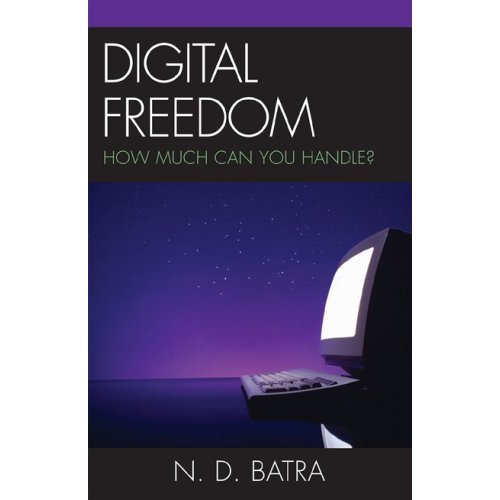
(ND Batra, the author of Digital Freedom, teaches communications and diplomacy at Norwich University. He is working on a new book, This is the American Way, Stranger.)

Tuesday, October 28, 2008

The New World Order

A world beyond our control

CYBER AGE
ND BATRA
From The Statesman

The idea that markets are always right was a mad idea. ~ President Nickolas Sarkozy of France

It seems the words of comfort or condemnation by world leaders do not mean much to the financial world. The two-day Europe-Asia heads of the state conference held in Beijing last week called for a concerted and coordinated global action to control the global financial crisis and restore confidence. But the meeting did not amount to much because the leaders did not offer any concrete and specific measures to solve the problem, except issuing a call for the need for more rigorous regulations and monitoring of the financial markets. Perhaps they do not know enough.

Prime Minister Manmohan Singh, who participated at the Asia-Europe summit meeting attended by 45 leaders, summed up how helpless global leaders had become in dealing the crisis: “We are not in complete control. There are bigger players and we are victims of that. The crisis is not of our making.” Big or small, every country today has become a victim of the unknowable, which makes one wonder whatever happened to the early warning systems. Few people believe that the coming of the new United States administration, whether led by Senator Barack Obama or Senator John McCain, would make much difference to the global financial crisis. The financial world with floating currencies, innovations such as margins, credit default swaps and securitisation of debts has become too complicated for any single global leader or a country to handle, even though a dominant economy like the United States might have triggered the butterfly effect that developed into a raging storm.

The raging storm analogy may not be too disconcerting because eventually even the most devastating storm peters out on its own. At present every rescue step taken by governments, for example, the US $700 billion bank bailout package and infusion of another $250 billion for unfreezing bank credit, the U.K.’s $692 billion financial-rescue plan and sundry other steps taken by other European and Asian governments do not seem to have amounted to much in restoring confidence. Wild gyration in the market continued.

Since Wall Street is still the ultimate measure of global finance, whether you like it or not, whatever happens there cannot be ignored. From its record of 14,000 in July 2007, the Dow Jones Index has been mostly moving downward and last Friday it pulled back to 8,378. The die-hard optimists believe that during these wild gyrations the Dow has been going up too and touched 10,000, giving some hope that eventually the market would stabilise and rise again on its own.

n other words, government authorities or politicians, Senator Obama or Senator McCain, French President Nickolas Sarkozy or British Prime Minister Gordon Brown, do not have any decisive impact on financial markets, though they use impressive rhetoric to sum up the situation and make prediction about the future over which they have no control. Mr Sarkozy said a while ago that the era of Anglo-Saxon no-holds barred Darwinian market capitalism, symbolized by Wall Street greed from obscene bonuses to golden parachutes, is dead. But this kind of contemptuous anger against the system that has been responsible for tremendous global economic growth and reduction in poverty is perhaps not fully justified. It is also true that the system cannot be left alone because the marketplace cannot solve all our problems; nonetheless, it must be made to work in the public interest and necessity, which will require state intervention.

Financial market cannot handle so much freedom and need global monitoring because a mishap in one country might cause turbulence in the whole interconnected system, which can spin out of control. But the question is that since the global financial crisis began with irresponsible sub-prime lending in the United States, can the world afford to let the US do what it wants to do with its financial market?

Why should Iceland, Norway, or Pakistan, for example, pay the price for the greed and mismanagement by the tycoons of Wall Street? Does the world have a right to expect better behavior from the US since it has been the primal cause of the trouble? Just consider China-Japan-US financial relations. A substantial portion of the staggering foreign exchange reserves of China ($1.9 trillion) and Japan ($995 billion) are parked in US treasuries, which made cheap credit available to everyone, even to those who could not afford it.

Shouldn’t China and Japan expect some accountability as to what is being done with their funds rather than merely assuring the safety of their capital? What a country does with its resources is a matter of sovereignty about which every nation is very sensitive. For example, Pakistan has been warning the US that its sovereignty should not be violated by the US troops in pursuit of terrorists who take shelter in Pakistan territory. But now that Pakistan is in financial trouble, it rushed to China for help.

Having been rebuffed by its all-weather friend, lately it has asked the US dominated IMF for infusion of capital for which it will have to accept tough conditions, some affecting its sovereignty. What is the difference if a country seeks capital infusion to keep itself alive or let’s foreign troops into its territory to kill terrorists?

In the ultimate analysis, both capital infusion and troop intrusion violate Pakistan’s sovereignty. In the interconnected world of finance and terrorism, national sovereignty has become an unsustainable myth. And what is true of Pakistan is equally true of the United States, which cannot be left alone to mess up with the world.

(ND Batra is professor of communications at Norwich University)

Tagore: Hope

HOPE

Poem: Asha (Hope) of the book Purabi (name of an Indian Raga played in the evening), written on board SS Andes on 19 October, 1924.
Translator: RAJAT DAS GUPTA (Calcutta)
rajatdasgupta@yahoo.com
& rajarch@cal3.vsnl.net.in

[Translator’s note: To the Poet, a man’s greatest achievements which bring him wealth and honour are not necessarily his life’s greatest accomplishments. As one advances in age with all recognition in the society for his successes, he may start realizing that he has missed many precious rewards which might be his exclusive either in his daily trifles or in his meditation for some supreme perceptions, which are not for the market place.]

Many a fantastic feat
Are not difficult indeed;
For the world’s welfare
I move everywhere.
Compatriots congregate
Many to educate
A lot of verbiage
In many a language
A lot of demolition
To follow new formation.
The nets web up, the knots fasten,
Bricks erect mansion after mansion.
Such creation some say good, some bad,
Credulous, some come close, some doubt as fad.
Some pure, spurious some,
As raw materials will chance to come –
On the whole
Something builds up as your goal.

But the hopes very humble
Sound easy, but not at all simple.
A bit of pleasure
From a song or fragrance of flower,
Dream in the shade of a tree
When I crave in leisurely spree –
Those fugitives are nowhere
So far I stare.
As the Creator fastened His belt
And the vast steamy space He dealt
To shape it up thundering the sky
With His primal labour raised mountains high;
But after dream of ages many a million
The first bunch of flower did dawn.

I cherished the hope many a day
In the corner of the earth I may
Stay exclusive in a cot,
Not with wealth and honour a lot.
The cool shade of the tree
The river flowing free,
In the dusk the evening star
The fragrance of the flower,
Just outside my window
Through which does glow
The first light of the morning
On the pond there shimmering;

Embracing All these
May work up my pathos and glees –
Not wealth and honour a lot
But I had hoped a mere cot.

For long I did cherish
My humble wish –
That my heart’s treasure
In eloquence will flower;
Not wealth nor honour –
But to be overt mere.
Hues the clouds the setting Sun
When his day’s round is done
To paint the portrait of the end
With his imagination’s blend.
Like that if I could
My dreamland paint I would
In light and shade
Bright and fade
Its myth to build
And around it to yield
Fullness to life’s tear and smile
Nor wealth nor honour to pile –
But only the language of dedication
Was my expectation.

For long the hope I did keep,
Thirst of my life deep,
To quench with the ultimate nectar –
Not wealth, nor honour –
A bit of love mere,
Only that hope I did bear.

With my heart’s music
Someone I would seek,
To put hand in hand
As one close to me will stand,
Worry alone when goes far
Talk eye to eye when comes near.
Around all these trifle
Will slowly fulfill
All tear and smile
Of this life for a while –
Nor wealth, nor honour
But I had hoped a bit of love mere.

Wednesday, October 15, 2008

Post-Bush America

Random thoughts on the prospects of post-Bush US

From The Statesman
ND Batra

The present global financial crisis that threatens to undo decades of economic growth has made it crystal clear that the US alone cannot set the world right. To lead the world, since it is still the only power that can play that role and is willing to do so, the US must seek global cooperation of the willing as well as the unwilling.

The US needs a deeper engagement with the world through international economic aid, building democratic institutions and strengthening weaker or failing states so that they don’t become havens for terrorists. But the US cannot depend solely upon its muscle power to subdue a restive people or bolster a failing state. Such hit-and-run scary and battle-scarred people, whether they are in the badlands of Pakistan-Afghanistan, Kashmir or elsewhere, need to be engaged culturally, economically and politically to sever them from an Islamic militant nihilistic ideology masquerading as anti-Americanism. Preemptive policy needs re-examination in the sense that it may not always be productive, though as an offensive-defensive tool it cannot be permanently eschewed.

Much has been written about Pakistan President Asif Ali Zardari’s bold and courageous statement to The Wall Street Journal that India has never been a threat to Pakistan. He called the militant groups operating in Kashmir terrorists, adding that though some others including former President Pervez Musharraf would have preferred to call them freedom fighters, he did not share that view. He also recognised the economic reality that there is no other economic survival for nations like them. We have to trade with our neighbours first, he said. These are not the views of a maverick or a lone ranger. Mr Zardari represents a steadily growing mode of consciousness in Pakistan that cooperation is more productive than confrontation in the interconnected global world. But this sentiment is not a sudden development. During the 2002 brinkmanship between India and Pakistan, the US by sharing selective military intelligence with both countries played a low-profile but significant role in defusing the crisis; and since then Washington has been unobtrusively supporting the process of normalisation.
So there is a lesson. The only way the US can exercise its influence is through the use of diplomatic power, the power of persuasion through cooperation, commonality of national interests and developing common goals such as, apart from fighting terrorism, global warming, financial stability, economic growth, eliminating AIDS and pandemics like bird flu.

Diplomatic power arises from the attraction of a nation’s culture and values, apart from its economic and military prowess. Most people around the world perceive American culture as a culture of Hollywood, pop music, blockbuster movies and steamy television programmes, but that’s a half-truth. American culture is a culture of openness, of freedom and open roads that leads to the free marketplace of goods and ideas. It is a culture of optimism that holds the possibility of expanding human horizons, the present economic gloom notwithstanding.

India like many other countries has fully grasped the power of US openness, the free marketplace, and has consequently become one of the fastest growing world’s economies. If the next US administration were to close its doors on India by reducing outsourcing, India’s technology-driven export economy would receive a setback, apart from hurting the US businesses. Fortunately, from an economic and diplomatic point of view, both Senator Barack Obama and Senator John McCain are equally good for India.

China beyond any doubt has benefited tremendously by opening its economy, though it has yet to open itself fully to other cultural influences including free expression and democracy. By opening its markets to China the US has exercised its diplomatic and cultural power to help transform China into a responsible global power. Americans may be resented in some places, but even today in spite of gloom doom atmospherics they are also the most admired and envied people in the world.

The faith in the dollar is undiminished. Wall Street is still the last best hope of global finance. A country can become attractive by “co-opting people rather than coercing them”, says Mr Joseph Nye of Harvard’s Kennedy School of Government. International influence, he believes, “comes from an effective aid and information programme abroad. What is needed is increased investment in soft power, the complex machinery of interdependence, rather than in hard power ~ that is, expensive new weapons systems”. Although fighting terrorism requires hard power, the attraction of the soft power, “is much cheaper than coercion, and an asset that needs to be nourished”. Just as trade with China and rising prosperity has changed the Chinese people giving them new hopes and new dreams, as you saw during the Beijing Olympics, a similar policy might transform North Korea, Iran and Pakistan as well, as it is happening today in Indonesia, the largest Muslin democracy in the world that has crushed Islamic terrorism and is showing rapid economic growth.

All battles ultimately have to be fought and won in the minds and hearts of the people. Effective global communication, wrote Edward Kaufman in The Battle for Hearts and Minds, “strengthens the traditional triad of diplomacy, economic leverage, and military power and is the fourth dimension of foreign conflict resolution...Perceptions change when outside information challenges certain assumptions”. More than anything else it is the US institutions of higher education, global philanthropy and to some extent corporate America, in spite of its shortcomings, that make the US a most attractive country.

The post-Bush administration must explore new directions in international relations instead of using only pre-emptive power. It is important that the US use the cultural power of its global media to present an alternative view of reality to the rest of the world. Unlike the spectacular but catastrophic invasion of Iraq, the results of such cultural engagements would not be immediately visible but they would be long lasting.

(ND Batra is professor of communications at Norwich University)

Monday, October 13, 2008

Tagore's Legacy


Life sketch of Rabindranath Thakur (Tagore)

By RAJAT DAS GUPTA (KOLKATA)
rajatdasgupta@yahoo.com
& rajarch@cal3.vsnl.net.in

Birth : 7 May 1861 AD
Demise : 7 August 1941 AD
Nobel Laureate : 1913 AD

Born at Jorasanko in Calcutta in a Brahmo family, Rabindranath Thakur was the youngest of his siblings. His grandfather Prince Dwarakanath Thakur earned his fortune from his trade, lead a luxurious life, an atheist but tolerant to all beliefs, was very Western minded promoting modern medical science which was a taboo even in the Tagore family, while Ayurvedic, the Indian medical science, ruled the roost in this entire sub-continent. He was widely traveled and died in England. Rabindranath’s father Maharshi Debendranath Thakur (“Maharshi” is an appellation for the sage-like persons) was a strict monotheist according to the preaching of Brahmo religion [in contrast with Brahminism- see note (**) at the end] and was averse to deity worship which his other family members did not give up. He was a failure in pecuniary and estate matters in which Rabindranath fared better when he had to take these over in his mid-twenties.

Rabindranath was a truant pupil both in Calcutta and England and eventually a confirmed drop-out from the formal educational courses including Bar-at-Law which more than he himself his elders had aimed.

Nevertheless, his scholarly/cultural/spiritual heritage and family environment, where such values are deeply imbibed, much more than made good his shortcomings in schooling. He was married at the age of 23 and thereafter he had to look after the huge feudal properties he had inherited, mostly located at the then East & North Bengal along the Padma river. Then, for a decade spent his time in that superb natural environment – “a meet nurse for a poetic child”.

In 1901, he came down to Santiniketan (where his University Viswa Bharati situates – about 4-hour train journey from Calcutta) the meditation place for his father Debendranath which he had shaped up in the model of Tapoban (wilderness for meditation) of ancient India, where learned sages in recluse would perform their worship and meditation along with giving lessons to their pupils on scriptures like Vedas, Sanskrit language and other classics. In that milieu of Tapoban, a gift of his father, Rabindranath built up his Viswa Bharati (=World University) true to its name which, since early twentieth century had been a pilgrim place for the scholars, poets etc. from various parts of the world, especially Britain, Germany, China, Japan etc. While this influx still continues, it is a pity the heavenly serenity there left behind by Rabindranath in 1941, when he had passed away, is alarmingly polluted by urbanization as well as onslaught of mod culture. In his learned article “The Tagore Connection” published in The Statesman on 9 January 2001, Dr. Martin Kampchen (a German scholar now translating Tagore in German language) reports about the institution ‘Ecole d’ Humanite’ in Switzerland – “ Its founder Paul Geheeb and his wife Edith were in touch with Tagore for about 10 years, almost until Tagore’s death. The impression these educationists made on each other was deep and lasting. Anybody who is aware of Rabindranath’s educational vision, can make out the similarities between Santiniketan and the Ecole d’ Humanite in Switzerland except that this vision is still thriving at Ecole, but, alas, is it still alive at Santiniketan?” Many like Dr. Kampchen are apprehensive about the finest humanistic culture at Santiniketan that ever evolved on our earth. Tagore built up this great institution under acute financial stress. Yet, the values he had built up there cannot be measured in terms of money. After independence of India in 1947 the Central Govt. of India took up the charge of Viswa-Bharati under the aegis of Jawharlal Nehru, our the then Prime Minister which solved the financial crisis. Yet, the regret of many eminent persons concerned about the institution’s future is – “earlier Viswa-Bharati had everything but money; now it has money at a high cost to everything else.”

Yet, sometimes there is a silver lining in the cloud. The Statesman in its Kolkata supplement of 3 December 2001 (Monday) reports encouragingly. The newly appointed Vice Chancellor of Viswa Bharati Dr. Sujit Kumar Basu has planned to open mini Viswa-Bharatis, one each in Japan, France and the U.K., to spread Tagore’s heritage in the fields of art, literature and music and thus to reach out to the world outside in the centenary year of Viswa-Bharati. Surely, the Bengalis will extend their wholehearted goodwill to Dr. Basu and eagerly watch his vision shape up. Like Switzerland, these places also may prove better host of Tagore’s ideals in contrast with Santiniketan amidst the all round corruption in West Bengal.

Rabindranath, however, never isolated himself from the rest of the country in his pre-occupation with his Viswa-Bharati. A fervent patriot, a number of his songs inspired freedom fighters against the British rule to whom the Poet had extended his active support also and was a suspect of the British Govt.. Interestingly, his song- “Jana Gana Mano Adhinayaka …..” is the national anthem of India while another song- “Amar Sonar Bangla, Ami Tomay Bhalobashi… (O my golden Bengal, I love Thee)” is the national anthem of Bangladesh, thus, he is the only Poet in the world whose songs enjoy the status of “National Anthem” in two different sovereign countries. Again, the Indian one is the only which imbibes the liberal concept of internationalism, a line of which is “Purba Paschim Aashe, Tabo Singhsana Pashe …(East and West come, By the side of Thy throne)”. After the historic carnage at Jalianwalabagh (in Punjab) in 1919 by the British police, when the freedom movement was at its peak, the Poet renounced his Knighthood to outlet his torment. As he described to Maitrayee Devi, while he was intermittently her guest at Mangpu (near Darjeeling) during the last few years of his life – “ They (British people) took it as a great insult. In England people are very loyal. So, this disavowal of the King did hurt them very much……”

Yet, he was against the negative spirit of the then Swadeshi (or National movement), loaded with sentimentalism losing the wider human perspective. His conflict with Gandhiji on this issue made history. Many of course opine that Tagore in his zeal for internationalism, missed some home realities of that time.

Thus, entangled in national and international life streams side by side with his enormous preoccupations in shaping up and driving forward his dream institution Viswa-Bharati, the Poet met all his domestic obligations as a dutiful head of the family. His love and affection for all his kith and kin was as anybody else’s. But remarkable was the calmness with which he had frequently faced many tragedies including death of his children and other near and dear ones.

While various events in the Poet’s life will go down in history with losing significance, eternal will be the vast literary treasure he left for us, or so it should be as many implore, to keep elevated the human mind and soul from mundane mediocrity. Poems, songs, short stories, novels, satires, scientific dissertations and even his personal letters rising to the level of belles-lettres did spontaneously fount from his pen since his early teens till his death, in which aesthetics/spiritual perception, wits etc. of highest order run through. Far from being an authority in Tagore literature, I have not shown the impertinence to make my work all pervasive which, in any case, seems to be an impossible task even for an erudite. I have only nibbled here and there of this vast treasure to present a few of its gems in English language, however incompetently.

Yet, I think, it will not stand on the way of exposing the greatness of the Poet as each piece of his work, big or small, is a window to the panoramic perception of the Poet of the wonders of Creation and his other noblest human faculties. The magic of his words also transmits instantly to the readers/audience to raise them to the lofty level of the Poet’s intuitions, however momentarily. Assimilation of Upanishada (4000 year old Indian scripture) in his blood props up his bewilderingly vast literature with its bewildering high quality, excelling all eschatology ever discoursed. Whit surfaces most in his oeuvre is his life long quest for the ever evasive Eternal Truth which, nevertheless, has been the pursuit of all great thinkers of all time and place, Maybe, the following poem sums up well this futile search of man –

Asked the primordial Sun
To the nascent Creation
“Who are you?”
But no answer he knew;
Years rolled by –
As on the Western horizon did lie
The Sun at the day’s end,
In the solemn hour when light and shade blend,
Asked,.” Who you are?”
Followed no answer.

Yet, “God freely reveals His secret to the worthy” (as was told about Newton), only a bit of which they can pass on to us..

(**) Brahmo is a religion established in the early nineteenth century by Raja Rammohan Roy by way of defection from the Hindu religion with domination of Brahmins at that time while the whole Hindu community was ailing under the caste system, depriving the vast majority of the people of their legitimate social and economic rights. While the object of the Brahmos was to fight out all these social evils, it also aimed to stop the conversion to Christianity which the rebel younger generation in Bengal, newly enlightened by the Western education, had opted for at that time in large number. One of the major evil custom Rammohan fought against was the ‘Sati’ system under which the young widows used to be burnt alive in the pyre with their dead husbands often to usurp the estates of the dead husbands by their relatives that would otherwise be inherited by the widows had they been allowed to survive. He persuaded hard the then British Govt. to ban ‘Sati’ while the latter hesitated a lot to interfere with the customs of the Hindus,
however inhuman. Rammohan traveled to England to press upon the Indian Council there, overseeing the governance of the Indian colony of the British, to abolish this cruelty at the earliest. Eventually, Rammohan in his death bed heard the good news that the bill of banning ‘Sati’ was passed by a single majority vote. After his death Rammohan’s was buried at Bristol in England.

**********************************************************************
Prelude to Nobel:

A few English scholars played important role to win the Poet his international accolade, the Nobel Prize. Rothenstein, one of them, was the first to discover the Poet while he had visited the Poet’s ancestral home (toward the end of the first decade of the twentieth century) at Jorasanko (North Calcutta) as a guest of the Poet’s nephew Abanindranath Thakur who was a renowned painter, his fame reaching Europe and, thus, earning high esteem of Rothenstein and of many others. Interestingly, Abanindranath never traveled far and wide, as, it is learnt, he was allergic to travel, and rarely crossed the boundaries of the then undivided Bengal. It is also learnt, it is Abanindranath who was supposed to visit Delhi to meet Rothenstein there but, somehow, the reverse followed. At Jorasanko, Rothenstein did not miss the beaming personality of Rabindranath at a gathering there, and on his enquiry, learnt from Abanindranath that Rabindranath was his uncle and a poet. So, had Abanindranath overcome his lethargy for travel and really visited Delhi to meet Rothenstein there, Rabindranath might not ever have been a Nobel Laureate and would remain a lesser local celebrity of Bengal. Another mishap was, when Rabindranath went over to London at the invitation of Rothenstein, he lost his manuscript of Gitanjali (see next paragraph) in a London underground tube which, of course, he got back courtesy British Railway else this trifle slip would have been enough to deprive him of this international accolade.

It is a shame that until the Nobel was conferred on the Poet many leading academicians of that time at home would not recognize this rare genius in human history. However, it is his own translation of a number of poems, which he had translated in Santiniketan to compile in a book titled “Gitanjali” (Offering of Songs) which were eventually read (on the 30th June 1912, it is said) in a gathering of a good number if top litterateurs of England of that time, that had paved his way for the Nobel. The Poet’s own description of that evening in London, as he had narrated to Maitrayee Devi in Mangpu (near Darjeeling), while he was her guest there shortly before his death (in 1941), may be found interesting by the readers. The following are the quotes from Maitrayee Devi’s book “Tagore By Fireside”, a translation by herself of her original Bengali book “Mangpute Rabindranath” (Rabindranath at Mangpu). Thus how the Poet had narrated that evening in London –

“When I first started translating them into English, I never thought they would be readable. Many have insinuated that Andrews was doing it for me. Poor Andrews felt sorry and ashamed. When Yeats arranged a meeting of distinguished people at Rothenstein’s house, I cannot tell you how embarrassed I felt. Yeats would not listen to me. He was undaunted . A galaxy of big people came. Gitanjali was read. They never said a word. They listened in silence and in silence they left – no criticism, no approbation, no favourable remark, no encouraging comment. Blushing in shame and disgrace, I wished the earth would have opened and swallowed me. Why did I ever listen to Yeats? How could I write English, had I ever learnt it? I was filled with remorse. I could not raise my head. Next day letters started coming, they flooded in, overflowing with enthusiasm. Everyone wrote. Then I realized they were so moved that evening that they dared not talk. English people are reserved, it is their nature. It was not possible for them to express their feeling at once. What a surprise it was, unexpected and unimaginable. Friend Yeats was pleased. “

How the Poet reacted when the Nobel had finally come through? Well, he said that it (the Nobel) was like a tin can tied up to the tail of a dog (the urchins’ favourite game) who can no more move around without making noise.. The flip effect of Nobel was the award money eased out the financial stress of Viswa-Bharati and soon put the institution on the international map to its great advantages, which the Poet acknowledged, though at the cost of its earlier solitude and peace. (Refer poem “Asha” to be seen in next publication)

Sunday, October 12, 2008

Don't Cry For Nano


Beyond Nano


Dear Mr. Batra,

Subho Vijaya to you and Mrs. Batra. This is how we Bengalees wish our near and dear ones after our Durga Puja which has just concluded.

Next, I would congratulate you having snatched away Nano from W. Bengal to Gujarat. I admire Mr. Modi having done it without any fuss and without extending any undue and unethical advantages to Tatas. My hunch is, it is the fear of exposure of these undue advantages that the Tatas have turned their tail to W. Bengal. The unbelievable pampering of the Tatas by our Buddhadeb Bhatterjee & CPI (M) which was already in the air, has been transparent by virtue of putting up the terms with the Tatas on website for a few hours under public pressure which was, however, withdrawn on a snub from the Tatas. But for the few hours it was there on the website, were enough for the smart people to download it and make it public. Of course, after withdrawal of the Tatas it is a non-issue and won’t be rubbed any more. Yet, it appears, the Tatas have by no means just written off these advantages, particularly the easy terms on which they acquired the land here. They will retain the land and will revert to Singur to start their operations at some opportune moment in future, at least on the portion they had from the so-called ‘willing’ farmers who have accepted monetary compensation for their land.

Over the last 3 decades CPI (M) turned West Bengal into a graveyard of industries which went to the top position in industrialization among all the Indian states during the time of Dr. Bidhan Chandra Roy. With no nobler object, but to tide over the election round the corner CPI(M) wanted to showcase Nano even by ruthless destruction of agriculture and dislodgement of the farmers from the most fertile land in the country, a most horrifying recent record of cruelty and human rights violation.
On the other hand, Modi’s wisdom is exemplary, having sold a Govt. owned land to the Tatas at market price which was an expansive grazing ground for cattle. Needless to say, re-habilitation of the cattle will be much less complex than the humans’ while no significant damage to agriculture will follow.

The really knowledgeable persons, who are ignored by our present Govt., opine that West Bengal is suitable mainly for agro-based industries. The agricultural sector itself employs people in Crores at the field besides creating jobs in Lakhs at the industries related to it, say, jute mills, rice mills, textile mills, paper mills, sugar mills, oil mills etc. Again, while agriculture independent industries (e.g. Nano) add glamour to the life of a handful of well-to-do people, agriculture supports life of the entire mankind. I came across an argument that the agricultural produce of Singur is worth on Rs. 20 Crore annually while Nano’s would be in many a thousand Crore. Without going into the accuracy of these figures, one might argue, the oxygen we breathe has no commercial worth and does not at all figure in our GDP. But, thereby, the essentiality of oxygen to sustain our life is by no means diminished.

Honestly, I am happy that Singur has sent one important message across the country that the process of destruction of agriculture is basically an imbecility and cannot go on ad infinitum. It is also a signal that a de-industrialization uprising is on the horizon at least for those industries falling within our traditional concept, continuously adding to global warming and leading the earth to disaster. Maybe, our future is in the IT and other knowledge industries as it appears from your columns.

Yours sincerely,

RAJAT DAS GUPTA
Kolkata-India

The End of America?

America ain’t collapsing but…

From The Statesman

ND Batra

'For the want of a nail, the shoe was lost; for the want of a shoe the horse was lost; and for the want of a horse the rider was lost, being overtaken and slain by the enemy, all for the want of care about a horseshoe nail.'
--Benjamin Franklin

Today we are much more connected with each other than in the good old times of Benjamin Franklin, one of the founding fathers of the United States, a man of immense genius who invented the lightening rod and the bifocals and published Poor Richard’s Almanack, among his other great deeds of innovations and inventiveness. In fact the whole world, like a massive web, has become so interconnected that a slight tremor ripples through the entire global eco-system. The collapse of a bank in New York might dry up credit flow in South Korea, sink stocks in Russia, or trigger a financial stampede in India, prompting the governments to take extra-ordinary protective measures.

Last week, in the first attempt, when the US House of Representative defeated the $700 billion proposal to bailout the financial system, it was clearly perceived as a stunning rebuke to the Bush administration, Congress leadership and other smarty-pant dealmakers that they had not explained themselves to the American people, most of who now regard Wall Street as a nest of thugs worse than 9/11 terrorists. It’s a terrible failure in communication at a time when the American people need to understand how their daily lives are connected with what happens in Wall Street and how its collapse would spin the global economy out of control and plunge it into an irreversible downward spiral. Whether you like it or not, global economy is anchored in Wall Street. Grasping quickly the anger and frustration of the American people and what might happen to the already weakened economy that has been rapidly shedding jobs (159,000 in September alone) if the credit pipelines remained frozen, the Senate revised the bailout proposal to incorporate some of the most popular demands including tax breaks of more than $150 billion for families as well as businesses. The new proposal also included increased Federal protection for bank deposits from $100,000 to $250,000, among other popular though economically less sensible provisions. In other times this kind of wheeling-dealing would have been called pork-barrel politics but this is how American democracy works sometime. The House members, confused and flabbergasted, followed the Senate lead and passed the bailout package with grim faces and muffled protests, as if a heifer were being led to the slaughter house.

It is doubtful nonetheless that these measures would quench the rage of those who are convinced that Wall Street investment bankers and tycoons, those who count their working hours in millions of dollars and have fail-proof golden parachutes, those whose greed and incompetence plunged the country into an unprecedented financial crisis, apart from triggering a global chain reaction that left no country untouched. To calm the mood of vindictiveness that has gripped the entire nation, Senator Christopher Dodd (D-Con) said, “We can take a cut at Wall Street, but Wall Street won’t feel the brunt of the pain.” The pain is not only being felt by the common man on the Main Street who has become a victim of the opaque financial system over which he has no control. The pain is also being felt by cities, counties, school districts and even states, because due to their limited cash reserves and the non-availability of credit, some of them cannot meet their payroll obligations. Car dealers can’t sell their cars unless customers can get credit, thus, locking up millions of dollars on unsold car lots. Perhaps the most desperate plea to unfreeze credit pipelines came from Governor Arnold Schwarzenegger of California who asked the Federal government last week for an immediate loan of $7 billion to maintain the government operations. He was quoted in the New York Times for having written to the Treasury Department that “The federal rescue package is not a bailout of Wall Street tycoons — it is a lifeboat for millions of Americans whose life savings, businesses, retirement plans and jobs are at stake.” But how do you explain this to Joe Sixpack or a hockey mom whose son might not get a college loan?

A similar sentiment was expressed by Bill Novelti, president of American Association of Retired People (AARP), one of the biggest and most powerful lobbying groups in the United States, who said, “It is no secret that people are angry about bailing out Wall Street. But Wall Street is us. These are our stocks, our retirement funds and our futures.” Millions of retirees depend upon a healthy functioning Wall Street for a steady flow of income. When a chill wind blows through Wall Street, some retirees wonder what they might have to give up; a prescription medicine, perhaps?
Wall Street cannot die, though you see some Asian investors salivating over the prospects of pecking over the carcass. Fan Dizhao, an investment manager at Guotai Asset Management in Shanghai, was quoted by Ariana Eunjing Cha of the Washington Post saying, “The United States may be grappling with its worst economic crisis since the Great Depression, but these are the go-go days for China.” And because of the “mountains of cash,” which China has built up through export, he said, “It is inevitable that we will take the US’s place as the world leader.” If you believe that China’s “mountains of cash” and America’s “mountains of debts” are not interconnected, pay heed to Ben Franklin, “For the want of a nail…”

ND Batra is professor of communications at Norwich University)

Wednesday, October 01, 2008

The Sacred and the Profane

Heavenly and earthly seductions

From The Statesman
ND Batra

Is militant Islam creating psychological conditions under which a person’s desires and dreams become compelling needs?

According to psychologist Abraham Maslow, there is a hierarchy of five primal needs that drive human beings to action to seek satisfaction. The motivating needs include physiological, safety, social, esteem and self-actualisation. Maslow said that a person would tend to fulfil his physiological needs for food and shelter first before he sought to satisfy other higher order needs. But experience shows that once the basic needs of food and shelter are satisfied, some people would seek to satisfy other needs simultaneously instead of seeking their satisfaction one after the other in a hierarchical order, as Maslow propounded. In fact the need for self-actualisation, realising one’s potential, summed up best in the slogan “We shall meet in Paradise,” may become so paramount in a person due to indoctrination that he may minimise or even forego other needs. For example, extreme skiers and mountain climbers do forego safety for the sake of their highest need, self-actualisation, doing the impossible, climbing Mount Everest.How advertisement, one of the most widely practised forms of indoctrination through seduction, creates and transforms our desires and wants into compelling needs is a fascinating field of study that should not be ignored by counter-terrorism experts. Just as the culture of consumption has been driving the Chinese people from Mao’s Thoughts to KFC and Pizza Hut (the owner Yum Brands is the biggest restaurant chain in China), the culture of eternal life/ Paradise that Islamic militants, Al- Qaida and its decentralised networked franchises, preach to the Muslim youth, has been driving them to jihad suicide. Both cultures promise fulfillment: here or the hereafter; as did Communism. The subliminal seductions of jihad are no different in the final analysis from what Communism had to offer in the bloody days of Leninism and Maoism; but you know what happened to the Soviet Union and Mao’s China.

Communism could not withstand the onslaughts of free society consumer culture and its endless capacity for self-renewal. Communism collapsed as a dream falsified. So would militant Islam if confronted the same way. In other words, those fighting terrorism must understand that they will not be able to win the battle against terrorism without replacing the promise of afterlife with the promise of gratification and fulfillment that liberal culture offers today. Mass media and advertisement have turned the West, as it is happening in India and China, into a culture of choices, although it wasn’t always so. Beginning with the Penny Press in the early part of the nineteenth century and later on through yellow journalism of Randolph Hearst, American news media began to depend increasingly on advertisement revenues.

Business and industry needed advertising to reach the masses in order to increase sales. Thus began the symbiotic relations among the three ~ the media, advertising and industry ~ to create the mythical American consumer whose desires must be measured and valued and be transformed into compelling needs. By turning malls into places of work, leisure and pleasure, marketers and advertisers have been transforming shopping into an enjoyable experience. Shop until you shop again, leaves little time for any thought for the afterlife. In the next few weeks India will be celebrating Diwali, which, like Christmas in the West, is gradually becoming a secular marketing experience and a major driving force for the economy. And Id-ul-Fitr festivities are going the same way, blending the sacred and the secular. Just look at Dubai.

By bringing consumers into a desirable media mix, by segmenting population into demographics and psychographics and by demanding media companies to create cultural programmes that not only support commercial products but also create a cascade of gripping needs, advertisers have created a culture of desire that makes people work harder so that they can buy and consume more. Every year, for example, the auto industry comes up with new models with varied psychological appeals and lucrative incentives for the consumer to get rid of his old car even if it is in a good condition and go for a newer model.

In the United States, advertising industry created “soccer and hockey moms” and told them that they needed a van to chauffer their children from school to the ballpark. Until the oil crunch, admen had made SUVs a vehicle of choice for many Americans. After 9/11, auto-manufacturers saw the consumer need for greater security and SUVs gave a feeling of strength and power like armoured vehicles. So even if everything goes well with Tata’s Nano, how long will the Indian consumer with rising income be satisfied with the four-wheel itsy-bitsy contraption? Advertisement is nothing but using all the available means of persuasion, to paraphrase Aristotle. Advertisers have been using target marketing to reach and persuade their audiences effectively. Similarly, instead of looking at the Muslim population of a country as a monolithic mass, it should be segmented demographically for specific messages. For example, the message for a Muslim woman with her overpowering needs for family and children has to be different from what is aimed at the youth.

No Muslim woman wants her son to be blown to pieces in a suicide mission so that he could go to Paradise.

Ultimately militant Islam like Communism would wither away by the seductions of consumer society with its promise of happiness in a world of here and now rather than the false glory of Paradise that jihad promises through press-button sudden death experience. It is going to be a long hard struggle, but the battle must be fought in the battlefield of ideas, desires, wants and needs. The news media and satellite networks that do not hesitate to broadcast messages from Islamic militants would have no problem, if paid well, for airing captivating commercials that persuade Muslims to reach for their wallets rather than explode remote-controlled bombs.Earthly seductions would ultimately win over the destructive culture of the myth of afterlife.

(ND Batra is professor of communications at Norwich University)

Wednesday, September 24, 2008

End of free-market capitalism?

Surviving the financial tsunami

From The Statesman
ND Batra

What will be US President George W Bush’s legacy to the world: an unfinished war on terrorism and global financial meltdown? In a subdued voice all that he could say initially was: “The American people are concerned about the situation in our financial markets and our economy, and I share their concerns.” But of course the government is doing much more than simply watching Wall Street blow up. Earlier the government took control of Fannie Mae and Freddie Mac, the government-sponsored gigantic home finance agencies, not only to help promote market stability and to ensure a housing market recovery but also to assure foreign debt buyers that their investments were safe. The Federal Reserve and the Treasury acted not too soon to prevent the collapse of one the world’s biggest financial companies, the American International Group (AIG), a development that could have given a fatal blow to global financial markets.

When a $13-14-trillion economy shakes, it causes a global earthquake. No one is even trying to stop the spiral of gloomy news. The mighty dollar has been falling in value, causing pain and anxiety. Consumer confidence is down and people are holding back from spending on durable goods such as cars, appliances, business equipment, electronic equipment, home furnishings and fixtures, and house wares and accessories. There are fewer buyers of houses even though house prices have declined substantially during the last two years. To stem the slide, Mr Bush and Congress came up with a $152-billion stimulus plan under which most taxpayers got from the government $300 to $1,200; but consumer spending did not lift the sagging economy.

Only six months ago, Mr Bush ritualistically said, “We believe in a strong dollar policy and we believe, and I believe, that our economy has got the fundamentals in place for us to be, to grow and continue growing more robustly, you know, hopefully more than we are growing now.” But the global market does not listen to Uncle Sam any longer. In fact when Federal Reserve Chairman Ben Bernanke warned during the second day of his semi-annual testimony before a congressional committee that even some banks might fail due to bad real estate loans, the stock market shrank in mortal fear. And no one believed him when he said that the overall banking system was in good shape, when Merrill Lynch had gone begging for billions of dollars of cash infusion from foreign government-controlled sovereign wealth funds. The levers of political power in Washington DC have little effect upon Wall Street, which runs on its own convoluted logic, alternating between illogical exuberance and uncontrollable panic.Today uncertainly and fear rule, though the recent massive infusion of liquidity by the Federal Reserve and European and Japanese central banks have firmed up the market for the time being.

It is rather strange that for Americans prosperity is so much tied up with the economics of the housing market. Market finance, in spite of all econometric models and theorising by economists, is essentially nothing more than a herd psychology of fear and hope.

Due to poor home mortgage lending practices verging on greed, banks started giving loans on low adjustable interest rates to people with poor or even no credit, hoping that since home prices were going up borrowers would re-finance their loans based on increased home equity.But sometime in this hope-and-faith-based financial system the weakest link snapped, lenders and borrowers started losing mutual trust, and whatever earlier seemed to be a blooming housing market turned into an empty myth, a speculative bubble that burst resulting in stampede and panic.

As the low initial interest rates on adjustable subprime mortgages were re-adjusted, borrowers defaulted and foreclosures began to rise. Even for the good borrowers, interest rates went up. Falling housing prices created negative equity, which made the mortgage relative to the value of the house much greater. Some people who bought houses with small or no down payment simply walked away, because their houses were worth much less than they originally bought for. There is nothing more humiliating for a person than losing his home to bank foreclosure, but many people swallowed their pride.

Foreclosures added to the market glut, so home prices kept sliding down and Americans began to feel less surefooted. Spending on non-essential goods, going to restaurants, buying a new a sofa, for example, seemed less necessary to many; and they postponed buying a new auto for another six months or even year. Banks shrank in fear lest consumers defaulted, so they pushed up the lending bar thereby reducing credit availability, which adversely affected economic activity further. So when Mr Bush thought that a tax refund would bring back spending and stimulate the economy, it was on the assumption that millions of small trips to malls would have an escalating effect, preventing the much-feared nightmare of recession from becoming a reality.

But neither he nor his advisors understood what was happening until they saw even trillion-dollar financial institutions with global tentacles like Freddie Mac, Fannie Mae and AIG in danger of being sucked into the black hole.Now that the unbridled trust in the self-correcting mechanism of free-market capitalism has been belied, the US government’s massive intervention to save the financial system from total collapse, you might say, is no different from what an authoritarian government, socialist or capitalist, would have done in similar circumstances.

The point is that in an increasingly globalised financial system, the role and the authority of the government, instead of decreasing, has become more important than ever. If the state ~ the ultimate saviour ~ were to wither away, who would come up with a trillion-dollar rescue package to mop up the toxic assets created by global corporates?

(ND Batra is professor of communicationsat Norwich University)

Tuesday, September 16, 2008

America: A nation divided for good reasons

The US is a nation divided for good reasons

From The Statesman
ND Batra

The American people observed the seventh anniversary of the 11 September terrorists’ attacks under the patriotic triangulation of God, the USA and Terrorism. The triangulation, the equivalent of space-age global positioning systems, enables the American people to be aware of the threat to their existence, the American way, relative to the known positions and undeclared intentions of the US’s enemies, and makes Americans see the world differently, whether they support Senator Barack Obama or Senator John McCain for the presidency.

If you are visiting the US for the first time, you might feel there’s too much of God here. That’s perhaps the first cultural shock you might feel on arrival but very soon it wears away because the American people don’t give much meaning to it, not as much as does the Islamic militants’ resounding cry, Allah O Akbar. And Americans invoke God often because sometime they have nothing else to say. Driving through the Pennsylvania Dutch countryside, a visitor would find it hard not to notice the billboard admonishing: “Everyone shall give an account of himself to God.” The US dollar bill says, “In God We Trust.” When someone takes an oath of office, he or she has to repeat after the person who administers the oath, “So help me God.” If you sneeze, someone will say, “Bless you,” even if the person does not know you.

Most Americans invoke God as a social crutch, much as a Frenchman would say bonjour (which, perhaps means, pardon my ignorance, that French wine and women are the best), unless Americans feel stressed and threatened as happened in the aftermath of the 11 September terrorist attacks when they mixed God with patriotism to make heady booze that would have blown your head off. It is also true that, more than ever, American political discourse, including whatever wisdom spouts from the White House, is suffused with references to God despite the constitutional brick wall between the church and the state.

You can’t live in fear and be free and so invoking God makes you feel free from fear. But to be free means to make your choice. Making a choice also includes choosing your own God, monotheistic or polytheistic; or even the God-particle that the CERN lab in Switzerland is trying to discover. It is not the government’s business to tell an American what God to choose, thus spake the US Constitution, and so ruled the United States Court of Appeals for the Ninth Circuit on 26 June 2002. The decision came after a lawsuit filed by a physician, Dr Michael Newdow, an atheist who complained that his elementary school daughter’s First Amendment rights to be free from God were violated when she was given no choice but to “watch and listen as her state-employed teacher in her state-run school leads her classmates in a ritual proclaiming that there is a God, and that ours is ‘one nation under God’”.That does not mean that atheists have no place in these US, except that they should not take their atheism too seriously.

Not all states require the Pledge of Allegiance to be included in the school day but half of the state legislatures have made its inclusion a requirement. Making the situation murkier is a 1943 US Supreme Court ruling that children cannot be forced to recite the pledge, though the school’s public address system may recite it. In matters of religion, the government shall remain uninvolved, that is the constitutional mandate. Until 1954, the Pledge of Allegiance included the phrase “one nation indivisible”, but to fight the godless communism, the Soviet or Chinese variety, Congress changed the pledge to include “one nation under God.”

The wall between church and state seemed to some extreme secularists to crack a little bit. And since then God, not a sectarian one, Catholic or Protestant, but a generic God, a mythical Supreme Deity, has found a frequent place in public discourse. In a 2-1 ruling, Judge Alfred T Goodman of the Circuit Appeal Court ruled that the pledge that we are a “nation under God” is identical to saying that we are a nation “under Jesus”, a nation “under Vishnu”, a nation “under Zeus”. Such a profession violated the First Amendment mandate that the government shall stay neutral in matters of religion. It would send a wrong message to impressionable children that if they did not participate in the recitation of the pledge, they might become “outsiders”, the judge wrote.

The court discovered a glaring contradiction in what the US Constitution professes and what the American people want to believe and practise. The pledge excludes some polytheists who worship multiple gods and goddesses; atheists and agnostics; or those like the Buddhists, who believe in nirvana, a state of supreme bliss, tranquillity and purity that is attained when the self is absorbed into the Infinite. It has been argued that the recitation of the pledge that includes “one nation under God”, is psychologically coercive, because it forces people to accept monotheism as the sole religious path available to them. The pledge not only violates the Constitution but also negates cultural pluralism. It violates freedom of choice. We should return to the original wording in the pledge, “one nation indivisible”, so it is argued.

Most Americans, like the dissenting Judge Ferdinand F Fernandez, however, dismissed the fear that the US might become a theocracy because of the inclusion “under God” in the pledge. The appeal court’s ruling was overturned by the US Supreme Court decision in 2004.

Late Justice William Rehnquist said, “To give the parent of such a child a sort of ‘heckler’s veto’ over a patriotic ceremony willingly participated in by other students, simply because the Pledge of Allegiance contains the descriptive phrase ‘under God’, is an unwarranted extension of the establishment clause, an extension which would have the unfortunate effect of prohibiting a commendable patriotic observance.”

But Governor Sarah Palin of Alaska, the young and the feisty running mate of Mr McCain for the presidency told Mr Charlie Gibson of ABC News last week that “God has a plan”.

Let’s see whether God’s plan is descriptive or prescriptive, evolutionary or intelligent.

(ND Batra is professor of communicationsat Norwich University)

Tuesday, September 09, 2008

Behold US Diplomatic Might

NSG waiver: This day will live in glory for India

From The Statesman
ND Batra

If you had any doubt about the global power and reach of the US diplomacy, you should ponder the one-off waiver that the Nuclear Suppliers Group (NSG) gave in connection with the India-US nuclear deal in Vienna on Friday. The NSG was established in 1974 after India’s first nuclear test to exclude the country from access to nuclear fuel.

Ironically, the same exclusive 45-nation club has now decided to allow India full access to nuclear fuel for civilian purposes, in spite of the fact that India never signed the Nuclear Non-Proliferation Treaty. The international group’s opposition to the deal came not only from China, as was expected, but also from a handful of smaller nations including Austria, Ireland and New Zealand, who wanted to give India conditional access, which of course India would not have accepted. A nick-of-time diplomatic iteration of India’s long-standing nuclear policy by External Affairs Minister Pranab Mukherjee that “India has a long-standing and steadfast commitment to universal, non-discriminatory and total elimination of nuclear weapons”, and that India would observe a voluntary nuclear test moratorium was enough to clinch the deal.

Commending the atomic club action, Prime Minister Manmohan Singh said, “It marks the end of India’s decades-long isolation from the nuclear mainstream and of the technology denial regime.” The decision will be Dr Singh’s greatest political achievement apart from giving India the momentum of a dynamic 8-9 per cent sustainable annual economic growth. Few politicians have done so much for India as Dr Singh in spite of the fact that he is perceived so unglamorous, non-assertive and ordinary looking.

In some ways India’s nuclear deal with the US is not unusual. In early May, Russia and the US signed a civilian nuclear power deal under which companies in both countries would have access to nuclear technology through joint ventures. The agreement would open up Russia’s huge uranium reserves to US companies and give Russian companies access to the US’s multibillion-dollar nuclear energy industry. From being great nuclear rivals to becoming nuclear partners would be a giant step, if Russia’s recent missteps in Georgia do not dampen the deal.

As the head of Russia’s state nuclear corporation, Mr Sergei Kiriyenko, said at that time, “The signing of this agreement opens a gigantic field of opportunities for economic cooperation in the large and growing businesses linked to the civilian use of nuclear energy.” That’s what India should also expect from the nuclear deal with the US.

China too is going ahead forging nuclear deals to meet its increasing energy needs. China plans to build 32 nuclear power plants by 2020 at a cost of about $50 billion, an enormous undertaking which can be accomplished only by accessing nuclear technology and markets in the US, Europe, Japan and Russia. China has signed uranium deals with Russia, Australia and Niger. So will India, hopefully.

The nuclear deal will assure India’s growing economy reliable and uninterrupted supply of nuclear fuel, when the last mile, the US Congress approval, is done. The civilian nuclear deal will open to India the world of sophisticated technology developed by the global nuclear powers, the US, Japan, Europe and Russia, with whom India has growing diplomatic and commercial relations.Access to high-end technology is imperative to keep India globally competitive.

The Indo-US deal is about having faith in India to develop as an alternative model of rapid economic growth without compromising fundamental freedoms. Rapid economic growth of the Indian economy will raise millions of Indians out of poverty. Without plentiful and reliable energy sources, however, poverty cannot be eliminated.

An economically dynamic India on a perpetual growth curve will lift its neighbours in South Asia and help make the world more economically dynamic.

Apart from removing hurdles in India’s search for alternative energy sources to fuel its growing economy, the deal will give India a strategic platform in the knowledge industry and encourage research and development in clean energy technology. As Mr Ratan Tata told Mr Karan Thapar of CNN-IBN a little over a year ago, “Over time this will give India a tremendously powerful position in the knowledge industry, in research and development, in high technology.”

From a humble agricultural power to a great knowledge power is every man’s dream in India. India must go beyond information technology outsourcing and capture the corporate global, as it has begun to do, for example, in automobiles and pharmaceuticals.

Clean coal technology, nuclear energy and solar power are practical alternatives for which the US and other advanced countries will open doors to India. France, for example, gets 80 per cent of its energy from civilian nuclear plants and is ready to collaborate with India in nuclear power development. India needs hundreds of billions of dollars of foreign direct investment in building power plants and world-class infrastructure to increase its manufacturing base in order to create employment opportunities for its growing young population.In the course of time a whole new world of sophisticated global technology will be opened to India, enabling it to spur its economic growth further. In return, India has agreed to do what other nuclear powers have been doing under the nonproliferation treaty, that is open some of its civilian nuclear power plants to inspection and continue to observe abstinence on nuclear testing. Its nuclear deterrent will remain off limits.

India’s sovereignty cannot be compromised, if the country continues to be economically and politically strong.
Poverty compromises national sovereignty. Poor, failed states have little sovereignty.

Regardless of who comes to power at the Centre next year, India should have one prime political goal: domestic harmony based on rapid economic growth in the range of 9-10 per cent that reaches the bottom of the pyramid, India’s not so silent masses that need more than the Nano and cell phones and slogans of azadi and freedom.

(ND Batra is professor of communicationsat Norwich University)

Tuesday, September 02, 2008

Kashmir and Arundhati Roy


Deconstructing Arundhati Roy and her tribe

From The Statesman
ND Batra

Ms Arundhati Roy, writing in The Guardian (UK) about the trouble in Kashmir, makes an interesting self-observation, with an aura of exceptionalism, saying, “For someone like me, who is not a Muslim”, the Islamic idea of freedom is hard to accept. Ah! But what if she were Muslim?

Islam would have been an unbearable burden upon someone born with a free spirit, 451-degree Fahrenheit imagination and a big incendiary mouth (“India’s many torture centres and Abu Ghraibs in Kashmir… The Indian military occupation of Kashmir makes monsters of us all”) for the simple reason that Islam (a non-pluralistic religion with an uncompromising claim for truth about one God the Greatest, the Prophet and the Holy Book), and secular freedom, as she has understood it, do not chime together. It is the same reason why Ms Taslima Nasreen, the Bangladeshi writer, does not find any Muslim country comfortable and has returned to India claiming, “India is my home though Kolkata is where my heart is.” If you open the door, all Bangladeshis will come to India because India has much greater freedom than any Muslin country. India has a future. Only the blind don’t see it.But what is wrong with Kashmiri Muslim separatists who do not find India comfortable as the rest of 150 million Muslims do? Ms Roy is puzzled and wonders, “Those who wish to turn to the Qura’n for guidance will no doubt find guidance there.

But what of those who do not wish to do that, or for whom the Qur’an does not make place?” Uttering such words about the Holy Book (no place in Qur’an?) would have been blasphemous if she were in Saudi Arabia, where as a Muslim apostate she would have been stoned to death or would have been running from one hiding place to another as Mr Salman Rushdie did for years after he had supped with Satan. Unquestioned obedience (to the religious doctrine) is freedom in Islam as it is in the traditional Christianity of which the historical consequences have been authoritarianism, intolerance and the Inquisition; not freedom and democracy which developed only after the Western mind began to unshackle itself from medieval religious orthodoxy.

Visiting the Kashmir Valley on the wings of poetic eloquence and with fire in her belly during the recent protests, Ms Roy hyperventilated about Srinagar, “The city floated on a sea of smiles. There was ecstasy in the air.” Kashmiris were free from fear. All they wanted was freedom from democracy by exercising their right for self-determination so that they could live according to the Shariat as the Taliban are trying to do in Pakistan and Afghanistan. But Ms Roy’s free spirit turned fearful and she began to wonder what would happen to the Hindus of Jammu, when Kashmiris are finally allowed to quit “nanga bhhookha Hindustan” and bravely march to “jan se pyara Pakistan” led by the self-proclaimed supreme leader Syed Ali Shah Geelani. Would they too have the right to self-determination? “Will the hundreds of thousands of Kashmiri Pandits living in exile, many of them in terrible poverty, have the right to return?” she asks. And she knows the answer.

Kashmir has seen one of the worst ethnic cleansing in recent history but Ms Roy, like other Indian intellectuals, opinion-makers and politicos, is afraid to call a spade a spade. Amazingly she brackets the fringe people with great writers like herself. Listen to her falsetto agony and self-pity: “What will happen to homosexuals and adulterers and blasphemers? What of thieves and lafangas and writers who do not agree with the ‘complete social and moral code’? Will we be put to death as we are in Saudi Arabia?” (Italics added). That Kashmiri scenario of freedom will be an intolerable nightmare and Ms Roy wants India to wake up and get out of a hellhole: “India needs aazadi from Kashmir...” Half a million Hindus who visit Amarnath every year too will be free from the burden of treading the inhospitable mountains. And the poor Muslims of Jammu, who will be deprived of the blessings of Kashmiri azaadi, too will find their own freedom as rest of the millions of Indian Muslims have found.

Echoing Ms Roy’s revelation of how the militancy is miraculously changing to non-violence in Kashmir, Jug Suraiya of the Times of India wondered what India would do if Mr Geelani, and “his followers were to adopt the strategies of non-cooperation and satyagraha…” If Mr Geelani were to develop the true spirit of Gandhian sataygraah and non-violence, he would cease to be the Geelani we know, the man who has never stopped believing that Kashmir being a Muslim majority region belongs to Pakistan and there is no other way except the Islamic way, the doctrine Al Qaida and the Taliban want to impose on all Muslims. The only man who ever succeeded in following Mahatma Gandhi was Martin Luther King Jr, who said 45 years ago, “I have a dream...” And that dream has come true in the rise of Senator Barack Obama, the first Black to be nominated the presidential candidate of a major political party in the US. That is an example of a non-violent revolution.

Mr Suraiya asks rhetorically, “By letting Kashmir go peacefully would the idea of India be subverted? Or would it be enlarged and further endorsed? That is the real import of the so-called Kashmir question: it has become the question of the idea of India, and what that idea means to us.”

Letting Kashmir go peacefully into the belly of the beast, the Taliban, is not my idea of India.

Will “India minus the K-word” (Kashmir) or A-word (Arunachal Pradesh) or N-word (Nagaland) still be India? No. India will not be India. India is much more than a mere geographical, sociological or philosophical idea in the minds of the English-speaking intelligentsia living in their gated communities. India is unlike any other nation, a nation so sharply divided and so diverse, culturally, racially and linguistically, that the only way the sufferings of millions of people can be mitigated, the only way natural and manmade disasters can be confronted and overcome is to keep India together ~ whatever it takes. No nation can survive without statesmanship; or without force.

(ND Batra is professor of communications at Norwich University)

Copyright ND Batra 2010